Kirstin Downey: Saving An Important Historic Site Near ʻAiea
Supporters say the 2-acre parcel can grow taro, be used to educate kids and teach people about food sustainability in Hawaiʻi.
March 20, 2026 · 9 min read

About the Author

Community activists in ʻAiea are in a race with time to preserve a historic site that is one of the last surviving slivers of what was once a panoramic pastoral landscape.
The Pearl Harbor area, formerly known as Pu‘uloa, is now a densely developed concrete jungle, but it was once the food basket for Oʻahu, a lush agricultural paradise of planted crops and productive fishponds.
This area was also the site of a little-known but decisive battle that changed the history of Hawaiʻi. ʻAiea was the culminating setting for a civil war that decimated the forces of High Chief Kahekili in December 1794 and set the stage for Kamehameha’s conquest of Oʻahu in May of the following year.

Ideas showcases stories, opinion and analysis about Hawaiʻi, from the state’s sharpest thinkers, to stretch our collective thinking about a problem or an issue. Email news@civilbeat.org to submit an idea or an essay.
The event is known as the Battle of Kūkiʻiahu. Thousands of warriors clashed on the plain overlooking Pearl Harbor. The preeminent chief, an imposing warrior named Kaeo, finally collapsed to the ground in death, felled by British cannon and gunfire after being spotted from the sea because of his brightly colored feathered cape and helmet.
One piece of the original landscape survives at the Sumida farm, which grows watercress, located right below Pearlridge Shopping Center.
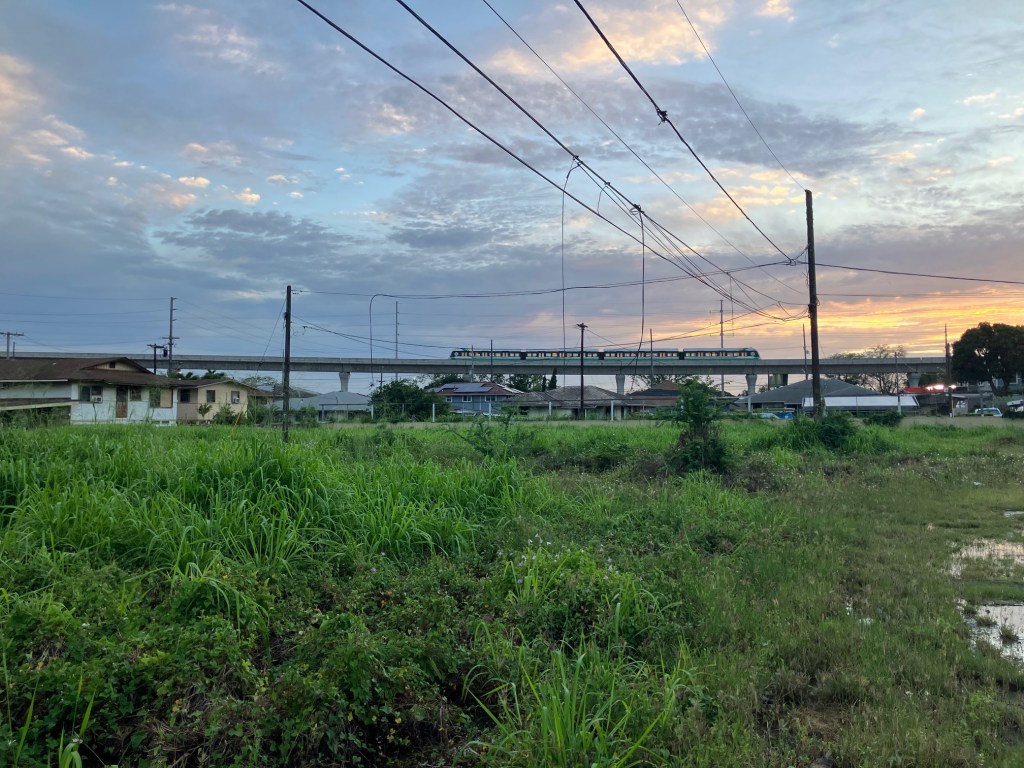
But another piece is the 2-acre parcel near Kamehameha Highway, behind the Dixie Grill restaurant. It is wedged among houses between Kauhale Street and Mikalemi Street.
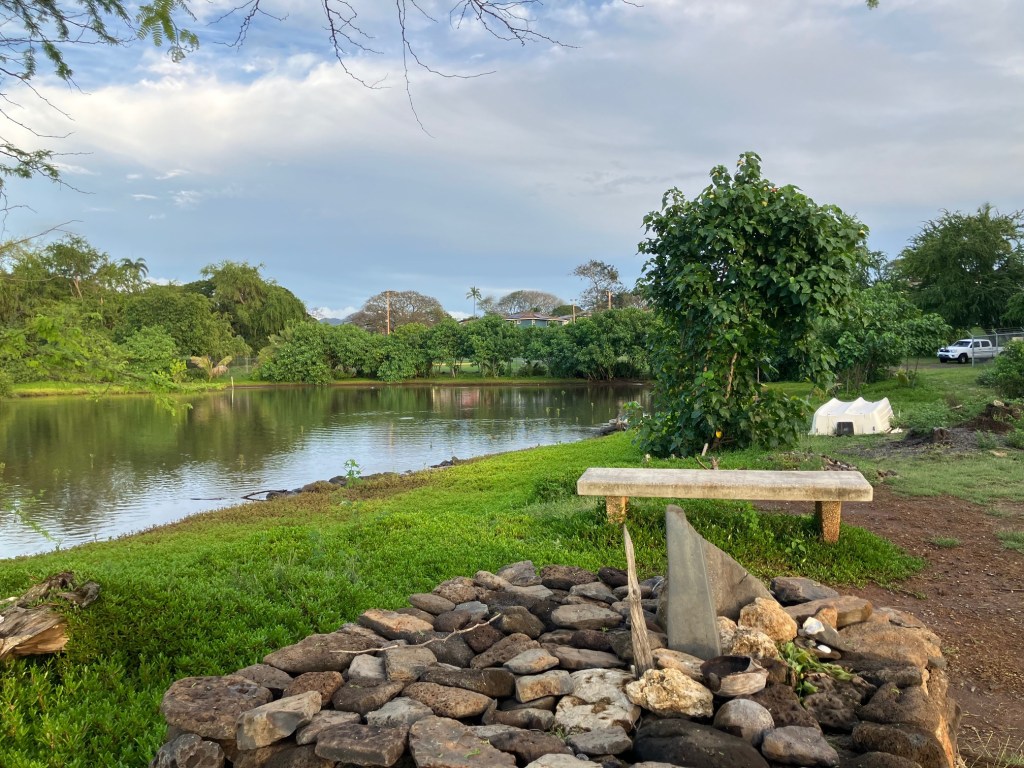
Now water-logged and strewn with trash, the site, assessed at $2.9 million, once looked much different. In living memory, taro grew on that field. Supporters are calling it Māʻona, which means satisfied, the way a person feels after a hearty and healthy meal.
Descendants of the Hawaiians who lived there and their community supporters think that the property can be restored to taro once again. They envision it as a place community members can work with the soil, teach children how to grow crops and contribute to the push for greater food sustainability in Hawaiʻi.
They are pointing to the land-preservation models at Ka Papa Loʻi O Kānewai at Mānoa, at the edge of the University of Hawaiʻi, and Kanewai Spring at Maunalua near Hawaiʻi Kai.
Leading the effort is longtime community advocate Kehaulani Lum, president of the Aliʻi Pauahi Hawaiian Civic Club, and her daughter Kanani D’Angelo, Hawaiian lineal descendants from ʻAiea. Their family had owned land there for nine generations, until, they say, they were forced out by government action.
With the support of hundreds of area residents, the ʻAiea Community Association is seeking support from the city’s Clean Water and Natural Lands Fund to buy the 2-acre parcel of land.
The proposal has won the support of the Oʻahu Historic Preservation Commission, which last month formally recognized Māʻona as a culturally significant place and asked that it be included in the Oʻahu Historic Property System. The commissioners unanimously said they supported the Community Association’s application for Clean Water and Natural Lands funds.
The Clean Water fund mirrors the state’s Legacy Lands fund. Both are designed to provide money to purchase land at risk of development or adverse use and are specifically funded by the real estate conveyance tax.
The Oʻahu fund has some cash. The Clean Water and Natural Lands Fund has swelled to some $70 million, according to Kevin Auger, director of the city Department of Housing and Land Management, who spoke last week at a city budget hearing.
Honolulu City Councilmember Esther Kiaʻāina wants to see more historic properties made eligible for purchase with the use of Clean Water funds. She supports an amendment, Proposal 148, to the City Charter to that effect, as part of the once-a-decade Charter Amendment process underway now.
City officials said they had received an inquiry about the funding process from the ʻAiea Community Association but had not yet received a formal application. They added that applications require a willing landowner, with documentation of willingness to sell.
Lum told the historic commission the property is owned by a foreign investor who has asked what the purchase price might be. Lum said they are opening up discussions.
The Community Association is already taking the lead on another landscape preservation project, the restoration of the 400-year-old Loko I’a Pāʻaiau, a joint effort with the U.S. Navy. Community residents have worked at the site for years and have turned it into a serene oasis, where birds hover and linger and fish can be seen frolicking in the waters.
This fishpond was part of a complex created in the 1500s by Oʻahu paramount chiefess Kalanimanuia, who envisioned aquaculture as a sustainable food source. Pearl Harbor was once lined with some 30 fishponds, historians say.

A Battlefield First
But the Pāʻaiau fishpond, the Sumida farm and the former taro field that the ʻAiea Community Association wants to buy weren’t only peaceful places. These sites also became the setting for the disastrous battle.
High Chief Kahekili, who controlled Maui from his base in Wailuku, gained control of Oʻahu in 1783 and moved to Waikīkī. For years he fended off attacks from the eastward islands by an ambitious up-and-coming younger chief, Kamehameha.
Kahekili’s son Kalanikūpule was not much help to him. He was badly defeated in a battle against Kamehameha on Maui that had allowed the Hawai`i chief to take control of a group of their high-ranking female relatives.
Kahekili convinced his half-brother, Kaeo, who was chief of Kauaʻi, to move to Maui and lead the defense against Kamehameha, which he did, successfully, for some years.
But when Kahekili died in July 1794, he told his brother Kaeo and son Kalanikūpule to share power. Kaeo didn’t think that was fair, as he was the one who had actually done all the fighting on the front lines on Maui while Kalanikūpule stayed behind on Oʻahu.
In late 1794, Kaeo decided to return home in disillusionment. A document that recently came to light in Australian archives, written by the Scottish botanist Archibald Menzies, says Kaeo had a formidable army of some 260 double canoes, manned by 20 warriors each, for a total force of more than 5,000. Kaeo ended up deciding to fight Kalanikūpule.
The Kauaʻi chief and his warriors, both men and women, landed on the western end of Oʻahu and successfully advanced across the island, consistently defeating Kalanikūpule’s forces over some weeks of battle.
In desperation, Kalanikūpule turned for assistance to a heavily armed British commercial expedition led by Capt. William Brown, according to both British and Hawaiian accounts.
But Brown had designs on Oʻahu himself and hoped to colonize it. In a letter he wrote that survives in the archive of British Prime Minister William Pitt, Brown suggested that the Hawaiian Islands would make a good penal colony for Great Britain. Great Britain had seized Australia and was sending its prisoners there but the land was inhospitable and many of the convicts died. Brown proposed the Hawaiian Islands instead, saying that convicts could be dropped off there and would be able to forage off the land, causing minimal expense to England.
Brown and his men decided that Kaeo was a bigger threat to their plans than Kalanikūpule. The British captain sent cannons and men with guns into the fray at Pearl Harbor. They identified Kaeo and his primary lieutenants by spotting their colorful feathered capes and helmets and directed fire in their direction.
This British support for Kalanikūpule proved decisive.
Kaeo and almost all his warriors were slaughtered, with only one woman survivor able to escape and tell the tale later to Hawaiian historian Samuel Kamakau, her relative.
Not surprisingly to those who knew his character, Kalanikūpule then killed Brown and some of his officers and seized his ships. Nonetheless, the surviving sailors eventually mounted a defense, recaptured the ships, dumped Kalanikūpule back in Waikīkī and made their way back to England.
In London, Menzies gained access to the ships’ logs and added the new information to a manuscript he was preparing but that was never published. The portion of his manuscript detailing what he learned had happened in the Hawaiian Islands was shipped off to Australia, where it rests in the National Library in Canberra.
Kalanikūpule and his forces were much weakened by these internal conflicts, even as Kamehameha organized his warriors for a major assault on them all. Kamehameha conquered Oʻahu in May of 1795.
One hundred years passed. A map from 1898 showed the ʻAiea area as a maze of terraced taro fields. Older residents recall the area was the site of a freshwater spring, with a bathing pool of clear, cold water. The Lum family lived there, farming taro and serving as caretakers to an important fishing shrine on the shore.
In the 1950s, the Lum family says, they were forced to sell the land under the threat of condemnation because the springs were deemed to pose a drowning threat. In the 1970s, they say, the stream running through the area was declared a risk because children were fishing there. It was fenced off and turned into a concrete-lined culvert.
They say that restoring the taro field at Māʻona would be a good way to recognize all that had happened in that area in earlier eras.
“It would serve a noble purpose to preserve this land,” Lum said.
Civil Beat’s coverage of climate change and the environment is supported by The Healy Foundation, the Marisla Fund of the Hawai‘i Community Foundation and the Frost Family Foundation; education reporting is supported by a grant from Chamberlin Family Philanthropy; “Hawai‘i Grown” is funded in part by grants from the Stupski Foundation, Ulupono Fund at the Hawai‘i Community Foundation and the Frost Family Foundation.
 Sign up for our FREE morning newsletter and face each day more informed.
Read this next:

Local reporting when you need it most
Support timely, accurate, independent journalism.
Honolulu Civil Beat is a nonprofit organization, and your donation helps us produce local reporting that serves all of Hawaii.
ContributeAbout the Author