Makana Eyre: An Inspiring Exhibit On Native Hawaiians That Most Of Us Won't See
The British Museum has mounted an exhibit in collaboration with Indigenous people. But when invaluable Hawaiian artifacts are held in collections so far from home, how many people from here will get to go see it?
March 31, 2026 · 10 min read

About the Author

First, you see Kū. He stands eight and a half feet tall on a red ochre platform that, in turn, rests on a white base. These supports, lending another five or six feet of stature, allow him to dominate the open space. He towers in an impressive stance: fists clenched, knees bent, mouth open wide.
It’s easy to get lost in Kū’s gaze, to forget the curious location of this kiʻi, or carving, one of three like it in the world. Just across the street lies London — Georgian terraced houses, wrought-iron railings, garden squares — all the iconography of this faded imperial capital.
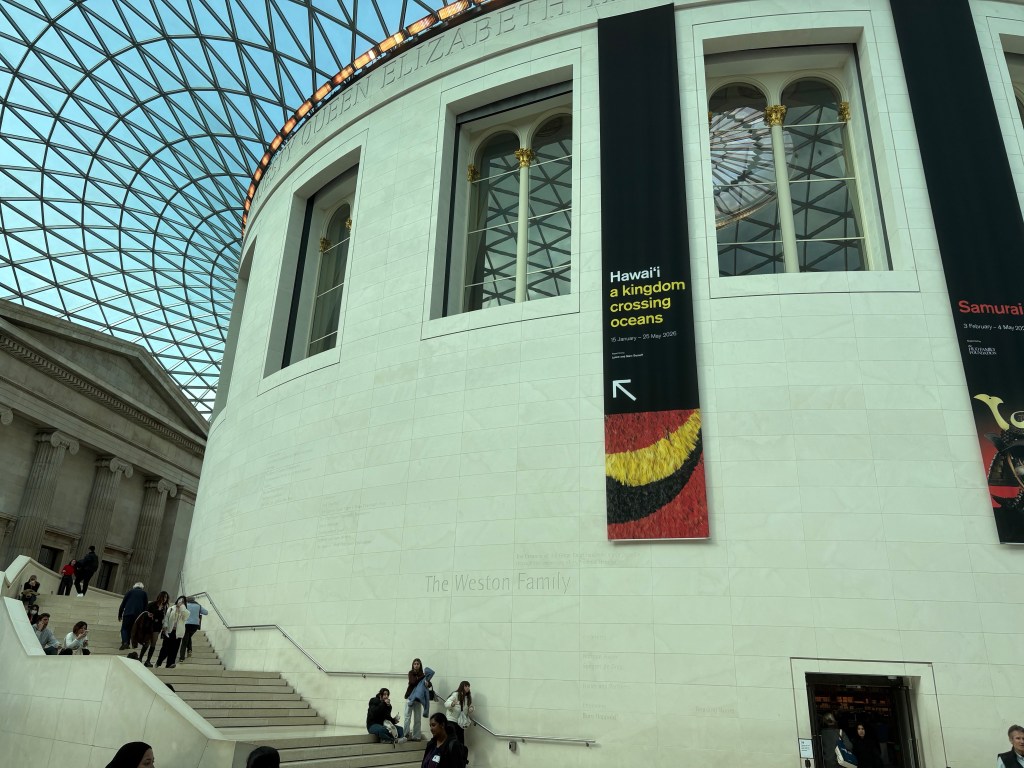
Kū marks a powerful point of entry to “Hawaiʻi: a kingdom crossing oceans,” a sweeping exhibition that opened in January at the British Museum and continues through the end of May. Behind him are the doors to a space where some 150 objects and artworks are on display, many for the first time in decades, some for the first time ever.

When I first got word of the exhibition last fall, I felt a sense of hesitant curiosity. From the start, I heard chatter from people in Hawaiʻi and among the diaspora that its organization had been refreshingly collaborative.
It wasn’t, as it has so often been before, an exhibition about an Indigenous people but one built in partnership with them.
Still, I must confess to some ambivalence, even on the morning of my visit when I was speeding beneath the English Channel on a train headed to London.
Museums, I muttered to myself, don’t exactly have an untarnished history. The Getty in Los Angeles, for instance, infamously built part of its antiquities collection with allegedly looted items, ignoring warning signs along the way. When the Musée du Quai Branly opened in Paris, critics condemned it for exoticizing Indigenous art and leaving out important cultural and historical context.
As the train emerged from the tunnel on the British side, I typed up some of my concerns: What does it mean that invaluable Hawaiian artifacts are held in collections so far from Hawaiʻi? How should we think about items that contain ancestral remains? Given the exhibition’s location, how many kānaka ʻōiwi and Hawaiʻi locals will get to see it?
Big questions, to be sure. Tugging at threads like these risks unraveling the fabric of most any major museum.

What began to assuage my doubts were two things: reading the exhibition’s catalogue, an exceptionally beautiful book filled with essays and pictures. And, in addition to that, spending several hours with the curator, Alice Christophe.
Though she might object to my characterization, Christophe was the principal driver of “Hawaiʻi: a kingdom crossing oceans.” Her choices, her vision, her cultural integrity are visible everywhere.
On paper, she is not the sort of person you’d expect to curate a major exhibition about Hawaiʻi. French by birth, educated at the renowned École du Louvre and University of East Anglia, she’s spent much of her career in Europe—with one big exception.
Between 2017 and 2020, Christophe worked in the Bishop Museum’s ethnology collections, an experience that must have been profoundly formative. Even for a person with a PhD in Art History, her grasp of Hawaiʻi’s history and culture is nuanced and extensive.
Perhaps most unexpected, she sprinkles her conversation with ʻōlelo Hawaiʻi, using words like mea hulu (feather work), mea kūpuna (ancestral treasures), lāhui (nation), hale (house), piko (navel), mōʻī (king), and kaona (hidden meaning), with ease and agency. And she pronounces them more convincingly than many people I know who’ve spent their entire lives in the islands.
From the start, Christophe had clear priorities. The exhibition, she knew, had to be brought to life jointly with Hawaiians — not just in collaboration or consultation but with them embedded in every layer of the process. This, she admits, was no easy undertaking within an institution as large as the British Museum. Processes had to be bent, challenged.

Christophe placed a stewardship hui at the core of the planning. It included Leah Caldeira, Noelle M.K.Y. Kahanu, G. Umi Kai, and Jsohnel Pacarro, among other curators and cultural practitioners. Together, they advised on everything from display and conservation to the use of Hawaiian language terminology.
In broad terms, the exhibition marks the bicentenary of King Liholiho’s 1823–24 journey to Britain, a 153-day voyage aimed at forging a deeper diplomatic bond between the Hawaiian Kingdom and the United Kingdom. Early in his stay, Liholiho — also known as Kamehameha II — visited the British Museum, a fact that now feels poignant. Later, tragically, he would die from measles alongside his wife Kamāmalu who also succumbed to the disease.
Yet, and as with much about Hawaiian culture, the exhibition is imbued with layers of meaning and symbolism. Simply putting an ʻokina in the title and not italicizing Hawaiian words in the labels and catalogue, for instance, mark small yet weighty choices.
Most significant is the framing around Liholiho’s mission, which enabled Christophe and the hui to invert our normal viewpoint: rather than British movement to Hawaiʻi, the story centers Hawaiʻi’s movement to Britain.
The exhibition dispenses with visiting ships and captains, probing explorers and proselytizing missionaries, placing the perspective firmly on shore. Captain Cook is hardly mentioned.
Instead, everything is rooted in Hawaiian culture and history. You enter the gallery space to the sound of oli, or chants. When you look to the north wall, you face a silhouette of Mauna Kea. When you reach two kiʻi — one with ancestral hair, the other with ancestral teeth, both thought to be taken from Hōnaunau by sailors aboard the HMS Blonde — you hear the bay’s lapping waves and gentle wind.

Central to the exhibition is kapa, or barkcloth. There are great sheets of it draped in banners around recessed display panels.
Kapa is not a pretty backdrop but a formidable presence, representing political memory, sovereignty and identity. It also evokes a wrapper, a kind of membrane, which Christophe explained is linked to the second of the three Hawaiian piko: the piko waena, the navel, which connects a person to their parents and their present life.
Predictably, there are places in the exhibition that are overwhelming. For me these moments came when seeing the displays of mea hulu (featherwork) and most strikingly, the mahiole hulu manu (feathered helmets) and ʻahu ʻula (capes), one associated with Kahekili, the aliʻi nui of Maui.
Another came when I stood before an expansive cape gifted by Kamehameha I — Liholiho’s father — to George III in 1810, the same year he unified the islands as one kingdom. The cape was paired with a letter which sought British protection from foreign powers. At the bottom, by his own hand, lies the signature “Tamaahmaah, King of the Sandwich Islands.”
Two and a half weeks later, a feeling persists: there’s something haunting and profound about seeing possessions of the aliʻi — the capes bereft of their kings, the helmets without a chiefly head within, the uncertain handwriting of Hawaiʻi’s most famous monarch.
“Hawaiʻi: a kingdom crossing oceans” has been open for more than two months now. The press coverage, almost entirely celebratory, has been written and printed. In some ways, I’m late in writing this column.
The truth is, I waited by design. I wanted to see the public’s reaction. I wanted to talk to people — kānaka ʻōiwi and Hawaiʻi locals above all — after they’d had a chance to ponder what it means.
In our fractured world, consensus is a rare thing. Here, though, I seem to have found an exception. By and large, people seem enthusiastic about the exhibition. Its multilayered conception, its joint stewardship, the allyship of its curator all carried deep meaning. What’s more, to see a flipped narrative about Hawaiʻi on a global stage — especially in the pages of the Guardian, the Times of London and the Sunday Times — also held significance.
And yet there’s the faint, unremitting throb, the ache that these items, so treasured, so essential — some taken from holy sites — should be housed so far away.
Furthermore, the exhibition will not tour. Noelle M.K.Y. Kahanu, a member of the stewardship hui, told me that since the show largely consists of material from the British Museum, much of it fragile, a loan at such scale would prove difficult. She added that highly specific lighting, mounts, and customized cases would also be hard to recreate elsewhere.
While it was not conceived as a touring exhibition, Christophe added that the British Museum is in talks with the Bishop Museum about the possibility of loans.
This is the sort of situation that resists a clean moral resolution. Instead, what we can land on, I think, are coexisting truths: joy and ambivalence, delight and an acknowledgement of what remains to be done.
Christophe, for her part, seems to be doing her work in exceptionally good faith, honoring as best she can the people behind this culture, these artifacts. Going forward, she says, there must be an emphasis on mobility. An early step she’s already taken is to publish an inventory of the Hawaiian collection at the British Museum.
My own hope is that this exhibition will spark discussion. There’s a lot to talk about, which is why Civil Beat will tomorrow publish a companion piece to this column that explores how Hawaiian treasures have been scattered around the world, and whether now is the moment to call for broader co-stewardship, even shared authority.
I’m more aware than most of the cost to travel from Hawaiʻi to Europe. I’ve done the trip more than 20 times, and I don’t take it lightly. If, though, travel is a possibility for you, if you are on the fence about seeing the exhibition, I think it’s worth the hassle.
It’s not just about seeing a collection rarely displayed, though that’s part of it. It’s also the chance to feel connected with the leaders of Hawaiʻi’s past, men like Liholiho who trod on London’s cobblestones two centuries ago.
To come to London would be to follow in his footsteps, to join in the reversal of movement: not Europe to Hawaiʻi but Hawaiʻi to Europe.
 Sign up for our FREE morning newsletter and face each day more informed.

Local reporting when you need it most
Support timely, accurate, independent journalism.
Honolulu Civil Beat is a nonprofit organization, and your donation helps us produce local reporting that serves all of Hawaii.
ContributeAbout the Author