Makana Eyre: Who Really Owns Hawaiʻi's Antiquities?
An exhibit at The British Museum, “Hawaiʻi: a kingdom crossing oceans,” poses questions that have historically been uncomfortable for museums.
April 1, 2026 · 8 min read


About the Author

In 2003, the daughter of the renowned writer André Breton made an important donation to the Centre Pompidou, France’s leading museum of modern art.
The core of the gift was a collection Breton had built over decades: a single wall in his snug Parisian apartment covered by Inuit masks, Mayan dolls, fossils, engraved whalebone, an Egyptian amulet and more than 200 other objects, many plucked from Paris’ celebrated flea market.
On the wall also hung something that would surely have jarred a person from Hawaiʻi: an early 19th century lei niho palaoa, an ornament worn by aliʻi made of ivory and thick, braided plaits of ancestral hair.
This case is not a one-off. Over the last two centuries, objects of immense value to Hawaiʻi have been spirited away on the ships of explorers, in the luggage of collectors. Today, they are dispersed in some very far-flung places.

Ideas showcases stories, opinion and analysis about Hawaiʻi, from the state’s sharpest thinkers, to stretch our collective thinking about a problem or an issue. Email news@civilbeat.org to submit an idea or an essay.
There are the sacred images, like the Kū kiʻi (carving of a god) at the Peabody Essex Museum in Massachusetts, the feather temple and feather bust of a god at Vienna’s Weltmuseum, or the feathered Kū at New Zealand’s Te Papa.
There are the capes and cloaks like this extraordinary ‘ahu ‘ula, thought to have been brought to Europe by James Cook, now held in the French city of Lille. Or one associated with Kamehameha II, also known as King Liholiho, now in a museum in Edinburgh. The Charleston Museum in South Carolina possesses this mahiole, or helmet, and Australia’s National Gallery holds this one.
Even a cursory search will turn up essential Hawaiian objects in museums as distant as Saint Petersburg, Moscow, Stuttgart, Göttingen, Berlin, Philadelphia, Madrid, Geneva, Copenhagen, Dublin and Cambridge, among others.
And that’s not all. This only accounts for a view of public institutions — and it’s an incomplete listing at that. It leaves out the opaque world of private collections, such as the 1,100-item collection that went to auction in 2017 in Paris and included what was described as a rare spear from Cook’s third voyage, an 18th century war helmet, and a war drum.
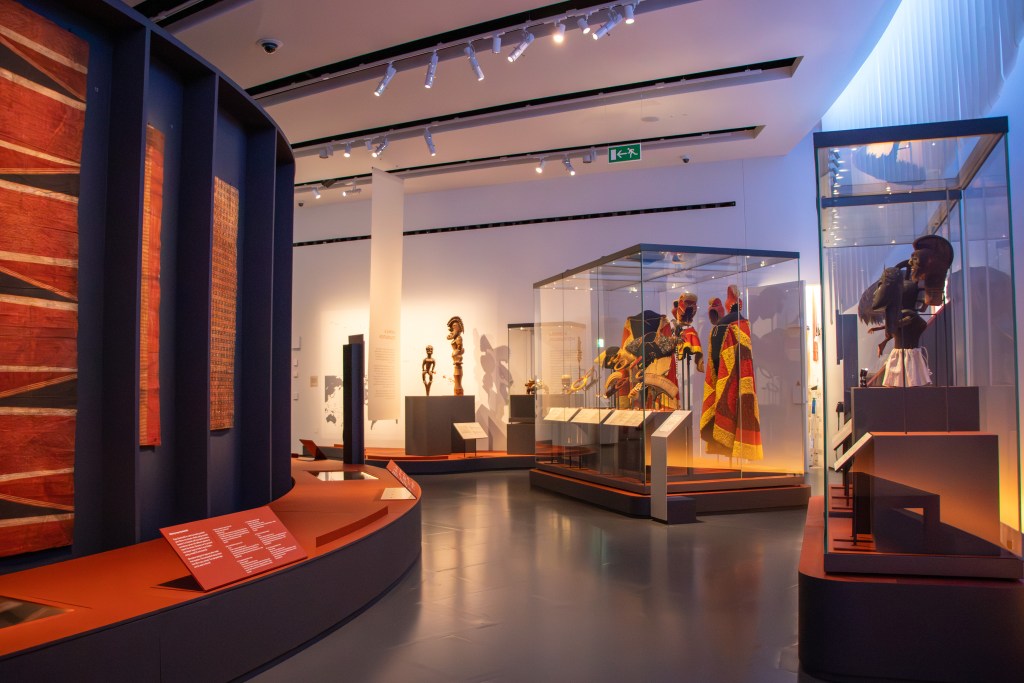
Earlier this month, I traveled to London to visit the British Museum’s exhibition, “Hawaiʻi: a kingdom crossing oceans,” which marks the bicentenary of King Liholiho’s 1823–24 journey to Britain. In my last column, I praised the museum — and the exhibition’s curator, Alice Christophe — for their commitment to co-stewardship.
My trip had another effect: it reminded me of how much of Hawaiʻi’s cultural heritage remains outside of Hawaiʻi. And it forced a question: Is it not the moment to build on and accelerate what is already underway to make this patrimony accessible to kānaka ʻōiwi and Hawaiʻi locals?
In some ways, now feels like a time of momentum. In the United States, changes to federal law have streamlined the process to return ancestral remains and culturally significant items to Indigenous peoples.
This, of course, is American law. It has no bearing on museums abroad.
Still, perhaps the standard set by the British Museum this year could serve as a model for something deeper, a broad evolution from outright possession to sustained co-stewardship and shared authority. Perhaps it could lead to more systematic loans, even discussion of repatriation.
I won’t gloss over the obvious. No matter the circumstances, repatriation is a charged question, one animated more by emotion — and political sentiment — than logic.
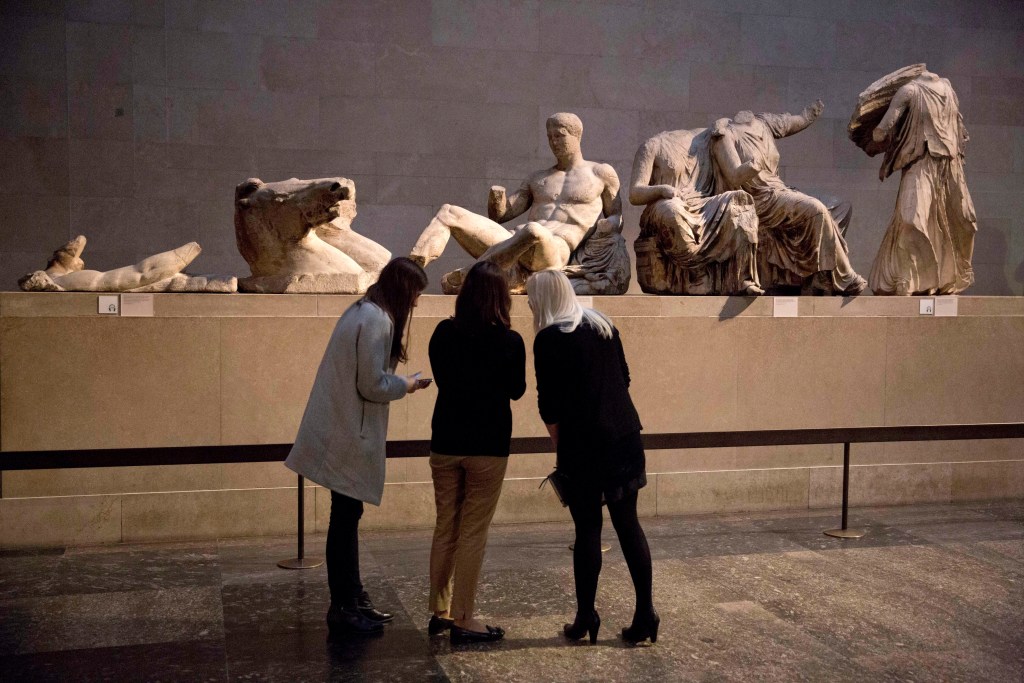
The so-called “Elgin Marbles” is one of scores of bitter disputes. For years, the Greeks have demanded the return of this vast collection of ancient sculptures once housed in the Parthenon and other structures on the Acropolis.
And they are far from alone. Cyprus has claims against the United Kingdom over lost antiquities. Italy has demanded the return of some items from the Louvre. Poland has long called on Germany to return items looted by the Nazis during WWII. Nigeria has for years lobbied western museums to return the Benin Bronzes, a group of thousands of metal plaques and sculptures taken by British soldiers in 1897.
Similar fights have even occurred in Hawaiʻi, most notably in 2000 when the Bishop Museum handed over 83 artifacts to Hui Mālama, a Native Hawaiian nonprofit focused on protecting burial sites and repatriating important artifacts. With the artifacts in hand, the group swiftly sealed them back in the cave where they had initially been found, almost a century earlier.
Art historians, curators and collectors often assert a universalist case: these are items made by humanity, they say, and now belong to all of us. There should be no borders, no factions, no claims.
There’s also the somewhat uncomfortable point that at least some of these artifacts would not still exist had they not been removed in the years following the overthrow of the kapu system.
Whether or not you buy these arguments is, in some way, beside the point since what they often conceal is the fear of western museums that one concession, one return, will set a fatal precedent. Pull one brick, the logic goes, and the walls of the British Museum, the Louvre, the Metropolitan Museum of Art will begin to crumble.
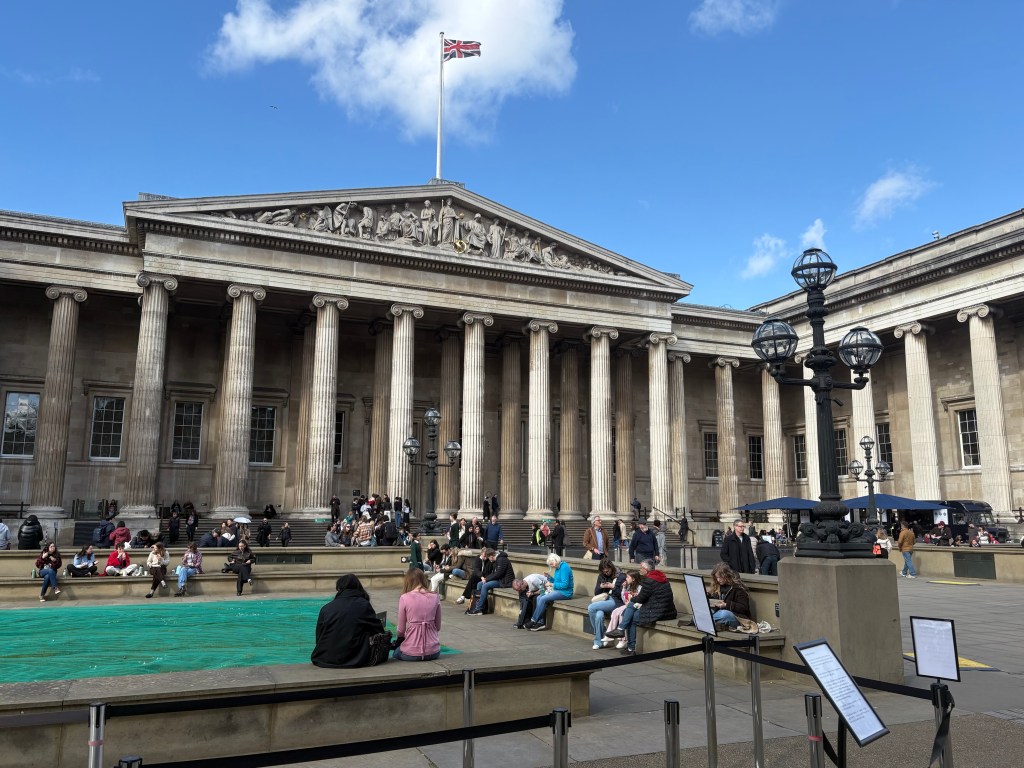
Except, the case of Hawaiian artifacts strikes me as different.
Many of them, though certainly not all, are sacred, intrinsically linked to ceremony, community, even Hawaiian sovereignty.
They are often bound up in spiritual matters, too, especially those items with links to holy sites.
They are, I’d argue, unusually tied to Hawaiʻi’s cultural patrimony in a way that fine art, which is alienable, bought and sold in markets, simply is not.
There’s a reason why France doesn’t make a moral claim to all the Monets held beyond its borders, or Italy to each da Vinci, or the Netherlands to every Vermeer.
And there are some cases that are more exceptional still. It is hard to draw a tidy comparison between European paintings and some of the kiʻi, or carvings, currently on display at British Museum, especially the two with ancestral remains from Hōnaunau, taken by the crew on the HMS Blonde, the same ship tasked with returning to Hawaiʻi the bodies of King Liholiho and his wife, Kamāmalu, after they succumbed to measles in London.
Regardless, one thing is clear. Repatriation, even systematic loans, would only be the beginning. Difficult questions would invariably follow.
If some of these items were returned, for instance, where should they go? Which island do they belong to, which museum? Is there an institution that can house them? Crucially, who decides and how?
Noelle M.K.Y. Kahanu, a curator, academic and a member of the British Museum exhibit’s stewardship hui, explained it to me this way, using the Native Hawaiian word for nation. “At the end of the day, what is their purpose for us and how does their return help us to better understand ourselves and our needs and desires as a lāhui?”
Perhaps taking more measured steps is the way forward, steps that will enable these discussions. That’s why the British Museum exhibition feels significant: It gives an example of how co-stewardship could look, all with the aim of thoughtful solutions in the future.
There seems to be energy now. I only hope kānaka ʻōiwi and their allies can seize on it.
Otherwise, we will be left with situations like the Breton wall, where a lei niho palaoa, braided of ancestral hair, is just another curio for a writer to build his “ideal surrealist palace,” or, as Le Monde later put it, his “cabinet of curiosities.”
 Sign up for our FREE morning newsletter and face each day more informed.

Local reporting when you need it most
Support timely, accurate, independent journalism.
Honolulu Civil Beat is a nonprofit organization, and your donation helps us produce local reporting that serves all of Hawaii.
ContributeAbout the Author