Beth Fukumoto: Democrats Need A Clear Vision. And To Stick To It
Hawaiʻi’s problems have been obvious for years. Political leaders are adding fodder to the argument that government doesn’t work.
April 5, 2026 · 5 min read


About the Author

If history tells us anything, Hawaiʻi Democrats will win in November. Why they’ll win is less certain. Will they win on inherited loyalty, opposition to Trump, or a vision for what comes next? I hope it’s the latter.
When state Rep. Elle Cochran switched to the Republican caucus last month, she cast a lot of shade on Democrats. Just to say it up front — I disagree with her reasons for leaving. Her criticisms don’t add up to a case against the party. But the arguments she deployed are the same ones Republicans here have been making for a decade. And they’re starting to land. Justified or not, that deserves our attention.
Trump got 30% of the Hawaiʻi vote in 2016. By 2020, that was 34%. In 2024, Kamala Harris still won by about 23 points, but Trump’s increase translated to three new Republican House seats and one Senate seat, driven in significant part by cost-of-living frustration in West Oʻahu communities.
The Republican talking points here are simple: government doesn’t work, Democrats have been in charge for decades, do the math. It doesn’t require Trump to be popular. It just requires enough people to feel like things aren’t working.
We’ve seen it pay off before. In 2002, Linda Lingle became the first Republican governor in 40 years after a campaign finance scandal and the Bishop Estate corruption case eroded public confidence in Hawaiʻi’s Democratic establishment. Voters were also tired of a stagnant economy. Some of those conditions are starting to rhyme with today’s.
A 2025 Holomua Collective survey found that only 20% of residents trust government to do right by working families, less than businesses, unions or nonprofits.
A Housing Hawai’i’s Future survey found 87% of residents want housing to be the legislature’s top priority. Only 8% strongly approve of how the Legislature has handled it.
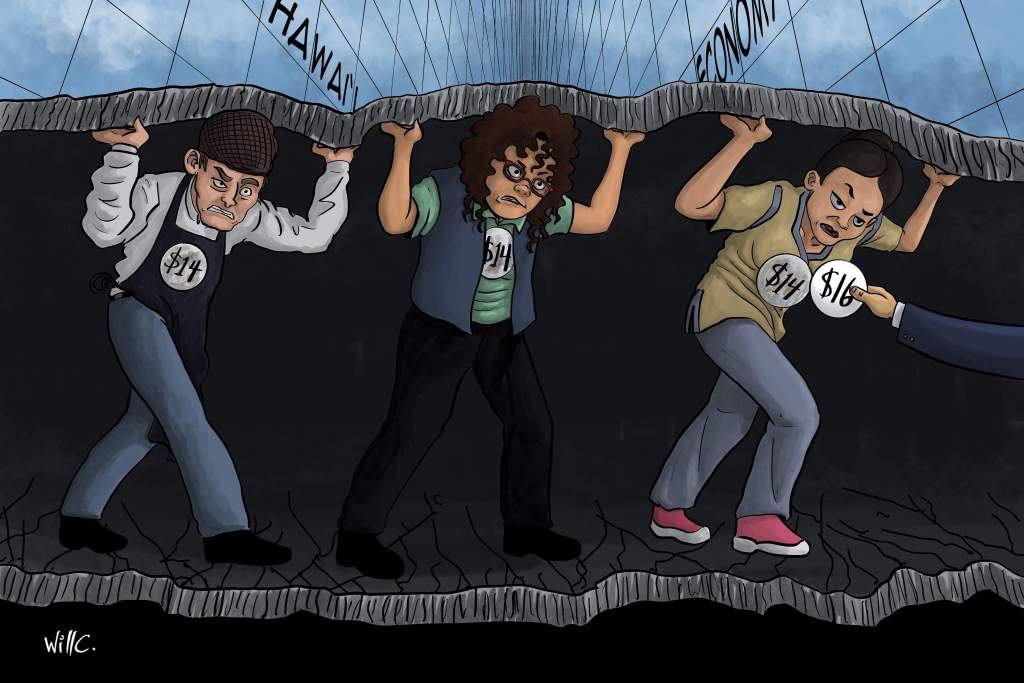
Perhaps the most damning context comes from the University of Hawaiʻi Economic Research Organization’s March 2026 report, which concludes that Hawaiʻi residents are simultaneously being priced out and left behind. High local prices push them out while low, slow-growing incomes pull them toward better opportunities elsewhere. Hawaii’s economic profile resembles distressed regions like West Virginia more than high-cost, high-wage cities like San Francisco.
It’s no surprise that 75% of middle-income households say they will or may leave because of financial pressure.
These aren’t people on the margins. They’re teachers, nurses, tradespeople, small business owners. If they leave, we don’t just lose residents. We lose capacity.
Democrats did real work last session. The historic income tax cut and significant housing legislation were genuine achievements, which I hope they stick with. And yet, according to the Pacific Resource Partnership Winter 2025 Hawaii Perspectives survey, 47% of residents still say the state is heading in the wrong direction. Affordable housing, cost of living and homelessness remain the top three concerns.
We know that perception can diverge from reality. Republicans, as the minority party, are positioned to take advantage of that. Being right about the facts doesn’t close a trust gap on its own. Delivery closes it. So does communication. Democrats need to do both.
This is where I think Democrats have a model — one we built ourselves, even if it hasn’t fully delivered results yet.
Hawaiʻi’s electricity rates are the highest in the nation. That’s not a Democratic governance failure. It’s structural: island isolation, no mainland grid connection, decades of petroleum dependence.
In 2015, Gov. David Ige signed House Bill 623, making Hawaiʻi the first state to legally mandate 100% renewable energy. The bet was on the structural cause, not the symptom. Rates are still high, and we need to do more so renters and apartment dwellers can benefit directly from our renewable pivot.
But the commitment has survived multiple governors, election cycles and a federal administration that would cheerfully undo it. Voters understand why we need it. That’s why it has held.
We can and should follow that model: name the structural problem clearly, make a specific long-term commitment to it, and sustain it across administrations and political headwinds. It doesn’t produce overnight results, but it gives us a direction. It tells us we’re struggling toward something together.
That’s what I hope comes out of this session and this election. A clear vision and a real plan to build our economy and lower our cost of living, with actual goals and milestones we can track.
People understand that things don’t change overnight. Communities know what it means to make sacrifices and build for the future. But we have to know what we’re building, and we have to know our leaders are committed to seeing it through.
We already have visible leaders who can help. Both Gov. Josh Green and Sen. Brian Schatz maintain approval ratings far above most of their peers. I’d argue it’s because they’re clear about what they’re going to do and why. Even when they make choices we don’t like, we know what they’re aiming for.
That’s what the party — from district chairs to legislative leaders — should be doing this election. Giving us something to hope for and work toward.
Hawaiʻi Democrats have every advantage going into November. They could win simply because we are a Democratic state. Or they could use this moment to set a cohesive vision and a define a tangible path forward.
 Sign up for our FREE morning newsletter and face each day more informed.
Read this next:

Local reporting when you need it most
Support timely, accurate, independent journalism.
Honolulu Civil Beat is a nonprofit organization, and your donation helps us produce local reporting that serves all of Hawaii.
ContributeAbout the Author