The Sunshine Blog: Follow Along, Folks. Money Matters More Than Ever This Year
Short takes, outtakes, our takes and other stuff you should know about public information, government accountability and ethical leadership in Hawai‘i.
April 26, 2026 · 8 min read

About the Author

Budgetary first aid: It’s that time of year again at the Legislature. No, The Sunshine Blog isn’t talking about any old conference committee but the budget conference committee when regular citizens are basically shut out of any meaningful participation in the process by Senate and House money chairs who speak in a code only they and a few others can understand. Not to mention most of it is worked out behind closed doors anyway.
Fortunately, the Hawaiʻi Appleseed Center for Law & Economic Justice has stepped up and created a new online tool to help regular folks (and hopefully rank-and-file lawmakers) keep track of changes to the state budget during this all-important time.

Understanding the byzantine state budgeting process is already hard enough. During conference committee, it becomes nearly impossible for a lay person to grasp.
In a typical year, the money committee chairs take turns ringing off a series of numbers when they reach an agreement on funding.
As The Blog reported last year, the public negotiations (and The Blog uses that term loosely) go something like this:
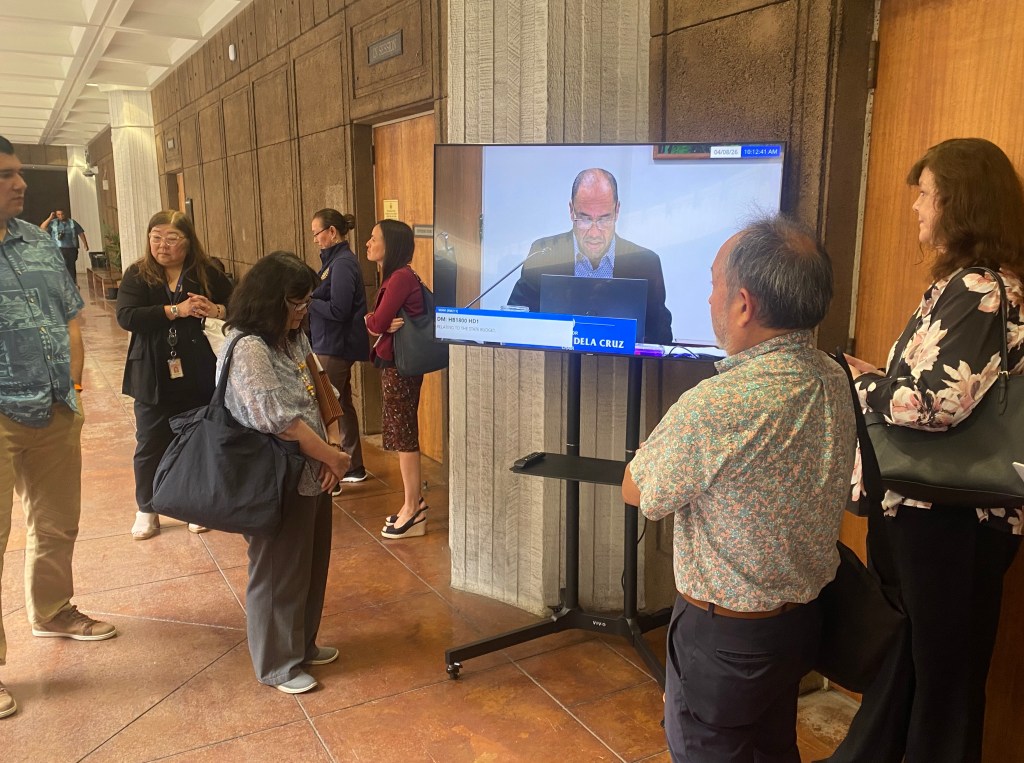
“AGR192 sequence 1100-001 House,” Senate Ways and Means Chair Donovan Dela Cruz said during one non-closed door session.
“OK, AGS111 sequence 100-001, we’ll go with the Senate,” then-House Finance Chair Kyle Yamashita replied.
First comes the identification numbers that correspond with state programs like adult mental health, law enforcement, or public housing. But, say you’re interested in programs affecting the film industry and didn’t know funding could go under the code BED105, the creative industries division. You’re SOL!
Next, the chairmen read sequence numbers that indicate which version of the budget – the House or Senate – is moving forward. Those are usually hidden in hundreds of pages of budget worksheets.
The Appleseed tool promises to track all of that.
For example, you can pretty quickly see that the drafts of the budget under consideration by the Legislature this year are about $800,000 short on capital improvement funding for the state emergency management agency compared to the governor’s submitted budget.
Appleseed promises to update the tool in real-time. The Blog just wishes it had detail on what each of the line items in the budget could be. Those are all still buried in those budget worksheets.
Still, this is much better than trying to decode all those program codes and sequence numbers.

Bills coming due: Speaking of conference committees, there are nearly 600 bills that the Senate and House could not agree on this session, and a good many of them are now in conference committee where most of them will die behind the scenes, as always is the case. Consider: More than 3,000 bills normally get introduced in January and about 300 of those get passed and sent to the governor by session’s end in May.
“We could not get release from FIN and WAM,” a lead conferee will no doubt explain, referring to the money committees — even if the bill contained no appropriation.
Still, The Blog was pleased to see that at least some sunshine bills are faring well. On Wednesday, the first bill of conference, which ends next Friday, to make it out alive was a measure establishing a statute of limitations of nine years for a bribery offense. The reason for what amounts to a three-year extension is to streamline cooperation with federal investigations, according to the Honolulu Prosecutor’s Office, which noted, “It would also ensure that investigations are complete and thorough before charging.”
“We got a bill,” House Judiciary Committee Chair David Tarnas announced to a round of applause from spectators in Conference Room 325 at the State Capitol. “Nice to start the ball rolling here.”

One other bribery bill still awaits action, this one making it a misdemeanor to fail to report bribery of a state official. There’s been a lot of talk about bribery this year, maybe lawmakers have actually been listening.
Also surviving conference committee is a measure specifying that the chief election officer may only be terminated for cause. The League of Women Voters of Hawaiʻi says the legislation is important to protect voters but also because “in recent years we have seen election workers subjected to harassment and intimidation.”
A related bill still alive would create an order of succession for an interim chief election officer in the event of a vacancy. Currently, there isn’t one, raising the specter that our elections could not be certified should something suddenly happen to a Scott Nago or his successor.
Dishing it out: They’re not on the ballot this year, but U.S. Sens. Brian Schatz and Mazie Hirono are spreading their money around to help Democrats retake control of Congress.
Together Schatz and Hirono have reported donating $271,000 to various Democratic campaigns through their leadership PACs, which were set up to help them build political influence within their party and among their colleagues.
Schatz’s Hawaiʻi PAC reported dishing out $156,000 since the beginning of last year while Hirono’s Pineapple PAC reported sending $115,000 to her favored candidates.
Many of those donations went to Democratic incumbents in the Senate, including Georgia’s Jon Ossoff, whose seat is viewed as among the most vulnerable in the chamber.
But the senators also donated to former Alaska congresswoman Mary Peltola and former North Carolina Gov. Roy Cooper, who are both seeking to flip Republican-held seats.

Another familiar name the senators have lavished with their largesse is U.S. Rep. Jill Tokuda.
Together, Schatz and Hirono have donated $20,000 to Tokuda’s reelection campaign. As of now, she doesn’t face a major challenger in the Democratic primary for her seat representing Hawaiʻi’s Second Congressional District although Greg Guithues, a resident of Ocean View on the Big Island, sent around a press release last week saying he is running for CD2 in the August Democratic primary. Come November, she is poised to square off with Republican state Sen. Brenton Awa in the general election presuming he wins the nomination. (And right now he doesn’t have much competition.)
The Blog was also interested to see Schatz isn’t just donating to campaigns. He also gave $12,500 to legal defense funds set up by U.S. Sens. Adam Schiff and Mark Kelly, both of whom have been targeted by President Donald Trump.
In Schiff’s case the DOJ launched an investigation into him for alleged mortgage fraud while the president has accused Kelly of “seditious behavior, punishable by death” after he posted a video with other Democrats telling military troops that they could refuse illegal orders.
By the numbers: Asian/Pacific American Heritage Month is coming up in May. And on Saturday the Pew Research Center published a detailed article laying out “Key facts about Native Hawaiians and Pacific Islanders in the U.S.”
“About 1.7 million people in the U.S. are Native Hawaiian or Pacific Islander (NHPI), tracing their roots to Hawaii, Guam, Samoa or other Pacific Islands in Oceania,” the article says. “They make up 0.5% of all Americans and encompass a wide range of cultures, histories and communities.”
One key fact is that the diaspora is strong and growing. Pew reports that “about 1.3 million Native Hawaiians and Pacific Islanders live in the continental U.S. – that is, in the lower 48 states, D.C. or Alaska. Another 398,000, or roughly a quarter of all U.S. NHPIs, live in Hawaii.”
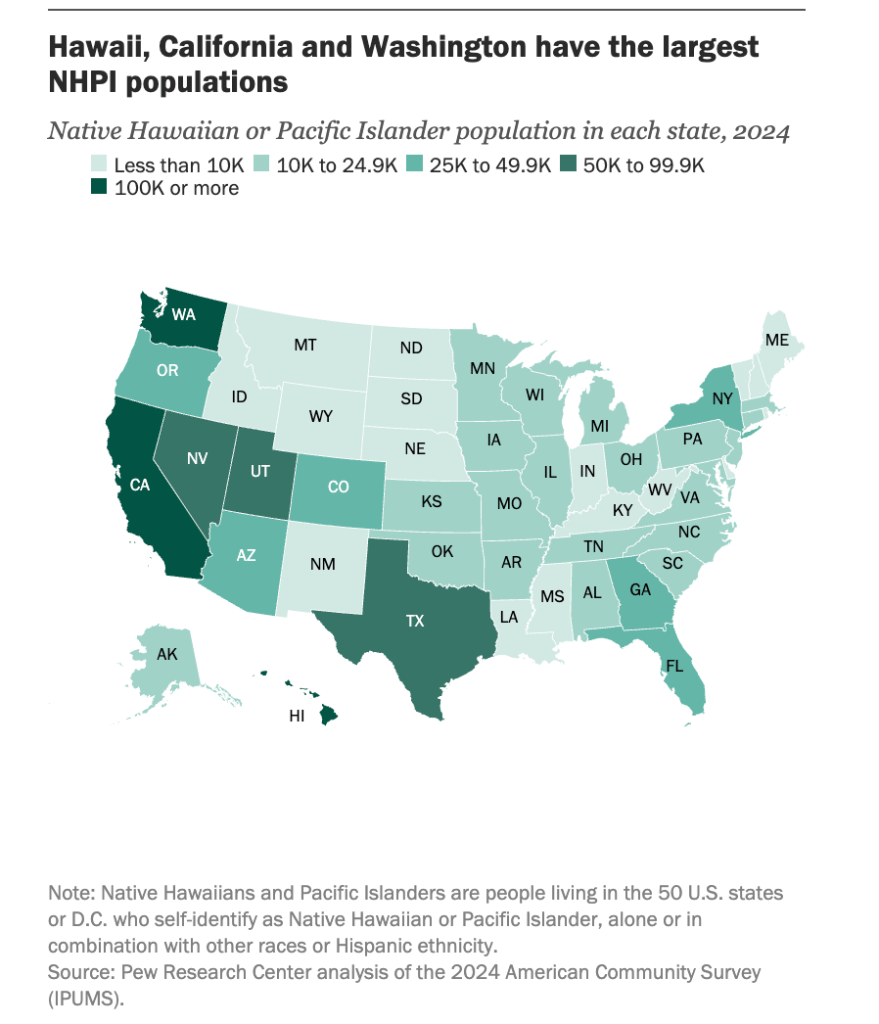
About 52% of the entire NHPI population in the U.S. were born on the mainland while only 27% were born in Hawaiʻi, the article says.
And, Pew notes, their political affiliations also reflect the mainland population overall, rather than deep blue Hawaiʻi. A survey from 2023 and 2024 found NHPI adults were about evenly divided in their party affiliations, 40% were Democrats or Democratic leaners while 47% identified as Republicans or leaned toward the Republican Party.
 Sign up for our FREE morning newsletter and face each day more informed.

Local reporting when you need it most
Support timely, accurate, independent journalism.
Honolulu Civil Beat is a nonprofit organization, and your donation helps us produce local reporting that serves all of Hawaii.
ContributeAbout the Author