Makana Eyre: Can Social Media Fill A Growing News Void?
These pages have immense reach. For crime news, they are one of the top sources of community information.
June 2, 2026 · 6 min read


About the Author

It’s no secret that local media is in crisis. Here’s just one figure that captures the situation.
A 2025 report from the Hawaiʻi Institute for Public Affairs found that between the 1980s and today, the number of local newspapers has fallen from as many as 52 to around 13 or 14, depending on how you count.
The void left by these once healthy dailies is huge. Anyone else remember when Oʻahu still had a morning and afternoon paper? Both were thick enough to land on your doorstep with a heavy thud.
Some pundits have argued that the decline in news consumption can be blamed on technology, social media in particular. We’re more inward facing, so goes the logic, far more interested in the allure of the eternal scroll than city budget meetings.

Ideas showcases stories, opinion and analysis about Hawaiʻi, from the state’s sharpest thinkers, to stretch our collective thinking about a problem or an issue. Email news@civilbeat.org to submit an idea or an essay.
I don’t buy this. Technology has undoubtedly upended the media business. But I don’t think it has weakened our appetite for news.
For proof, look at what has, in part, filled the vacuum left by our papers: news influencers.
If you’re on social media, I bet you’ve already encountered them. They have names like Hawaii News Report, HHHNewz, My Kailua, Stolen Stuff Hawaii, 808 Viral, Mean Hawaii and a dozen others.
In a broad sense, they function like community-driven incident aggregators, posting a mix of crime, accidents, theft and local announcements — all delivered with a heavy dose of paid promotional content.
Another thing they have in common: enormous followings. Just take Hawaii News Report as an example. It has almost 180% more followers than KHON2 and 360% more than the Honolulu Star-Advertiser. In fact, it significantly outranks all traditional media by Instagram following, save for Hawaii News Now.
Before you rush to the comments to tell me followers aren’t everything, yes, social media clout is not a clean metric of influence.
Followers don’t necessarily equate to audience and engagement figures matter. Perhaps most relevant are the incentives of social platforms, which tend to reward high volume, emotionally charged content.
Yet we can’t deny that these pages have immense reach. On certain beats like crime, they are one of the top sources of community information.
Interested to learn more, I called up one of the major players in Hawaiʻi social media news.
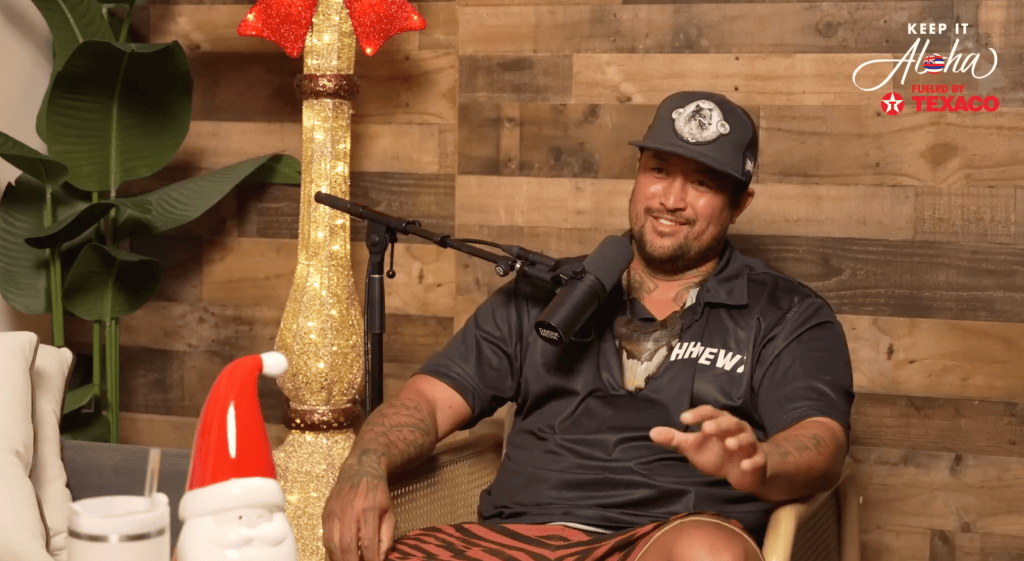
Isaac Scharsch, who’s perhaps better known as the Hungry Hungry Hawaiian, is the man behind HHHNewz. He is a busy guy, posting from early in the morning until late at night and filtering sometimes hundreds of DMs with tips and videos. Remarkably, he does all of this in addition to his work as a Waikīkī Beach boy and as a father of four.
Much of Scharsch’s content comes from the community, though he also goes to the scene of incidents to stream live — often beating the news vans.
How does he get his information? Much of it appears organically in his overflowing DM inbox. He also has a network of sources, some of whom are anonymous even to him. These sources share detailed information that, he says, sometimes feels like the sort of thing only law enforcement would know.
Scharsch uses digital tools like the PulsePoint app, which is linked to local emergency services, for medical emergencies. Despite the recent brouhaha over whether media should have access to police radio traffic through scanners, though, he does not have a police scanner — nor, he says, does anyone else doing this sort of work.
On the phone, he comes off as thoughtful and reflective. He told me he does his best to verify information — so far as that’s possible — to issue corrections when necessary, and present his posts with a neutral framing. Politics don’t interest him much.
Notably, he refuses to be anonymous. He chose to reveal his identity, he told me, because it makes him more accountable and holds him to a higher standard.
In terms of approach, though, Scharsch is a bit of an outlier. Hawaii News Report posts to its 448,000 followers anonymously and often with the resentment-driven register of our current president.
One recent post, for instance, criticized congressional candidate Jarrett Keohokalole for his association with Tim Walz, the former Minnesota governor and presidential contender Kamala Harris’ running mate in 2024.
In the caption on a post that shows Keohokalole and Walz as close allies, whoever runs the page wrote, “U see what Tummy Walz did for Minnesota… ran it into the ground with DEEP CORRUPTION! Get registered to VOTE IN MY BIO NOW! Don’t let Hawaii follow this direction!”
For all Scharsch’s thoughtful instincts, HHHNewz does post videos that are, at times, hard to watch. HHHNewz isn’t the only one. Do a brief survey of these accounts and you’ll find fighting and traffic accidents (some involving pedestrians or moped riders) — even the occasional shark attack or suicide.
Perhaps this content is so popular because it lets us indulge in trauma voyeurism. It soothes the itch that makes us crane our necks on the highway when we pass a collision.
In some sense, I get it. These sites offer an enticing mix of entertainment and information that fills the void print news left.
Yet I worry about what could happen to the reliability of information as these sites grow even more popular. Stolen Stuff Hawaii, another major social media page, regularly posts unverified footage of people supposedly committing crimes. What happens if they get it wrong?
My other concern is this: people already seem to be conflating these influencers with journalists. Original reporting — that is, the painstaking work of gathering news from sources, vetting it with the help and judgment of editors, and only then disseminating it — remains vital to our society.
News influencers might have a role to play — Scharsch already collaborates with several local TV stations. But we should resist allowing them to replace traditional media where reporters comb through court documents, pose uncomfortable questions to policymakers and hold those in power to account.
Our newspapers left a void. It’s up to us to be careful about how we fill it.
 Sign up for our FREE morning newsletter and face each day more informed.
Read this next:

Local reporting when you need it most
Support timely, accurate, independent journalism.
Honolulu Civil Beat is a nonprofit organization, and your donation helps us produce local reporting that serves all of Hawaii.
ContributeAbout the Author