Cats Vs. Birds? It Shouldn't Be One Or The Other
After 23 years in animal welfare, I think we’re asking the wrong question.
August 20, 2026 · 5 min read

About the Author

For years, Hawaiʻi has been having the same argument about cats.
One side talks about protecting native birds. The other talks about protecting cats. Everyone retreats to their corners, argues over TNR, feeding bans, removal and sanctuaries, and not much changes.
That debate has new urgency. The Department of Land and Natural Resources is proposing changes to Hawaiʻi Administrative Rules Chapter 13-124 that, among other wildlife protections, would prohibit feeding or abandoning wildlife and domestic animals on department lands.
The proposal has also raised concerns about what may happen to cats removed from these lands, including the possibility of lethal control and the absence of clearly stated safeguards.
I understand why. Cats are predators, and there are places in Hawaiʻi where they should not remain, particularly around endangered or threatened native species. Conservationists are right to insist that our most vulnerable ecosystems must be protected.
But the current debate also raises a larger question: Are we still trying to solve a complicated problem with one answer?

Ideas showcases stories, opinion and analysis about Hawaiʻi, from the state’s sharpest thinkers, to stretch our collective thinking about a problem or an issue. Email news@civilbeat.org to submit an idea or an essay.
After more than 23 years working in Hawaiʻi animal welfare, I have learned that black and white solutions may be easier to argue for, but they rarely reflect what is happening on the ground.
I began my career with the Hawaiian Humane Society working in animal law enforcement, dealing firsthand with Hawaiʻi’s free roaming cat population. My work included investigating hoarding, abandonment, poisoning and neglect, responding to conflicts between landowners and cat colonies, and working with caregivers and communities trying to find solutions.
Over my 10 years at Hawaiian Humane, I eventually became vice president and director of operations. I saw this issue from nearly every angle: people trying to protect cats, landowners frustrated by unmanaged colonies, caregivers struggling with limited options and conservationists concerned about native wildlife.
I spent years in meetings where the argument eventually seemed to come down to which species mattered more.
I never thought that was the right question.
In 2014, I went to work at Lānaʻi Cat Sanctuary because I saw an opportunity to try something different. The mission got me: Saving cats, protecting birds.
I believed then, and still believe today, that we can do both.
A cat living next to a seabird colony presents a very different challenge from cats living behind a shopping center in Honolulu. Each island is different. Each community is different. The risks and available resources are different.
On Lānaʻi, we developed an approach for our island. What began with roughly 25 cats has grown into a sanctuary caring for more than 700 today.
That does not mean Lānaʻi found the answer for Hawaiʻi. We found an answer that works for Lānaʻi.
A sanctuary can be one tool. TNR can be one tool. Adoption, responsible pet ownership, containment, enforcement, removal and cat free areas can all be tools. None should automatically become the answer everywhere.
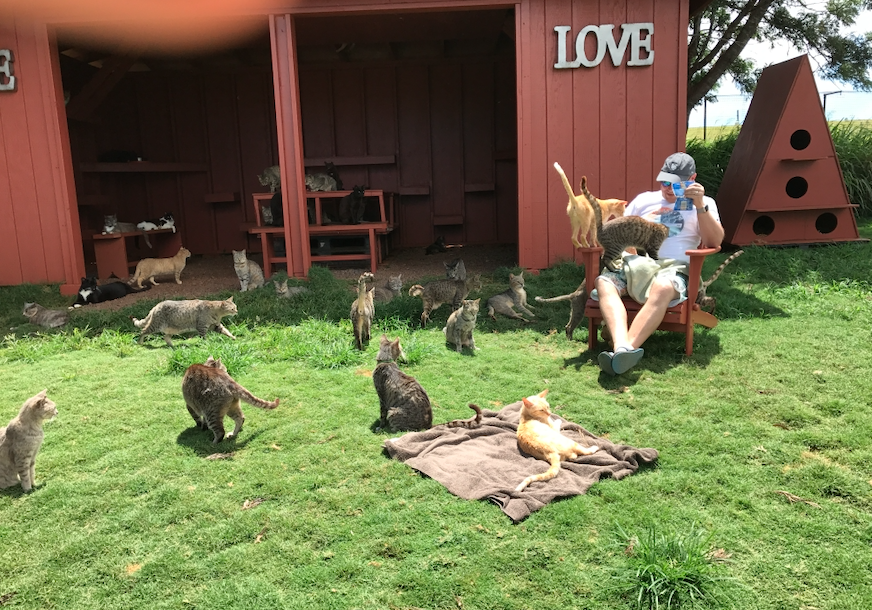
My experience investigating failed rescues also taught me that good intentions are not enough. A sanctuary that grows beyond its financial or professional capacity can become part of the problem it was created to solve. Any sanctuary must know what cats it will accept, where they will come from, who will provide professional care and what happens when it reaches capacity.
The same standard should apply to every approach: What is the goal, and is the strategy actually achieving it?
There should be places where the goal is no free roaming cats because the wildlife risk is simply too great. Other communities may need intensive sterilization, adoption, stronger pet ownership laws, enforcement, containment or sanctuary capacity. Most will probably need some combination.
And we should be able to agree that owned cats are safest indoors, protected from cars, dogs, disease, fights, poisoning and getting lost while also preventing predation on native wildlife.
Instead of another statewide argument over which side is right, Hawaiʻi should bring conservationists, animal welfare professionals, veterinarians, land managers, pet owners and residents together to develop measurable plans based on local conditions.
How many cats are there? Where are they coming from? What native species are at risk? What resources exist? Is the outdoor cat population actually declining?
Then choose the tools. Measure the results. If something is not working, change it.
Our goals should be straightforward: fewer cats living outdoors, fewer unwanted kittens, more pets safely indoors, fewer cats entering sensitive wildlife areas and fewer native animals being killed.
We do not have to choose between compassion and conservation.
We have to stop treating compromise as failure and start judging our work by outcomes.
Hawaiʻi does not need one answer for every island.
It needs the courage to find the right combination of solutions for each community.
 Sign up for our FREE morning newsletter and face each day more informed.
Community Voices aims to encourage broad discussion on many topics of community interest. It’s kind of a cross between Letters to the Editor and op-eds. This is your space to talk about important issues or interesting people who are making a difference in our world. Column lengths should be no more than 800 words and we need a photo of the author and a bio. We welcome video commentary and other multimedia formats. Send to news@civilbeat.org. The opinions and information expressed in Community Voices are solely those of the authors and not Civil Beat.
Read this next:

Local reporting when you need it most
Support timely, accurate, independent journalism.
Honolulu Civil Beat is a nonprofit organization, and your donation helps us produce local reporting that serves all of Hawaii.
ContributeAbout the Author