Jeta: The Stories We Fight to Preserve
For one Hawaiian artist, reclaiming a buried identity began with learning the ancient art of kapa. The barkcloth opened a pathway that led back to their roots.
August 11, 2026 · 6 min read

About the Author
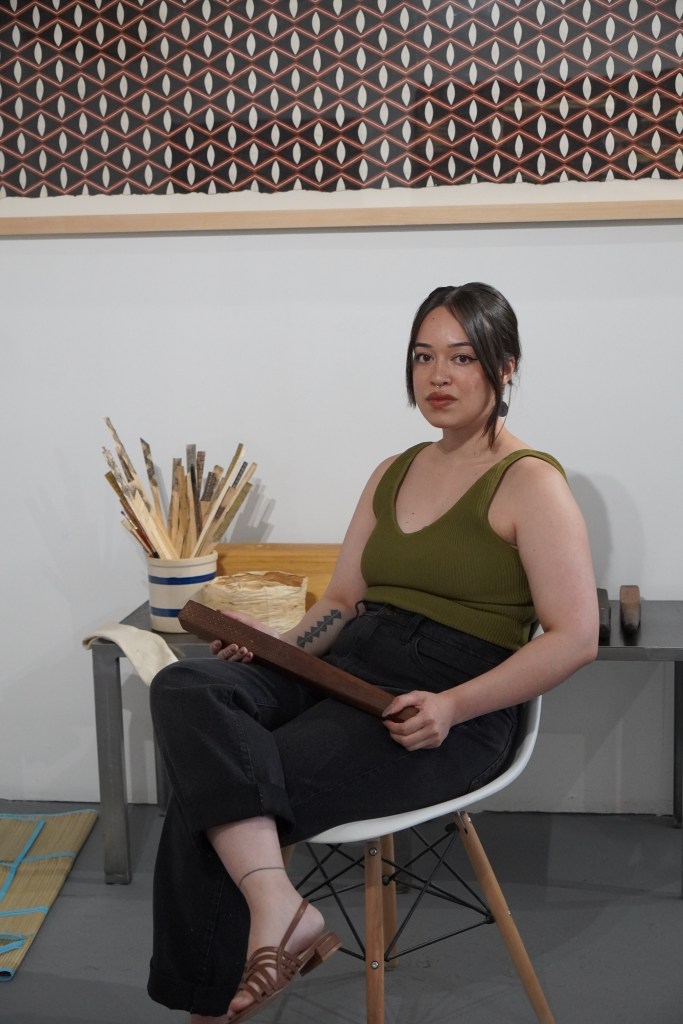
Growing up in Pāpaʻikou on the Big Island, Lehuauakea was immersed in the overlapping worlds of Hawaiian and Japanese traditions. Being of multiracial ancestry was as unremarkable as rice on a plate lunch. It was simply life.
Then, at the age of 14, Lehuauakea’s family relocated to Oregon. In a predominantly white suburban space, the identity Lehuauakea had never questioned became the very thing others used to define them.
Lehuauakea recalls their first day of high school, when a classmate made a Dragon Ball Z joke after learning they had attended Kamehameha Schools. The student continued, “So you’re from Hawaiʻi? Does that mean you lived in a grass hut?” Their social studies teacher witnessed the exchange but said nothing.
Sixteen years later, Lehuauakea reflects, “How uneducated of our mainstream education system to not know the history of Hawaiʻi, the overthrow, the annexation and all that.”
But that moment had followed them.
Over time, Lehuauakea learned to make themself more palatable to a dominant culture that assumed they were Hispanic for having brown skin. They began using their English name, growing estranged from their multicultural upbringing, while slowly erasing parts of themself.
It would take years before Lehuauakea reclaimed the identity they were taught to suppress. The journey back began with kapa.

Ideas showcases stories, opinion and analysis about Hawaiʻi, from the state’s sharpest thinkers, to stretch our collective thinking about a problem or an issue. Email news@civilbeat.org to submit an idea or an essay.
Finding the Thread
“I buried myself for many years. I lost my sense of self and confidence. I couldn’t do it anymore,” they share.
After high school, Lehuauakea studied at the Pacific Northwest College of Art, where they explored kapa (Hawaiian barkcloth), an ancient art form that transforms wauke bark into cloth. They taught themself the craft, making ʻohe kāpala (bamboo stamps used to imprint patterns), and found in this ancestral practice a pathway back to their roots.
“My previous work was just abstraction for geometric abstraction’s sake with no deeper meaning, no cultural background, no sense of me. It wasn’t until I started making kapa that I got my identity back.”
Lehuauakea began going by their Hawaiian name, dancing hula and practicing ʻŌlelo Hawaiʻi again. They sought an apprenticeship with master kapa practitioner Wesley Sen, who trained alongside the late Puanani Van Dorpe, a leader in kapa revival.
Like Lehuauakea, kapa itself carries a story of loss and reclamation.
Woven Back Together
Under Western colonization, Hawaiian culture was systematically dismantled: Native Hawaiians were stripped of their land, their language was criminalized in public education and traditions like hula were prohibited. This is American history.
In recent decades, cultural revitalization has taken root. The Hawaiian Renaissance of the 1960s and ’70s brought artists and cultural practitioners to historical records, museum collections, and surviving family knowledge to revive Hawaiʻi’s cultural legacy.
Among these revivals are kapa and the reclamation of māhū (third gender), a term stigmatized under colonial rule that is now being restored within its traditional context.
Battle Over Memory
For the nation’s 250th anniversary, the White House released a scathing 162-page report, condemning the Smithsonian Institution for “erasing American heritage.” The Smithsonian, a network of 21 museums exploring history, art, and culture through an American lens, serves millions of visitors each year.
In the report, the Smithsonian’s National Museum of American History (NMAH) was accused of promoting “woke” and “unpatriotic” ideology through what the report called “extreme political activism that seeks to transform our country.” Among its criticisms, the report cited the Museum’s examination of Indigenous land rights, transgender representation and other progressive programming it deemed “radical.”
Established in 1964, the NMAH has upheld its duty to capture the nation’s “heritage of freedom,” telling the story faithfully, even when American history contradicts its founding principles. To tell the story of America without mentioning genocide, stolen land or the oppression of Indigenous people ignores an indelible and violent chapter in our history.
Suppressing reality doesn’t protect American heritage: It erases it.
Whose Stories?
Beneath the controversy lies a fundamental question: Whose stories are preserved, and whose are overwritten?
Lehuauakea, now 30, first encountered the term māhū at Kamehameha Schools, where it was used as a slur for transgender people. Even at a school founded to educate Native Hawaiians, they said that history went untaught.
It wasn’t until Hina Wong-Kalu reclaimed the term in the documentary Kumu Hina that Lehuauakea discovered the place of respect and honor māhū once held as healers and teachers. After that, they themselves moved away from the Western framework of non-binary identity and embraced māhū.
During Pride this year, Lehuauakea partnered with HOSH, an Indigenous arts platform, to release kapa designs celebrating Native Hawaiian communities, including māhū, rather than centering Westernized Pride imagery.
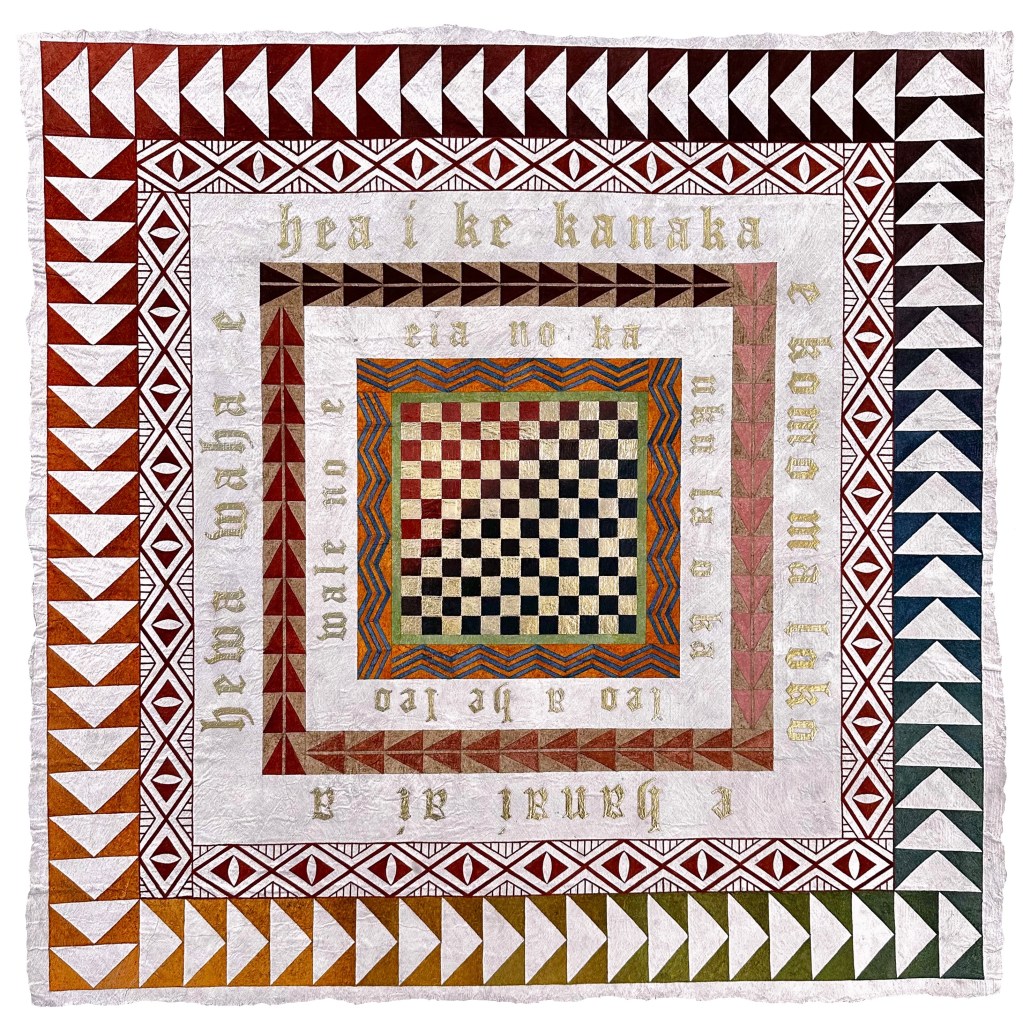
Last November, Lehuauakea’s contemporary art joined the Smithsonian when the National Museum of the American Indian (NMAI) acquired their kapa piece “Puka Komo ‘Ekahi: Portal to Grant Permission” (2024).
Lehuauakea hopes the acquisition can set the tone for future Kānaka artists: “It is a step to undo the injustices of erasure while rewriting the story to include the multitude of voices that have been historically excluded.”
In 2022, during one of their first major exhibitions at the Portland Art Museum, Lehuauakea received a message from a teacher whose queer Pacific Island student had seen their work. “They got so excited,” Lehuauakea said. “Like, ‘Oh my gosh, I never imagined myself in a museum like this.'”
For Lehuauakea, that message said everything about why preservation matters.
“Out of thousands of people, there was at least one kid who felt seen and validated,” they said. “That is not only healing for them, but also for me to know my work is going where it belongs.”
Preserving the Whole Story
On July 24, Trump signed an executive order directing warning signs to be placed outside the NMAH, steering visitors toward “more accurate information regarding America’s history.”
The Trump Administration then organized its own counter-exhibition: “Passport to Patriotism: 250 Years of Diplomacy,” which runs through October 18 at the American Arts Conservancy. The show features AI-generated images of the founding fathers, 68 depictions of the American flag and other displays of “patriotism.”
Like the Smithsonian, admission is completely free—unlike the Smithsonian, no historians or professional curators were consulted.
America has a complicated past, and our bloodstained history shapes our national identity, triumphs and atrocities alike. We slaughtered, we stole, we oppressed, but we also pioneered, innovated and led.
The stories we preserve do not weaken our nation; they paint a fuller picture of us. To deny or alter reality is to diminish our history—and that, by its very nature, would be truly unpatriotic.
For Lehuauakea’s upcoming shows, visit their website here, or sign up for their newsletter for updates on their work.
 Sign up for our FREE morning newsletter and face each day more informed.
Local reporting when you need it most
Support timely, accurate, independent journalism.
Honolulu Civil Beat is a nonprofit organization, and your donation helps us produce local reporting that serves all of Hawaii.
ContributeAbout the Author