The Sunshine Blog: Will They Or Won't They? Vote By Mail, That Is
Short takes, outtakes, our takes and other stuff you should know about public information, government accountability and ethical leadership in Hawai‘i.
August 30, 2026 · 9 min read

About the Author

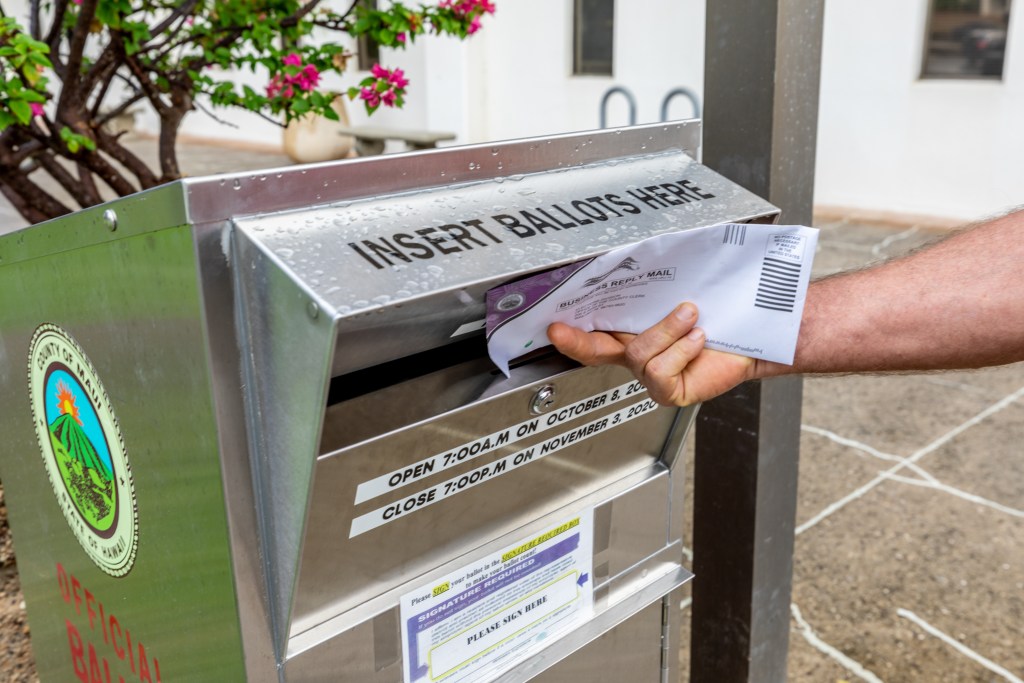
Going postal: If you were like The Sunshine Blog this week you were probably bracing yourself for the possibility that you could be waiting in a very long line in order to vote in the general election this year.
But even as President Donald Trump keeps looking for ways to mess with the November midterm elections – including restricting mail-in ballots – Hawaiʻi officials say there’s no need to worry. At least not yet.
It’s been a week of wild legal whipsawing over voting procedures that are normally left to the states to decide. Trump wants to change that by mandating creation of a national database of approved registered voters for the November elections. He wants the U.S. Postal Service to have the authority to discard mail ballots from people not on that list.

Before Monday, Trump’s executive order on the matter seemed to be in legal limbo, but then the U.S. Supreme Court paused an injunction by a federal judge in Boston that had barred the administration from implementing the executive order. The court’s six conservatives ruled that states had not yet demonstrated harm from the president’s order. The court’s three Democratic appointees dissented.
If put into action, the executive order would create the first national database of mail-in voters, which would require “significant work to maintain and secure,” according to the National Conference of State Legislatures. It would also require many states to reformat what they send voters in the mail, resulting in “last minute changes to ballot envelopes,” said the NCSL, and potential delays that could prevent many registered voters from casting ballots.
On Thursday another federal judge issued a ruling preventing the Postal Service from implementing regulations carrying out the president’s wishes.
Scott Nago, Hawaiʻi’s election chief, tells The Blog that the Supreme Court’s ruling “puts the cart behind the horse again” amid numerous legal challenges, but voters shouldn’t be distracted by it. They should still expect to receive their ballots as normal and don’t need to take any extra steps.
“We’re going to continue to monitor and see how other states handle this,” Nago says, “and do the best we can to get the ballots out.”
Hawaiʻi Attorney General Anne Lopez says her office is continuing to push back on the administration’s plans and was a party to the legal action in Massachusetts that resulted in Thursday’s temporary restraining order. There’s a hearing scheduled next month on that very TRO, and any ruling is expected to be appealed to the Supreme Court.
Trump has been seeking to restrict mail-in voting for years, claiming without evidence it results in widespread voter fraud that cost him the 2020 election against Joe Biden. Since states with Democratic majorities tend to vote by mail more than Republican states, restrictions on such voting could limit Democratic turnout in the November midterm elections, when control of both the House and Senate are at stake.
Hawaiʻi is among many states that have embraced mail-in voting, making it the law in 2020. In the November 2024 presidential election, 522,236 Hawaiʻi residents cast ballots, with 92.5% voting by mail. Earlier this month, 97% of the ballots cast in the primary came in the mail.

Most people have wised up that voting in person in Hawaiʻi no longer is the way to go and that it is especially unwise to wait til election day to go to the polls. Long lines that stretch for hours have become the norm because the counties only operate a handful of voter centers. On Oʻahu there are only two for hundreds of thousands of registered voters.
And despite legislative efforts to mandate more voter centers on election days, the counties have successfully argued that there is just no way they can staff more centers than they do now.
That makes The Blog wonder what will happen if Trump prevails — he has a way of getting what he wants — and Hawaiʻi ballots are waylaid by the Postal Service. No one seems to be making contingency plans, just shrugging off that such a debacle could ever happen.
So for now, plan to vote as usual starting in about 45 days (mail ballots are supposed to arrive Oct. 16). But keep your eye on the Supreme Court.
Another one bites the dust: Chalk up another lost opportunity to hear top contenders for a political office debate each other on a public stage. This time it is the Kauaʻi mayor’s race where Bernard Carvalho pulled out of the planned event with two days notice.
Debate organizers say both Carvalho and Mel Rapozo had previously confirmed their participation. But then Carvalho, a former Kauaʻi mayor and county council member, bailed.
Kauaʻi Now reports that a large crowd turned out anyway on Thursday to hear what Rapozo had to say and that Carvalho declined to talk to the news outlet about why he didn’t show up.
More and more political candidates both in Hawaiʻi and across the country seem to be playing the odds that voters don’t really care about debates and won’t hold it against them.
That was definitely the case in the Aug. 8 primary when lieutenant governor candidate Derek Kawakami turned down joint appearances with Della Au Belatti and John Choi, the other two leading contenders.
U.S. Rep. Ed Case made no bones about why he refused to debate challenger state Sen. Jarett Keohokalole. “My opponent’s sole campaign strategy is to attack me,” Case told Civil Beat’s Nick Grube. “He offers no real policy proposals of his own, no alternative vision, no argument of effectiveness. His goal is heightened visibility by any means.”
Kawakami and Case both easily won their primaries and face no substantial challenge in the Nov. 3 general election.
GOP gubernatorial candidate Gary Cordery is itching to debate incumbent Gov. Josh Green. But Green’s people have already told The Blog no way. Green is still wary of the unruly tactics and antisemitic threats from the Aloha Freedom Coalition, headed by Cordery, that came his way when he was lieutenant governor and the conservative activists didn’t like how Green was dealing with Covid-19 restrictions and vaccine mandates for travel, among other things.
Another legislative candidate, Marcus Owens, a Democrat running in Senate District 20 against GOP former state Rep. Bob McDermott, this past week turned down a request to appear at a Civil Beat candidate forum saying he’s not doing any forums.

The Blog will always love you: If you’re wondering why the flags are still flying at half-staff, you must have missed the news about the death of country music icon Dolly Parton. The Blog is a huge fan of the woman who made a big impression on Hawaiʻi back in the day and couldn’t let her go without a bit of reminiscing.
The arc of Dolly Parton’s life traveled a long way from a one-room cabin in Tennessee to a half-acre beachfront estate on Oʻahu. Yet despite that incongruous path, Dolly developed a lifelong love for Hawaiʻi – starting in the mid-1980s – that endured to her death on Wednesday, at age 80.
As with many transplants, it was a learning curve for Dolly, and the locals sometimes poked fun at her. When she brought her family to Waimea Falls, a newsletter in the area called them the “Hillbillies in Hawaii” gang.
On a 1988 television special, Dolly jokingly disparaged a staple of the islands, saying: “For hundreds of years Hawaiians have been pounding taro root into poi. It’s going to take me at least that long to acquire a taste for it.”
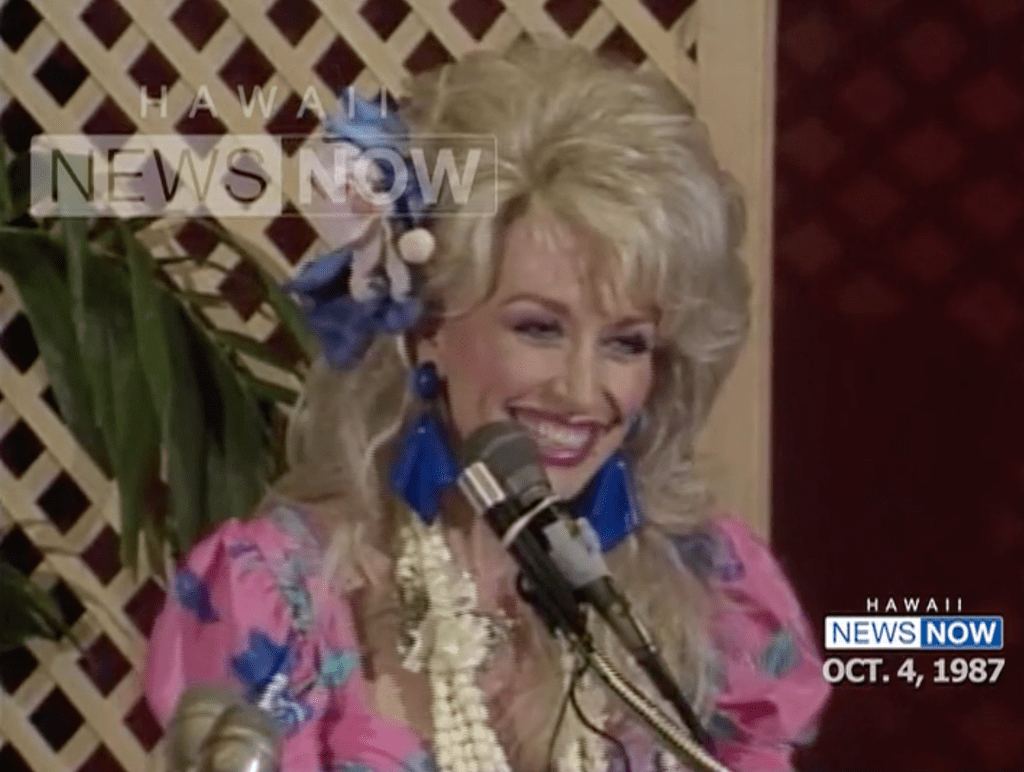
She bought a plantation-style home in the Portlock area of Hawaiʻi Kai with a giant banyan tree in the yard. In 1987, she orchestrated the opening of the Dockside Plantation, a restaurant and entertainment venue in Hawai‘i Kai that served fried chicken, biscuits and other Southern food. It generated lots of buzz. But unlike Dolly’s music, its shelf life was short-lived. It closed within a year – a victim of uneven food and an owner who may have been juggling too much as her career soared.
Dolly, however, remained committed to the islands. In 1998, she brought together a legendary group of Hawaiian performers, including The Brothers Cazimero and Danny Kaleikini, for her television special, “My Hawaiʻi.” More recently, after the 2023 Lahaina fire disaster, she teamed up with Felix Cavaliere of The Rascals to produce a new recording of “My Hawaii,” with proceeds going to the Maui United Way Maui Fire Disaster Relief Fund.
Dolly’s 1973 hit, “I Will Always Love You,” was recorded long before her Hawaiʻi days, but it captures how she felt about the people of Hawaiʻi, whom she once called “angels.”
I hope life treats you kind
And I hope you have all you’ve dreamed of
And I wish you joy and happiness
But above all this, I wish you love
 Sign up for our FREE morning newsletter and face each day more informed.

Local reporting when you need it most
Support timely, accurate, independent journalism.
Honolulu Civil Beat is a nonprofit organization, and your donation helps us produce local reporting that serves all of Hawaii.
ContributeAbout the Author