Hawaiʻi's Fuel Supply Chain Is Dangerously Stressed
That gap between pump prices and crude prices is a lag that will hit us hard.
September 23, 2026 · 7 min read

About the Author

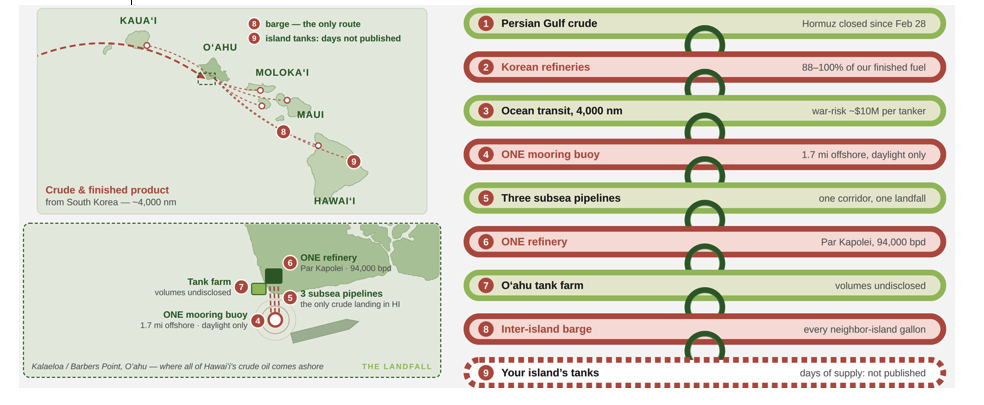
I have spent the summer mapping Hawaiʻi’s energy supply chains. Four of the nine links in that chain have no backup at all.
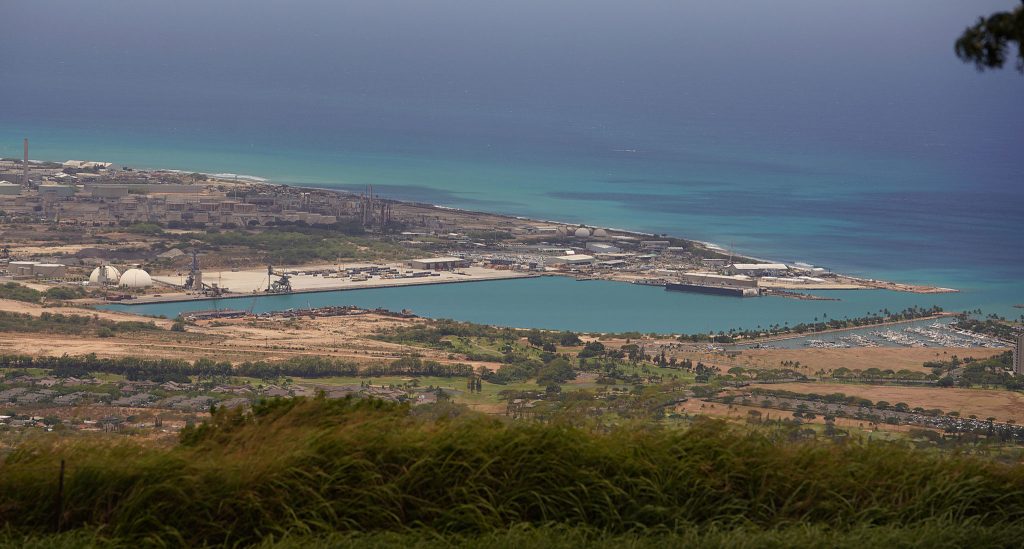
Start with the one almost nobody has heard of. All of Hawaiʻi’s crude comes ashore through a single mooring buoy floating 1.7 miles off Barbers Point. Three subsea pipelines run from it to the Par Kapolei refinery, the only refinery in the state. Tankers can tie up to that buoy only in daylight.

Ideas showcases stories, opinion and analysis about Hawaiʻi, from the state’s sharpest thinkers, to stretch our collective thinking about a problem or an issue. Email news@civilbeat.org to submit an idea or an essay.
One buoy, one refinery, one landfall — and every gallon reaching Hawaiʻi island, Maui, Kauaʻi, Molokaʻi or Lānaʻi gets there by barge from Oʻahu, because there is no other way.
Above that sits our supplier concentration: between 88% and 100% of the finished fuel we import — gasoline, jet, and every drop of ultra-low-sulfur diesel — comes from South Korea. That is not a supply chain. It is a single thread.
The Thread Is Being Pulled Hard
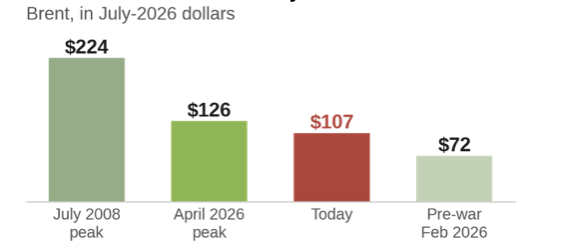
The Strait of Hormuz has now been largely closed for 200 days. Libya’s crude exports collapsed this month to roughly 400,000 barrels a day from 1.02 million in August. Saudi Arabia’s East-West pipeline — the workaround meant to bypass Hormuz, carrying 4 to 5 million barrels a day — was shut on Sept. 11 after drone strikes launched from Iraq, and may be down for five to six weeks, or even longer. Brent closed at $107 this week, up 18% in a month and 58% in a year.
Last week the Wall Street Journal reported what oil executives are now saying out loud, in an article called “The great fuel crisis is here.”
ExxonMobil’s Darren Woods: “I’ve never seen the available capacity relative to demand as low as it is today.” Between 5 and 7 million barrels a day of global refining capacity is offline, American refineries are running flat out near 98%, reserves are being drawn down to dangerous levels, and U.S. diesel has set records above $6 a gallon.
This is no longer “just” a crude shortage; it is a refining shortage. We import mostly finished fuel, from refineries in exactly the region running hottest.
Why The Pump Still Looks Calm
Here is the trap. Hawaiʻi averages $5.44 for regular and $7.02 for diesel — up 96 cents on the year but barely moved in a month. Crude rose 18% in the last month.
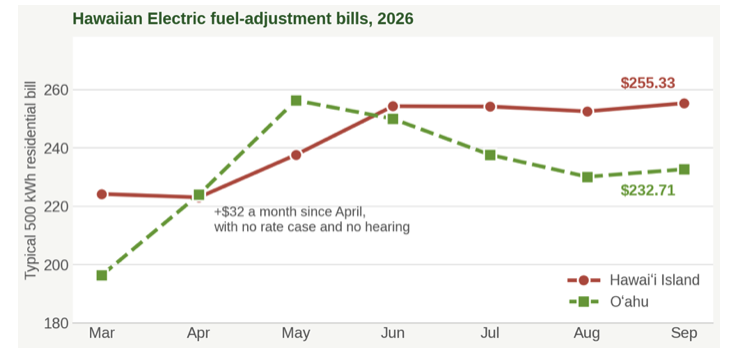
That gap between pump prices and crude prices is a lag that will hit us. September’s fuel adjustment prices Keāhole diesel at $173 a barrel — fuel bought weeks ago. Crude purchased at $107 has not reached a single Hawaiʻi bill; it arrives in the October and November filings.
Since April the typical Big Island bill is already up $32 a month, about 14%, with no rate case and no hearing. The reassuring number is the one structurally guaranteed to move last, which is exactly why it is the wrong number for the state to wait on.
The Cushions Are Nearly Spent
Fairness requires saying what is holding prices down, because it is not resilience. China cut crude imports from 12 million barrels a day to 8.1 million, the lowest since 2016 — price rationing, not necessarily prudence. Global demand has been contracting, but China is starting to resume its oil imports, relying less on its massive oil reserves.
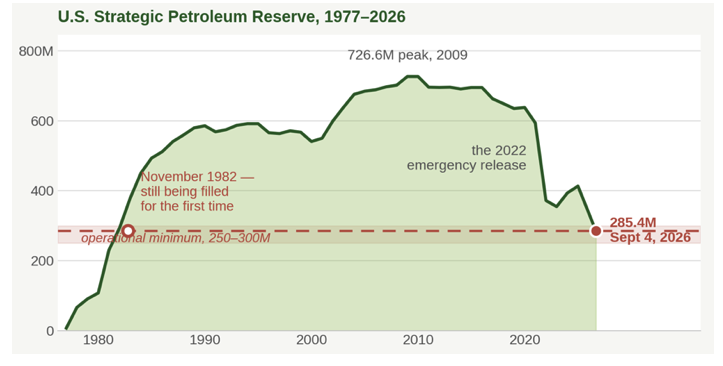
But the rest of the world is draining its reserves: OECD stocks fell 410 million barrels from February to July, the IEA’s record 400-million-barrel release has already fired, and the U.S. Strategic Petroleum Reserve sits at 285.4 million barrels, the lowest since November 1982 and drawn down 24 weeks running. In Europe, 23 of 27 member states are below the 90-day reference level for jet fuel.
Fairness also requires conceding that in real terms we have seen higher prices before. Brent’s 2008 record of $147.50 is about $224 in today’s dollars; at $107 we are under half that peak.
What is unprecedented is the lack of any remaining buffer. In 2008 the reserve held nearly 700 million barrels and OECD stocks were full. Demand destruction, drained inventories and a nearly empty federal reserve are not supply. They are cushions, and each one works exactly once.
Here are six things I recommend that the state do now:
- Publish days-of-supply, weekly, by island, by product. The Energy Office already collects it. Today no resident, business or county civil defense agency can learn how many days of diesel their island holds. That number is the trigger for every other decision.
- Lock in Jones Act coverage before Nov. 9. The waiver exists, but on Aug. 11 it narrowed from blanket relief to case-by-case voyage review — slower, precisely when speed matters.
- Count neighbor-island diesel: water pumps, hospitals, harbors, generators. Hurricane Lala stopped making this hypothetical. It darkened roughly 233,000 meters, left parts of Puna out for weeks, knocked four Big Island independent power producers off the grid, and pushed the Department of Water Supply to essential-needs-only, because the pumps run on power. Everything still running ran on diesel, and nobody could say how many days of it we had.
- Get inventory numbers from Par, whose refinery turnaround finished on schedule;
- Build a rotating finished-fuel reserve of diesel and jet on every island, since the federal reserve holds only crude, on the mainland, and routes through the one company that owns our only refinery.
- Last but definitely not least: accelerate the resilience and price hedges that we already know work — move to rapidly build out huge amounts of rooftop and parking-lot solar with battery storage, oodles more EV charging, restored EV and charger incentives, better mass transit across the board.
Notice the position we are in. The refinery is back. The barges still run. The tanks are not empty. That is not a reason to wait — it is the reason for us to move now, with determination. You can only build a buffer while you do not yet need one.
The cheapest fuel Hawaiʻi will ever buy is the fuel it never has to import. The second cheapest is the fuel it bought before it needed it.
 Sign up for our FREE morning newsletter and face each day more informed.
Community Voices aims to encourage broad discussion on many topics of community interest. It’s kind of a cross between Letters to the Editor and op-eds. This is your space to talk about important issues or interesting people who are making a difference in our world. Column lengths should be no more than 800 words and we need a photo of the author and a bio. We welcome video commentary and other multimedia formats. Send to news@civilbeat.org. The opinions and information expressed in Community Voices are solely those of the authors and not Civil Beat.
Read this next:

Local reporting when you need it most
Support timely, accurate, independent journalism.
Honolulu Civil Beat is a nonprofit organization, and your donation helps us produce local reporting that serves all of Hawaii.
ContributeAbout the Author