Is Hawaiʻi Creating Enough Opportunity For Locals To Live Here?
A labor market dominated by replacement openings is fundamentally different from one driven by rapid employment growth.
September 1, 2026 · 4 min read

About the Author
In his recent Civil Beat commentary, “Hawaiʻi Doesn’t Have A Worker Shortage. It Has An Opportunity Shortage,” Harvey Stone challenged a common assumption in Hawaiʻi’s workforce debate.
Around the same time, two workforce analyses approached Hawaiʻi’s future from different perspectives.
The Hawaiʻi Workforce Funders Collaborative’s Workforce Understory, mentioned in Stone’s article, focuses on opportunity, economic mobility, and living-wage employment. The Hawaiʻi Department of Labor and Industrial Relations employment projections for industries and occupations 2034 focuses instead on where future job openings are expected to come from.
Rather than viewing the issue solely as a worker shortage, he argued that Hawaiʻi may also face an opportunity shortage: too few pathways to living-wage careers for many of the people who already call these islands home. That observation deserves serious consideration.

Ideas showcases stories, opinion and analysis about Hawaiʻi, from the state’s sharpest thinkers, to stretch our collective thinking about a problem or an issue. Email news@civilbeat.org to submit an idea or an essay.
Viewed together, they suggest a larger conversation about Hawaiʻi’s workforce future.
For years, workforce discussions have focused on whether Hawaiʻi has enough workers. Employers across multiple sectors report difficulty finding and retaining talent. The typical response has been to recruit more workers, expand training programs, and encourage more young people to stay in Hawaiʻi. Those efforts remain important.
But Stone’s article invites us to ask a different question: Are we creating enough opportunities that allow local residents to build economically secure lives here? Viewed alongside the DLIR projections, however, an even broader question begins to emerge: What are we replacing our workforce into?
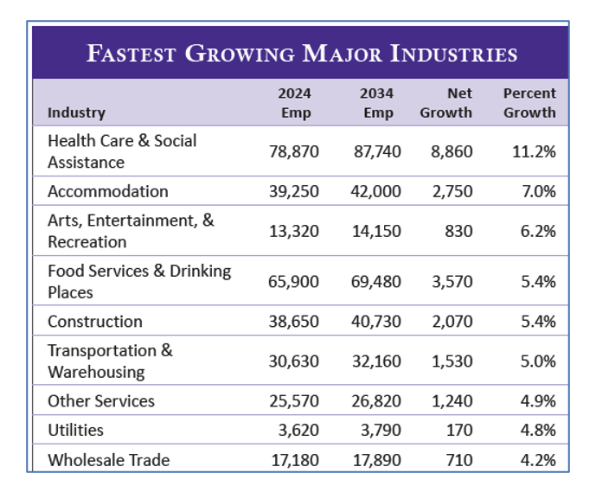
The DLIR projections suggest that most future projected job openings will arise from replacement demand rather than job growth. Most of the jobs Hawaiʻi will need to fill over the coming decade are not new positions created through economic expansion. They are positions opened by retirements, career changes and normal workforce turnover. The report’s central story is about demographic churn rather than large-scale job creation.
This is a critical distinction.
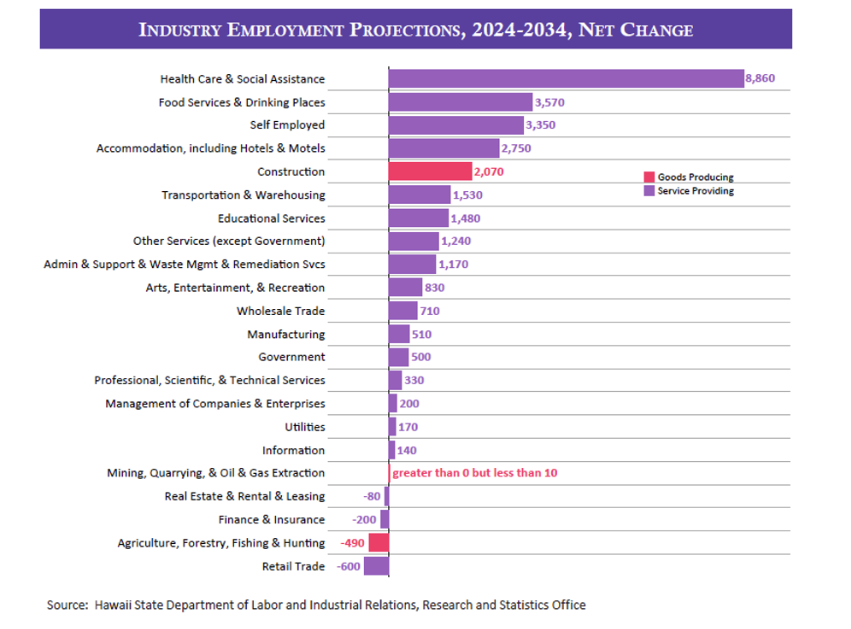
A labor market dominated by replacement openings is fundamentally different from one driven by rapid employment growth. One reasonable interpretation is that Hawaiʻi’s workforce outlook is becoming increasingly focused on sustaining existing economic capacity rather than creating large numbers of new opportunities.
That raises an important question: What kinds of opportunities are created when most future openings come from replacing existing workers rather than creating new jobs?
The Workforce Understory addresses this quality question and asks whether Hawaiʻi is producing enough living-wage opportunities. The DLIR projections instead ask where future openings will come from.
Together, they raise a deeper question: Can Hawaiʻi sustainably replace its workforce if too many of those replacement opportunities fail to provide a pathway to economic security?
For years, workforce discussions have focused primarily on supply:
- How many workers are entering the labor market?
- How many students are graduating?
- How many workers are retiring?
Those questions remain important. But if replacement demand will account for most future openings, then opportunity quality deserves equal attention. We should also be asking:
- Which replacement occupations provide a living wage
- Which occupations offer meaningful career mobility?
- How can the number of new higher paying jobs be increased?
- How can more replacement openings become family-sustaining careers?
These are not simply workforce development questions. They are, more importantly, economic development questions about the kind of future Hawaiʻi is building. A labor market defined largely by replacement demand may look very different from one driven by economic expansion.
At a policy level, understanding that difference matters. If replacement demand will define much of Hawaiʻi’s labor market over the coming decade, then the conversation is no longer simply about how many jobs will be available. It should be about what kind of opportunities those jobs will provide, and what that means for Hawaiʻi’s economic future.
 Sign up for our FREE morning newsletter and face each day more informed.
Community Voices aims to encourage broad discussion on many topics of community interest. It’s kind of a cross between Letters to the Editor and op-eds. This is your space to talk about important issues or interesting people who are making a difference in our world. Column lengths should be no more than 800 words and we need a photo of the author and a bio. We welcome video commentary and other multimedia formats. Send to news@civilbeat.org. The opinions and information expressed in Community Voices are solely those of the authors and not Civil Beat.
Read this next:

Local reporting when you need it most
Support timely, accurate, independent journalism.
Honolulu Civil Beat is a nonprofit organization, and your donation helps us produce local reporting that serves all of Hawaii.
ContributeAbout the Author