Eric Stinton: A Staple Of Hawaiʻi's Literary World Is Back
The state’s longest-running reading series has returned. It is inspiring people to read, network and write.
September 22, 2026 · 5 min read

About the Author

If you ask Sujatha Raman and Kristiana Kahakauwila how they became co-organizers of MIA Honolulu, the longest-running reading series in Hawaiʻi, they will tell slightly different versions of the same story. In both tellings, it started at the Association of Writers and Writing Programs conference in 2025.
“In my version,” said Kahakauwila, a celebrated author who directs the creative writing program at the University of Hawaiʻi Mānoa, “Sujatha had been talking about wanting to start a reading series.”
“There’s some truth that I wanted to organize it,” said Raman, a writer and non-profit consultant. In her version, she had been wanting to focus more on writing; attending the conference in the first place was a part of her mission to take her own work more seriously. Organizing a reading series, in her telling, “adds labor without adding pages.”
But while at the AWP conference, she attended a panel on – you guessed it – starting a reading series. Raman, who grew up in Singapore and lived in Brooklyn for 20 years before moving to Hawaiʻi in 2016, had already been organizing a weekly writing group at Hub Coworking Hawaiʻi.

“Anybody who wanted to write and just needed an hour of quiet space would come,” said Raman. “We’d write together and then hang out for an hour. It was really generative. So I said maybe we should provide this sort of space for readers.”
The idea stuck with her, so she reached out to several writers, including Kahakauwila. The connection felt like a sign. “I had already been thinking of restarting MIA,” said Kahakauwila.
MIA – which stands for Mixing Innovative Arts – started in 2009, the brainchild of Jaimie Nagle, then a PhD student at UH Mānoa who was looking for a place for artists to share work and hang out off campus. “I read in it during its second year, so I’d been there pretty early, and I loved the vibe, that it felt casual and community-based,” said Kahakauwila.
MIA continued under different organizers until 2020, when the pandemic sent it into a dormancy that, after five years of silence, started to seem permanent. (Yours truly was one of the readers at its final 2020 event; the extent to which I am to blame for its hiatus is unclear.)
In October 2025, Kahakauwila and Raman co-organized the first MIA event since February 2020. MIA was officially, ahem, back in action.
Before that, the literary community had deeply felt its absence. They had lost a space for writers and readers to gather just as Hawaiʻi’s literary renaissance was beginning to blossom.
Hawaiʻi Writers On The Rise
Hawaiʻi has always punched above its literary weight class, with writers such as Kiana Davenport, Lois-Ann Yamanaka, Susanna Moore, Chris McKinney and Kaui Hart Hemmings publishing to significant critical and commercial success in the 90s and 2000s.
But in the last six years, Hawaiʻi writers have been publishing acclaimed, award-winning books nearly every year. Just last week, two Hawaiʻi writers – Keala Kendall and Tae Keller – were longlisted for the National Book Award for Young People’s Literature.
“There’s an incredibly vibrant literary scene, and there has been since the 1820s,” said Kahakauwila, whose 2013 story collection “This Is Paradise” is a monument of contemporary Hawaiʻi literature. “The problem wasn’t finding enough people. It’s a really exciting time. 2026 has been a year of great books from Hawaiʻi.”
So far in this year alone, Shay Kauwe’s “The Killing Spell” and Alicia Upano’s “Everything To The Sea” have been published by Big Five publishers; both Kauwe and Upano read at MIA earlier this year.

Ideas showcases stories, opinion and analysis about Hawaiʻi, from the state’s sharpest thinkers, to stretch our collective thinking about a problem or an issue. Email news@civilbeat.org to submit an idea or an essay.
And more great books being written means more book-launch events, filled with celebratory energy that has inspired the newly-resuscitated MIA.
“There’s a jubilance at these events, a joy, because you’ve worked so hard on this book and here you are finally presenting it to the world,” said Raman. “But maybe you’re working on your first draft, maybe you’re in between books and you want to try out something different, or maybe you’ve been writing and writing but have only published a couple of short stories. I just felt the need to meet more people who are reading and writing.”
‘People Just Can’t Stop Talking!’
MIA holds readings every second Thursday of the month at OurSpace Hawaii, with different themes for each gathering. “Literary happenings should be like costume parties,” Kahakauwila said. “It’s a way to bring in writers from different communities.”
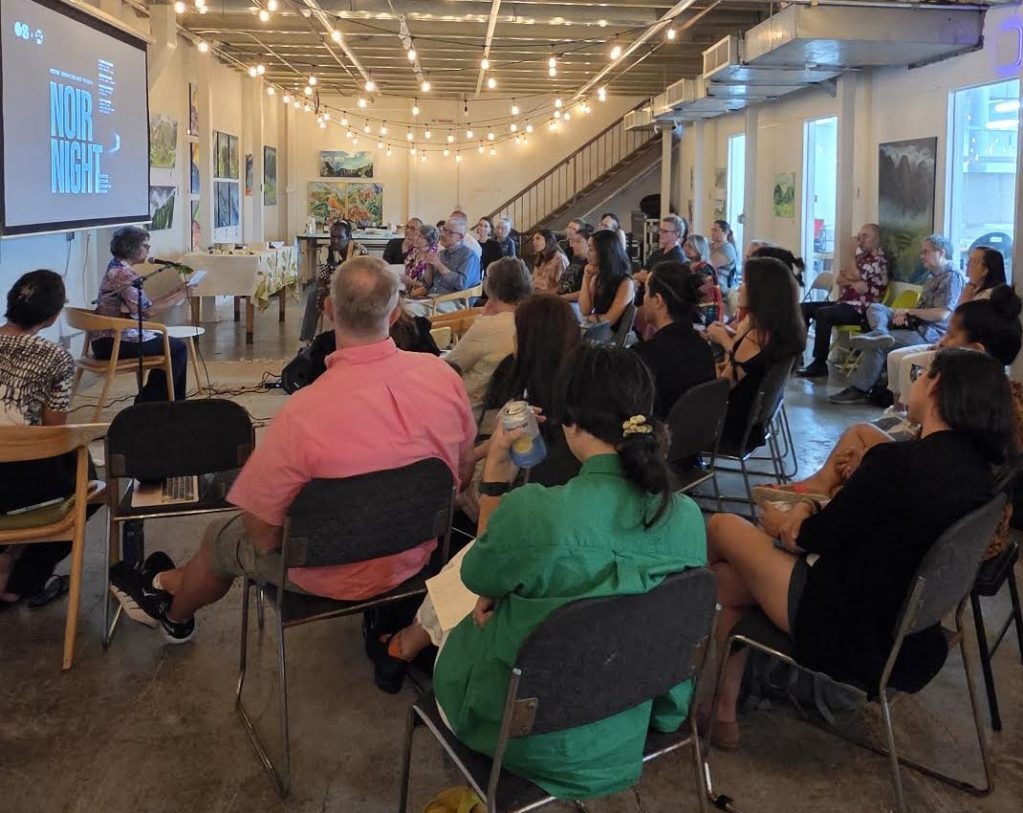
The March event, “Build Me A Bangka,” featured Filipino writers; the event from earlier this month was “Noir Night.” And when the opportunity arrives, themes are often seasonal, like February’s “Love & Other Disasters” for Valentine’s Day, and next month’s “What Whispers Back: Spinning Hawaiʻi’s Spooky Tales” for Halloween.
Writing, or art of any kind, is often a solitary, lonely pursuit, but having a space to share and enjoy that art with others – off-screen and in-person – taps into a deep, human need that our increasingly digitized world overlooks: the need for connection and community.
After the readings, people hang out, talk story, eat pupus, go out for drinks together. “Your world feels fuller,” said Kahakauwila.
“I’ve been surprised at how vibrant the social hour is after the readings,” said Raman. “It’s magnetic. People just can’t stop talking! They express all sorts of things, hidden desires to write. It’s lovely.”
 Sign up for our FREE morning newsletter and face each day more informed.
Local reporting when you need it most
Support timely, accurate, independent journalism.
Honolulu Civil Beat is a nonprofit organization, and your donation helps us produce local reporting that serves all of Hawaii.
ContributeAbout the Author