Supreme Court Ruling On Disputed Election May Conflict With State Law
The high court struck down a state-ordered election in House District 43 resulting from a lauhala basket tiebreaker. The remedy is now being called into question.
September 27, 2026 · 9 min read


About the Author

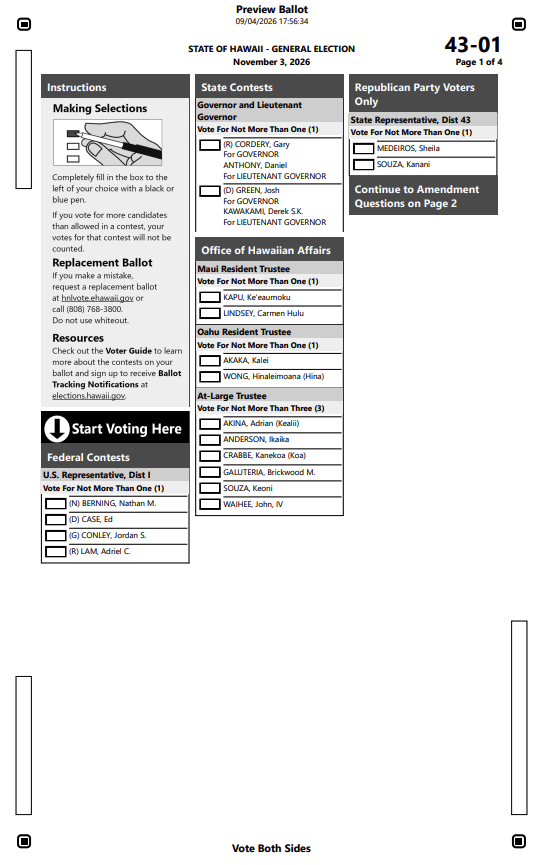
When voters in House District 43 get their general election ballots beginning next month, they will be asked to decide on a race that could not be settled in the Aug. 8 Republican primary. But the ballot will also include this label: “Republican Party Voters Only.”
That label, which is unenforceable — Hawaiʻi has no party registration — has perturbed both candidates in the race.
What’s received less attention is that two justices who were in the minority of the 3-2 Hawaiʻi Supreme Court ruling — the one that ordered the rematch for the Kapolei-Makakilo seat — say the ruling conflicts with state law, and may set a precedent that could disenfranchise voters.
In a nutshell, the ruling in Souza v. Nago allows non-GOP voters to cast ballots in a do-over race that originally was a primary between two Republicans. That means that Republicans in House District 43 seeking to choose their preferred GOP candidate will have their votes diluted by non-Republican voters.

It was not an easy call for the Supreme Court. The justices were wrestling with election laws and with each other, all under a deadline to meet the electoral calendar. But in crafting a solution, they may end up harming the very same Republican voters they were trying to help. It might also influence future cases involving tied elections.
If you haven’t heard the story by now, here’s a brief recap:
A Burst Of Legal Jousting
After votes were cast, the Hawaiʻi Elections Office determined Rep. Kanani Souza and challenger Sheila Medeiros were tied at 842 votes each. A subsequent tiebreaker — now locally famous, because election officials used plastic Easter eggs and a lauhala basket — gave the win to Medeiros. But the Hawaiʻi Supreme Court on Sept. 4 invalidated that and ordered a new election on Nov. 3.
A flurry of court motions and opinions soon followed. They include a petition from Souza on Sept. 11 asking the court to change the ballot language so that it gives voters “accurate information that is not confusing.”
Her preference was that the label instead read “Republican Primary Election.” She called the court’s directive on the language “internally inconsistent” with not only Hawaiʻi Revised Statute 12-31 on parties and primaries but also Article II, Section 4 of the Hawaiʻi State Constitution regarding suffrage and elections.
“The language should not be construed to require a voter to declare a party preference as a condition of voting,” Souza argued.
“Souza has a point,” Associate Justice Todd Eddins and Acting Chief Justice Sabrina McKenna wrote in their Sept. 16 dissent, illustrating significant differences with their colleagues.
Eddins and McKenna also said this in their amended separate opinion to the initial majority opinion on Sept. 4: “The primary remains unfinished. It’s not for us to declare the winner. That’s up to the people. Some rights sit above the rest. Like the right to vote.”
But the majority opinion on Souza’s motion, authored by Associate Justice Lisa Ginoza and two justices filling in on the five-member court (Intermediate Court of Appeals Associate Judges Kimberly Guidry and Sonja McCullen) rejected the request, saying the label change request for the new election “does not materially affect who will vote in the new election.”
That opinion, on Sept. 16, also took issue with Eddins and McKenna’s separate opinion to the Sept. 4 ruling that ordered the Nov. 3 rematch. The two justices amended that same opinion one week later after reconsidering the circumstances, making clear that they have major problems with the majority decision.
In short, Eddins and McKenna preferred that the rematch be held after Nov. 3 in a stand-alone ballot.

“The winner of the completed District 43 primary is then deemed elected under Article III, Section 4,” they wrote, referencing the part of the Hawaiʻi Constitution delineating the power of the Legislature. “She takes office on the day the primary election result is certified.”
But the three-member majority disagreed with that, too, noting that voters from other parties and nonpartisans would also still be able to cast votes in a post-election election.
“There is no way to perfectly replicate the August 8, 2026 primary election; it is simply not possible to do so at this point in time,” they wrote.
Still, the dissenting justices felt a separate election after Nov. 3 was a better solution because “it keeps the primary-general sequence intact. Our approach is the closest approximation the law allows.”
The dissenters are raising issues about both the letter of the law and past judicial precedents, said Lance Collins, a Maui attorney.
“What they’re saying is that the remedy the Supreme Court has ordered is inconsistent with the statute that the Legislature passed on how to run primaries and how the Supreme Court has interpreted that for the last 40 years,” said Collins, who represented Maui County Council election disputes in 2022 and 2024 before the Supreme Court.
In an email Thursday, Souza said she “feels strongly” that the court-ordered label violates both the state constitution and state law and that it will only confuse voters who have long been required to pick one party in the primary.
“Every District 43 voter will be able to vote in the State Representative District 43 race, despite the heading for the race: ‘Republican Party Voters Only,’” she said. “Any information to the contrary that tries to narrow the electorate is not appropriate.”
Candidate Responses
Souza does not want a special election after the general, however, as she says it would cost too much money.
“This race on the general election ballot is fine, the language is not,” she said. “This language is restrictive and constrained. Voters may be confused. Everyone in District 43 can vote in this race and they should.”

Medeiros also opposes the restrictive language and wishes the court had accepted the outcome of the elections office tiebreaker (the one with the plastic eggs and lauhala basket) that initially gave her the win.
“Some will think they received the wrong ballot,” she said in an email this week. “Some who voted Republican in August will think they cannot vote this race. Some who did not vote in that primary can mark it anyway.”
“After the ruling I said that replacing an August Republican primary with an open November contest disenfranchises the 1,684 Republican primary voters who already decided this race,” she said. “Competing on November 3 is compliance with the court’s order. It is not consent to the heading or to the precedent.”
Medeiros also reiterated a point she made following the earlier decision to hold a rematch.
Her preferred solution, which she told the court in her own filing, was for the court to go with the candidate certified by the tiebreaker Aug. 15 (Medeiros) “or at minimum keep a true party primary that can actually be closed.”
Medeiros worries that the court’s remedy may be applied going forward.
“The same template will reach every party the next time a primary ties or an overage appears; Democrat, Republican, or any other party with a nominee and no opposing-party candidate in November,” she said. “A caption that cannot be enforced is not a closed primary. It is an open general dressed as one. Parties have a right to associate and to choose their own nominees. This order severs that.”
Asked whether Souza v. Nago (Scott Nago is the state’s chief election officer) will serve as precedence, Collins, the Maui attorney, said, “It might.”
But he said the ruling may also be limited to situations where there is a tie vote and there were ballots mistakenly issued to two voters, as happened in District 43. As the court concluded, those votes could well have determined the primary winner.

Indeed, Eddins and McKenna acknowledged in their amended opinion that what happened in District 43 was unique.
“This case is unusual,” they wrote. “Medeiros and Souza drew no general-election opponent. That absence is why a November option was even on the table.”
The Hawaiʻi Supreme Court has the last word in this dispute, so there will not be an appeal in Souza v. Nago. The state elections chief, meantime, has been ordered to promulgate rules on how to handle tiebreakers in future elections.
Both candidates say they are now focused on the campaign and reaching out to voters. But there are no forums scheduled before Nov. 3, as Souza declined invitations from Civil Beat and PBS Hawaiʻi. Ballots will be mailed beginning Oct. 16.
Only 1,684 people voted in the Republican primary, and the turnout was a mere 27%, below the statewide turnout rate of 32%. But the district has a resident population of more than 28,600 and roughly 70% of them are over the age of 18. It is unclear whether they are all registered to vote, or will vote on Nov. 3.
And the District 43 ballot is not just about the Souza-Medeiros race. It includes the 1st Congressional District race, the races for governor and lieutenant governor and Office of Hawaiian Affairs trustees, two constitutional amendment questions and 20 charter amendment questions.
Souza was elected to the seat in 2022, defeating Democratic incumbent Stacelynn Eli. Souza defeated Medeiros in the 2024 GOP primary and was unopposed in the general election.
The district generally leans conservative but is described as diverse by both candidates. And what matters most will likely be more personal than political.
“People in my district usually vote for the person, not party,” said Souza.
“I do not run as if only one slice of the district counts,” Medeiros said. “I live here. I serve here. I am asking every voter in the district to mark the race on Nov. 3.”
 Sign up for our FREE morning newsletter and face each day more informed.

Local reporting when you need it most
Support timely, accurate, independent journalism.
Honolulu Civil Beat is a nonprofit organization, and your donation helps us produce local reporting that serves all of Hawaii.
ContributeAbout the Author