Anything But Easter Eggs: How Hawaiʻi Could Settle Tied Elections
Flip a coin, pick a card, draw straws — do anything except use plastic eggs and a lauhala basket, the state’s high court suggests.
September 13, 2026 · 9 min read

About the Author

To Kanani Souza, it was a suspicious procedure from the start.
First was the email she received from the Hawaiʻi Office of Elections at 7:26 p.m. on Friday, Aug. 14. She was informed that there would be a “drawing” the very next day — a Saturday — to decide the winner of her tied primary election with Republican challenger Sheila Medeiros.
Souza emailed right back suggesting that that was not a good idea, as the governor had just issued an emergency proclamation because Tropical Storm Lala was nearing the state. Couldn’t it wait, she asked, as state law did not place any time frame on election tiebreakers?
By early Saturday morning the governor was urging residents to shelter in place, as Lala had become a hurricane. But the drawing of lots at the State Capitol was already set for a livestream at 1 p.m.

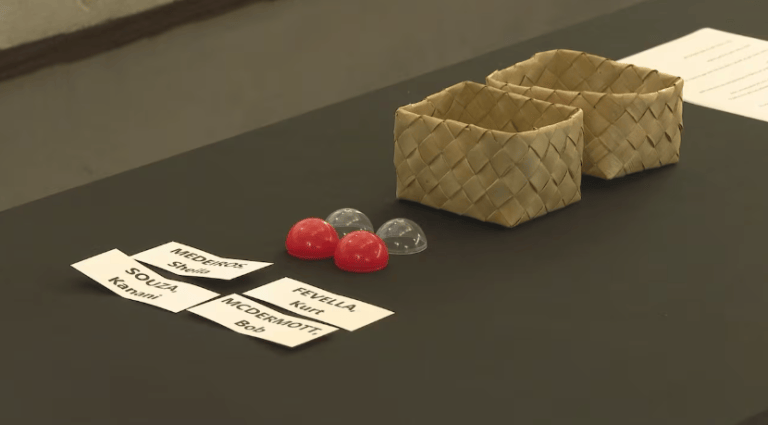
Souza arrived at the Capitol Auditorium 40 minutes early not knowing how the drawing would be conducted. But she soon spied on a table several pieces of paper, two halves of a lauhala basket and what she described as “four half-shaped spherical domes,” two clear and two colored.
Media were on hand too, and the set-up in her view “did not appear to be in a secure area or supervised for the duration prior to the drawing taking place.”
The drawings for Souza’s House District 43 seat, as well as another tied GOP race, the one between Sen. Kurt Fevella and Bob McDermott, were then held. But the livestream was not operational and the general public was unable to view the drawing, Souza later complained.
You can read the rest of Souza’s Aug. 24 complaint contesting the tiebreaker (see below) to learn more about her many concerns. The court filing is loaded with exhibits underscoring her arguments including copies of the emergency declarations, emails, screenshots and requests for government documents.

Souza, an attorney, told me she wrote the complaint herself. You can also watch the video of the drawings.
But let’s cut to the chase: The 144-page complaint persuaded the Hawaiʻi Supreme Court that there were very serious problems with the primary election as well as the tiebreaker for House District 43, which Medeiros won.
In addition to ordering a rematch, the justices ordered Chief Election Officer Scott Nago to “expeditiously promulgate” rules for how tiebreakers should be handled going forward. It should be done, the court said, “with due regard to giving public notice of the proposed rules, and in compliance with the procedures required by law.”
The order, authored Sept. 4 by Associate Justice Lisa Ginoza and two Intermediate Court of Appeals justices assigned to the case due to vacancies, concluded with an alert that the justices will be paying close attention to what comes next: “The court retains jurisdiction over this matter in the event it may be necessary for the court to take further post-judgment action to enforce its decree and fully determine the proceeding.”
How Other States Do It
These were the first ties to occur in a Hawaiʻi primary in nearly 40 years. The last time it happened, there was no tie-breaker regulation in place, so a runoff settled the outcome of the contested 1988 House race.
Nationally, 28 states determine winners of state House and Senate races by drawing lots “or similar random methods,” according to the National Conference of State Legislatures. In Hawaiʻi, that’s decided by lot by the chief election officer for state offices or county clerk for county offices.
Twelve states state that a tie vote means that no candidate actually won the seat and so a new election is called, while two states (New Jersey and New York) do not have statutes governing the breaking of tie votes.
NCSL reports that three states allow either the governor or the state board of elections to pick the winner, while two others call for a joint vote of the state legislature. And Texas, North Carolina and Missouri each have their own variation of tie-breaking systems.
No state, however, appears to place candidate names in plastic spheres with the winners drawn from a basket, as the elections office did on Aug. 15 for the Fevella-McDermott and Souza-Medeiros races.
(No state uses jan ken po, either, the Japanese version of rock, paper, scissors that’s popular in Hawaiʻi. But some wags have half-seriously suggested that possibility going forward.)
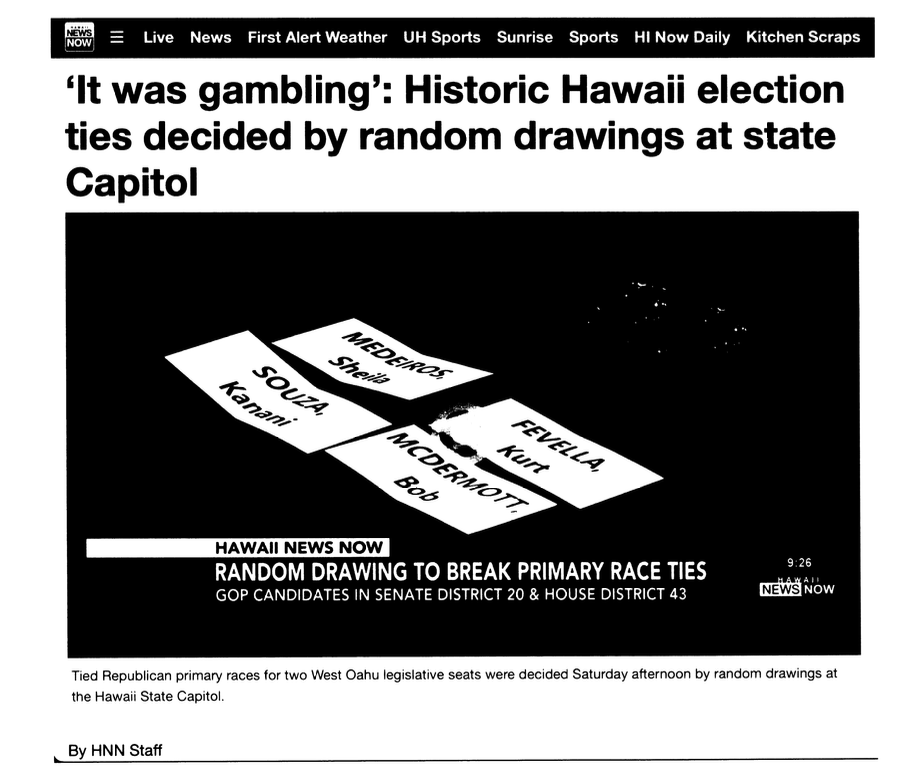
The novelty of Hawaiʻi’s tiebreaker was noticed by no less than The New York Times, which cited it in a front page story Aug. 28 on how some races in recent decades have come down to poker games, straw-drawing and picking cards from a deck.
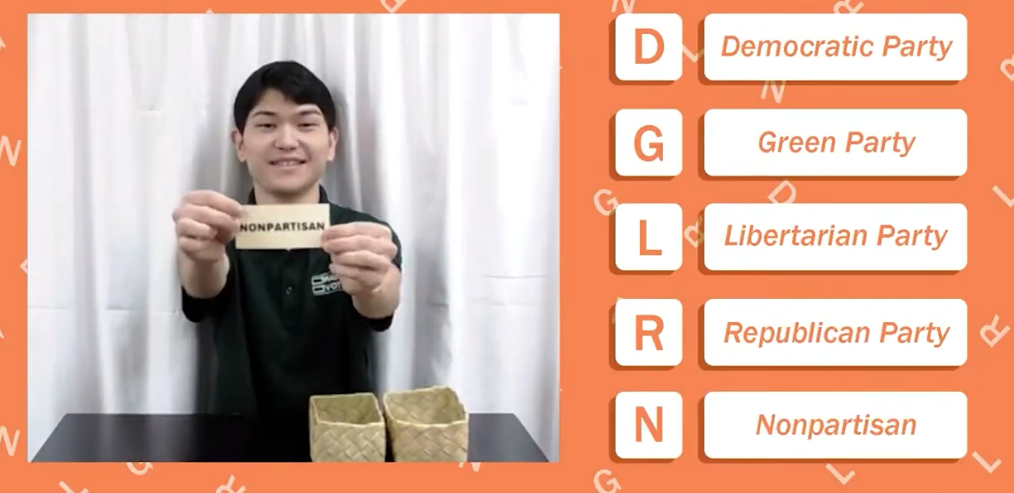
Nago defended his decision to go with the eggs and lauhala. After all, that is how the elections office in April determined the order of political parties on the primary ballot. (It used the same basket but did not use the eggs.)
The same method was also used as recently as Sept. 4, when the elections office randomly chose between two nonpartisan candidates to appear on the Nov. 3 general election ballot for Senate District 18. (You can read about that election kerfuffle here.) This time, the eggs were back along with the lauhala basket.
No one appears to have objected to either lot. But then, those drawings did not result in the election loss of two legislative incumbents.
Several of the justices seemed perplexed by the procedure used by Nago during questioning of him at the Sept. 2 court hearing at Aliʻiōlani Hale.
Acting Chief Justice Sabrina McKenna asked whether the eggs-in-a-basket method was tested so that it did not favor certain outcomes. Nago said he did not think so but argued that his office found that it worked better to put the slips of paper with names in capsules.
Associate Justice Todd Eddins asked whether there was any Hawaiʻi Administrative Rule or other standard procedure for how election ties should be broken. No, said Nago.
Eddins then asked whether Nago consulted the Hawaiʻi Elections Commission to seek public comment on the tiebreaker process. Nago did not.
And Associate Justice Lisa Ginoza asked why Nago decided to hold the tiebreaker the day after it was determined that the Souza-Medeiros race ended in a tie. Nago replied that it was the department’s “philosophy” to give notice to the candidates as soon as possible.
Was there any rule or procedure that required that to happen, asked Ginoza. No, said Nago, who later said he was not aware of any rule that would allow a candidate to object to the lot process.
Thomas Otake, Souza’s attorney, told the justices it was essential to have such rules and that they should be promulgated so that the public has the opportunity to weigh in.
“The point is that it’s too important to leave, respectfully, to Mr. Nago’s discretion about how to go about this without any input from anybody,” he said.
Without such a rule, Otake argued, the elections office would undoubtedly follow the same process in the event of another tie.
“There’s a number of ways to fix it, but what we cannot do is simply say there’s a narrow reading of Hawaiʻi Revised Statute 11-173.5 in a clinical case that says that the Supreme Court cannot do anything,” he said. “That just cannot stand.”
The justices agreed.
What’s Next
Raymund de Vega, who handles voter services for the elections office, said in an email Thursday that the office was “in the process of drafting the initial language for the rule.” It would then submit the proposed rule to the Hawaiʻi attorney general for approval.
In the meantime, there have been related developments in the wake of the tiebreaker turmoil.
On Wednesday Fevella asked the Hawaiʻi Supreme Court to consider whether there should also be a do-over election for Senate District 20.
That same day, Medeiros asked the court to reconsider its ruling ordering a new election for House District 43. By allowing for all voters in the district to vote between her and Souza on Nov. 3, she argued, it disenfranchises the Hawaiʻi Republican Party and the 1,684 Republican voters who voted in the primary Aug. 8.
Lastly, Ralph Cushnie and Tamara McKay, two of the eight members of the Hawaiʻi Elections Commission, issued a press release Thursday complaining that the state’s elections watchdog “has been locked out of its own room.”
That’s because the commission lacks a ninth member, a chair, and has deadlocked on finding one. It has not met since June 30.
“Hawaii just came through the most extraordinary election in memory,” they wrote, pointing to the tiebreakers, the fact that incorrect ballots were issued to two Oʻahu voters in those races as well as the ruling by the Hawaiʻi Supreme Court last month that a Honolulu City Council chair was ineligible to run for a third term — “after voters had already marked ballots bearing his name.”
Cushnie and McKay are asking that the commission, which appoints and evaluates the chief election officer and fields election complaints and concerns, be allowed to meet to elect a new chair so that it “can function again.”
Cushnie has repeatedly called for Nago’s firing, accusing him of mismanaging the 2024 general elections on Kauaʻi and the Big Island. Nago has denied any interference and defended his office.
Sounds like Cushnie and McKay are looking to break some eggs.
 Sign up for our FREE morning newsletter and face each day more informed.
Read this next:
Local reporting when you need it most
Support timely, accurate, independent journalism.
Honolulu Civil Beat is a nonprofit organization, and your donation helps us produce local reporting that serves all of Hawaii.
ContributeAbout the Author