Kirstin Downey: How 2 Hawaiʻi Civilians Exposed Historic Navy Scandal
Jim Maus and Ed Hanel Jr. teamed up to investigate Glenn “Fat Leonard” Francis. They helped bring him down, but were never officially thanked.
September 11, 2026 · 13 min read


About the Author

Civilian employees are crucial to the U.S. military. They handle logistics, contracting and other vital duties. They vary in their dedication to the job, but some are unsung heroes. In Hawaiʻi, two civilian employees working at Pearl Harbor — one a supply specialist and the other an attorney — were responsible for exposing one of the biggest scandals in U.S. Navy history.
We will get to their names in a moment. First — the villain they exposed and helped bring to justice.
As I recapped last week, Malaysian defense contractor Glenn “Fat Leonard” Francis systematically bilked American taxpayers of vast sums of money over three decades. He did so by bribing U.S. Navy officers throughout the Pacific theatre with gifts of fine wine, cash, luxury goods, Cuban cigars, lavish meals, blow-out parties and sessions with prostitutes.
Francis had developed a dense network of informants, learning the character defects of ambitious officers on the make, which allowed him to become a genius at capitalizing on the Navy’s weak spots and profiting from them.
As his knowledge of the Navy’s fleet operations grew, he had gradually run his competitors out of business, allowing him to operate as a near-monopoly in Southeast Asia. He became the largest single supplier of goods and services in far-flung ports unfamiliar to most Americans. And that, too, allowed Francis to pad the bills that U.S. taxpayers paid.

Publicly presenting a face of congeniality and enthusiastic American boosterism, Francis privately spoke contemptuously of service members he had ostensibly befriended. He found it easy to manipulate younger officers by underscoring his warm and deep associations with top admirals, frequently appearing as an invited guest in the VIP seating area at change-of-command ceremonies at Pearl Harbor.
Cornered in 2013, he was jailed but escaped and fled the country. Recaptured and sentenced in 2024, he is serving a 15-year sentence at a low-security federal prison in Southern California. He was ordered to pay $20 million in restitution to the Navy and forfeit another $35 million, though he has paid only about $5 million, according to the Washington Post.
Much of that is familiar now. What is less known is the full losses incurred by taxpayers. They were likely far greater than first estimated, possibly exceeding hundreds of millions of dollars. That’s according to the two Oʻahu men who helped bring Francis’s corruption to light.
Unassuming Whistleblowers
The two civilians, Jim Maus and Ed Hanel Jr., both now retired, tracked and recorded overcharges and financial malfeasance in the face of overt hostility and active resistance by some of their coworkers. That included a ring of active-duty U.S. Navy officers who had become Francis’s collaborators and spies, secretly advancing his interests over those of the people they had sworn to serve.
Some of the naval officers even called Francis “Boss.”
Francis, whose firm supplied U.S. Navy ships when they were in port calls, a business called “husbanding,” fought back as his schemes were being exposed, trying to get one of the two civilians fired and prosecuted. He almost succeeded.
Maus, who lives in Kāneʻohe, had begun systematically instituting reforms in the federal contracting system for ships in port, finding ways to save millions of dollars on a single visit. It quickly emerged that Francis had become a master at overcharges.
Fleet counsel Hanel, a Kailua resident, had helped create the position that Maus landed. He shielded Maus from Francis’s efforts to undermine him, helped implement his reforms and ultimately arranged for the enactment of a new ethics code that clarified what kinds of behavior were crossing the line.
The two men’s work on the financial management side happened at the same time federal investigators were separately and secretly laying the groundwork for what became years of prosecutions for Francis and his collaborators. That led to more than three dozen convictions of service personnel. The prosecutors also found it difficult to determine who was, and who was not, on Francis’s payroll.

Ideas showcases stories, opinion and analysis about Hawaiʻi, from the state’s sharpest thinkers, to stretch our collective thinking about a problem or an issue. Email news@civilbeat.org to submit an idea or an essay.
Civil Beat covered the court maneuvers between 2017 and 2019. But the deeper details of the saga came to light in a book published in 2024 by Washington Post reporter Craig Whitlock, “Fat Leonard: How One Man Bribed, Bilked and Seduced the U.S. Navy.”
Whitlock’s book noted the significance of the two men, but other than that, their role in exposing one of the biggest scandals in naval history has never received the attention it deserved. Last week I interviewed them to learn more about how they did it.
Job ‘Was Written For Jim’
Maus, a former Navy captain, was born in Northern California. He joined the Navy in 1977 and briefly considered a career as an aviator before entering the supply corps at Air Station Miramar in San Diego, where he supported a F-14 fighter squadron operating in the TOPGUN hangar, surrounded by storied Vietnam War fliers.
Over the next 30 years, he served on eight Western Pacific deployments, which took him to ports all over Southeast Asia, finally rising to the post of chief of logistics for Naval Air Forces. He once calculated that he had spent 10 years of his life at sea.
Maus retired in 2008. He joined Francis’ company, Glenn Marine Defense Asia, as chief of operations in Singapore. He stayed there less than a year. When the recession hit and the company reduced its workforce, Maus was laid off with a $75,000 severance and a warm letter of thanks.
Maus quickly got a job offer in Pearl Harbor from Rear Admiral Thomas C. Traaen, chief of staff, logistics, fleet supply and ordnance for the U.S. Pacific Fleet, who was looking for someone who was an expert in ship husbanding — serving as a fixer and project manager for ships when they arrive in port — in Southeast Asia. Traaen had heard reports about some odd billing issues there and he wanted to make sure costs were being well managed. For Traaen, Maus’ stint as a contractor, combined with his decades of naval experience in Far East ports, made him a perfect hire.
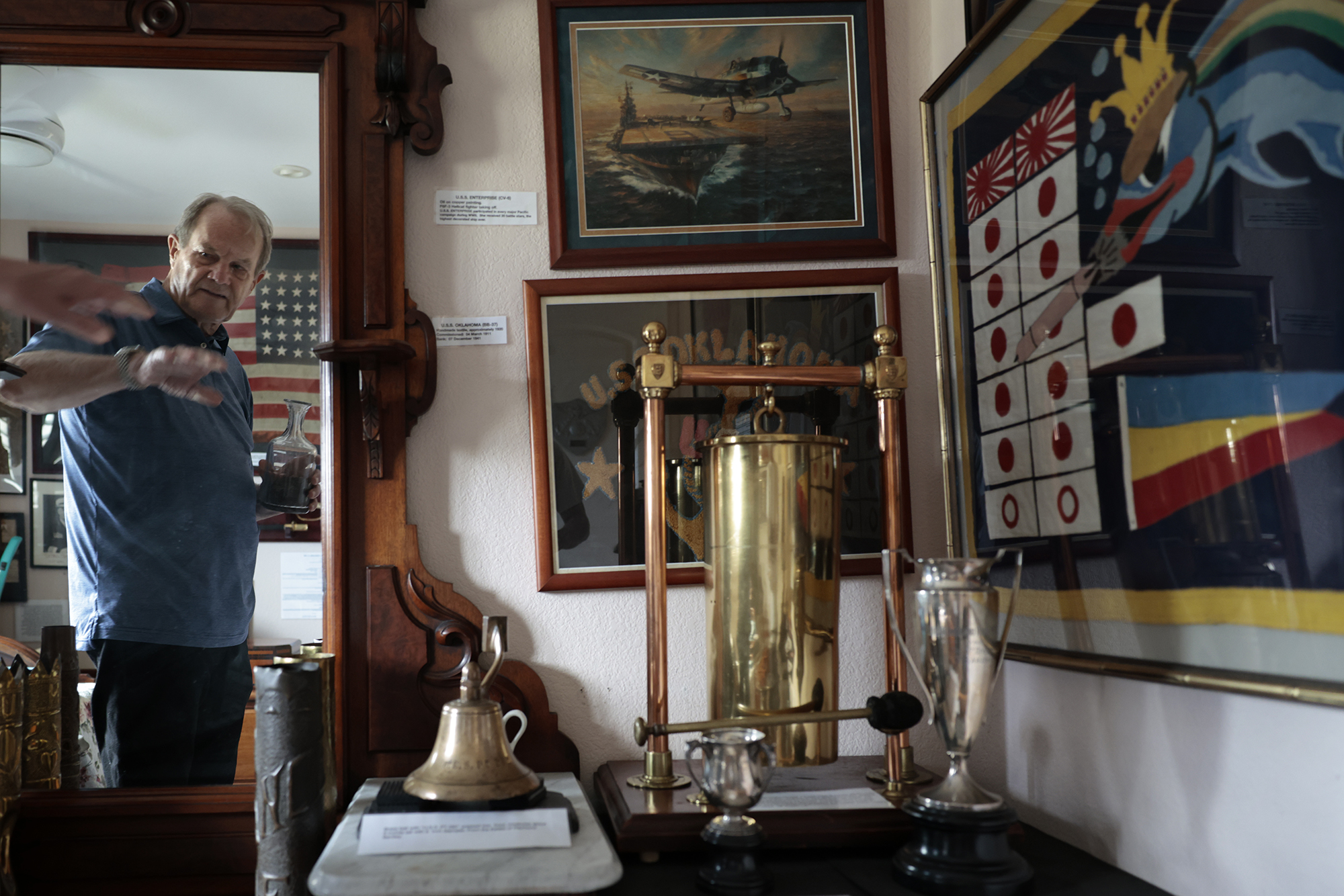
“This was a place he had a hole in his staff,” the attorney, Hanel, recalled this week. “He didn’t have anybody who could say, ‘I know,’ because he had worked as a contractor for husbanding … So it was like this job was written for Jim, for crying out loud.”
Hanel, who lives in Kailua, was raised in Tacoma, became a lawyer and joined the Navy’s office of general counsel, eventually becoming the top civilian lawyer at Pacific headquarters. He too brought valuable experience because he had been involved with ship husbanding contracts in Europe, giving him useful perspective as events began to unfold.

Once established in Honolulu, Maus quickly initiated a program of what he called “cost avoidance.” He applied the concept equally to all maritime suppliers. Inevitably it ended up costing Francis the most because, over the years, he had become the only provider of U.S. Navy husbanding services in entire countries or regions.
Under established law, if a contractor thought of a service, got a Navy officer to agree to it, performed the service and then billed for it, the Navy was obligated to pay promptly. This often happened on the fly.
Francis was a deft hand at dreaming up new services the Navy should buy. He could run circles around young naval officers new to far-flung ports who feared being held responsible for errors but who were not held accountable for rising costs. The Navy could appeal the contractor’s charges but clever lawyers in New York and Washington, D.C. were adept at finding ways to justify the expense.
In some cases, the naval officers had real cause for concern. The bombing of the USS Cole in Yemen in 2000 killed 17 crew members and was followed by the September 11 attacks. This made Navy officers eager to authorize any expenditure they believed would make them safer.
But sometimes they were willing to pay too much for a sense of security, and Francis found ways to exploit their fears.
Overbilling For U.S. Navy Sewage Pumping
Maus applied a lifetime of experience to the challenge at hand. He put together a four-person team to coordinate efforts, and began hosting a regular weekly meeting, held at 11 a.m. Honolulu time every Wednesday, requiring participation across time zones, through phone or video conferencing. He gathered together officials at the Pentagon and in Pearl Harbor, San Diego, Japan and Singapore, among other ports and offices. He initiated real-time, cross-command communication for Pacific ship husbanding.
Maus’s goal was to systematically monitor each purchase and help ship supply experts eliminate the unnecessary or overly costly ones.
Maus also required officers on ships in the Pacific to divulge details about charges they were reluctant to share with naval officers stationed elsewhere. Hanel often attended the meetings to provide legal oversight and he noticed that Maus often had to ask repeatedly to get specific answers about expenses that some people did not want to reveal.
It turned out to be a target-rich environment. For example, Francis’s firm charged the Navy for sewage pumping, but the Navy had no way to track the quantity he was handling, which allowed him to overbill. Maus arranged for flow meters to be installed on the ships so it could be measured. Ships purchased fuel at port from Glenn Defense at prices he set rather than at lower-cost locations. Once they learned Francis was charging $1 million for the use of a specialized barge that could be rented for $8,000. Maus’s team also found instances of outright fraud.
“This was our rallying cry,” Maus recalled last week. “I told my young officers, ‘Boys, the only way we will win is persistence. We’re going to put a thumb on them and not let go.’ ”
Soon lots of people began to notice, and some were forced to acknowledge how much the bills had been padded. Each cost-avoidance measure reduction had a multiplier effect because it could be replicated on other ships in the Pacific.
Maus and Hanel knew that Francis would lawyer up when their cost-cutting initiatives began to cut into his profits. Hanel, the lawyer, was careful to make sure everything was being done by the book.
Together they saved the Navy more than $100 million dollars in just the first two and a half years of their regular review, between 2009 to 2011, much of it attributable to Fat Leonard services, according to Maus and Hanel.
Francis grew increasingly angry. He knew what was happening in the meetings because he had informants participating in them, according to Maus, Hanel and federal prosecutors.
Francis tried to get Maus fired, or better yet, both fired and punished, according to Whitlock. He met with top officials and told them that Maus was a disgruntled former employee with a vendetta against him. Francis hired a lawyer who wrote a 40-page letter demanding that Maus be let go.
Hanel supported Maus, responded with a stern letter to Francis’s lawyer and spoke to senior officials in his defense. Maus didn’t know about the campaign at the time but learned about it afterward.
“He saved my butt,” Maus said. “If it hadn’t been for Ed, I would have been fired.”
Did “Fat Leonard” Squirrel Away Millions?
Finally the Naval Criminal Investigative Service began closing in on Francis, following up on a tip from an aggrieved Navy wife whose husband was patronizing Francis’s bevy of prostitutes. Their investigation was slowed because a NCIS supervisory special agent working at the agency headquarters in Quantico, Virginia, was part of Francis’s network. Eventually the U.S. Department of Justice stepped in.
Francis had become immensely wealthy. He had managed his sprawling empire almost as a sole proprietor, keeping his accounts close to the vest and private. When he was arrested, his business abruptly collapsed.
Both Hanel and Maus both think Francis likely squirreled considerable money away. Once the NCIS and Justice Department prosecutions were well underway, the two men tried to provide them with evidence of how extensive taxpayer losses had been. Francis had sold some assets in Singapore alone for $60 million, they recalled.
“Jim Maus and Ed Hanel top the short list of Navy officials who acted with integrity …”
Craig Whitlock, Washington Post reporter who has covered the “Fat Leonard” scandal for years.
And they had assembled information showing $100 million in overcharges in less than three years. Francis had done business with the US Navy for more than three decades, suggesting the likelihood of much more ill-gained profits.
Maus and Hanel were disappointed that federal investigators showed little interest in estimating the full extent of losses. They were dismayed when the prosecutions in San Diego went awry. And they never got the official recognition they deserved.
“There aren’t many heroes in this story,” Whitlock said in an interview this week. “But Jim Maus and Ed Hanel top the short list of Navy officials who acted with integrity and helped bring down Leonard Francis. The Navy has never publicly acknowledged their role or thanked them for defending and protecting the service. That recognition is long overdue.”
Both men say they feel great satisfaction in their teamwork. Maus praised Hanel for his savvy legal advice. Hanel said that Francis was a clever businessman but that he had met his match in Maus.
“Jim is probably the most business astute naval officer that I’ve ever known,” Hanel said. “He really did think like a corporate CEO — not as a navy officer — but like the CEO of a company like Coca-Cola. You know, they’ve got Coca-Cola all over the world. They’ve got to keep some kind of control over that.”
 Sign up for our FREE morning newsletter and face each day more informed.

Local reporting when you need it most
Support timely, accurate, independent journalism.
Honolulu Civil Beat is a nonprofit organization, and your donation helps us produce local reporting that serves all of Hawaii.
ContributeAbout the Author