An Urgent Plea For Safer Roads In Mānoa
Strolling down a valley avenue is very risky when cars are incessantly speeding.
October 19, 2026 · 3 min read

About the Authors



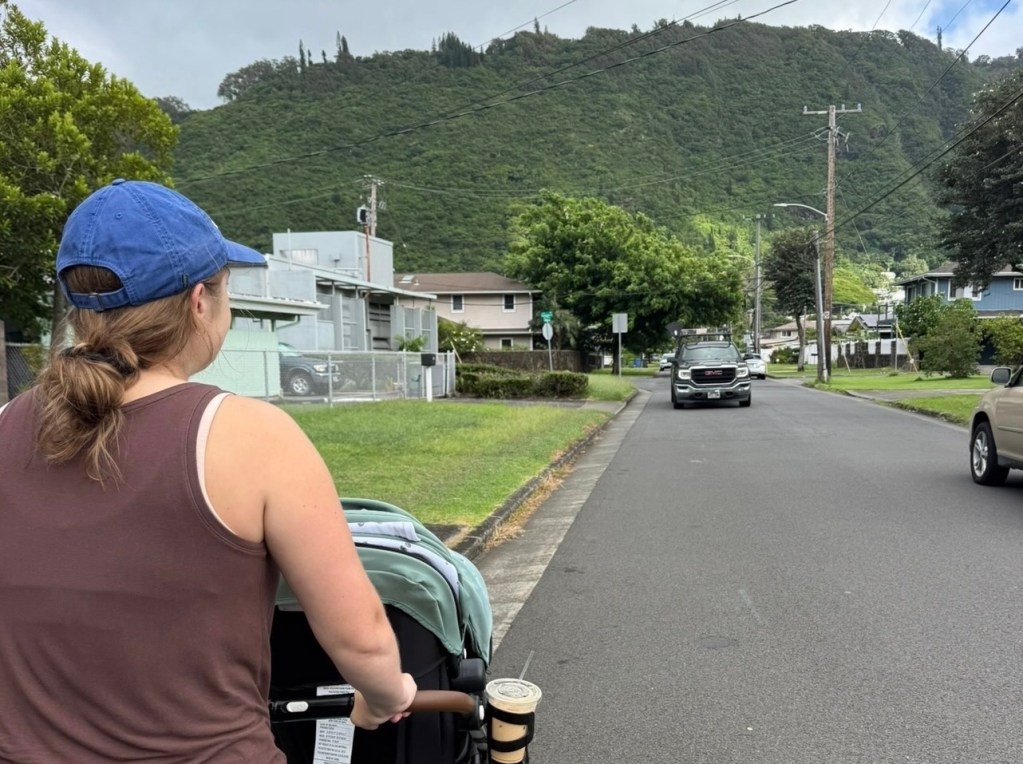
The beautifully grassy and panoramic Lowrey Avenue is Mānoa Valley’s only fully east-to-west corridor. Hence, Lowrey Avenue becomes a necessary thoroughfare for many residents and visitors to reach Mānoa’s homes, shops and infrastructure.
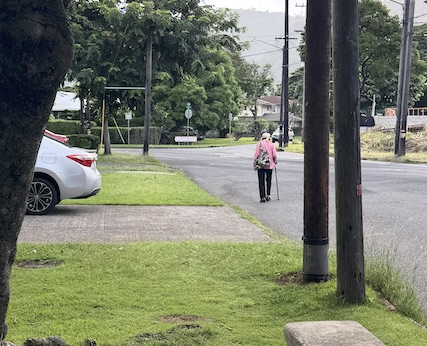
It lies one block makai of Mānoa Elementary School and Mānoa Valley District Park, which on an annual basis ranks atop O‘ahu’s most used district parks. Yet Lowrey’s 0.3-mile main stretch, between Mānoa and East Mānoa Roads, has neither sidewalk nor pedestrian infrastructure.
Needless to say, substantial safety issues arise.

Ideas showcases stories, opinion and analysis about Hawaiʻi, from the state’s sharpest thinkers, to stretch our collective thinking about a problem or an issue. Email news@civilbeat.org to submit an idea or an essay.
You can spot residents in wheelchairs, young students, kūpuna and parents with strollers traversing Lowrey’s roadway. They’re often dodging speeding cars. For those hoping to enjoy brief trips without a vehicle, Lowrey Ave presents a difficult transportation question.
How does a community balance disability access, neighborhood character, vegetation, drainage, traffic and heat with all the ways we use roads?
Last April, Mānoa Neighborhood Board passed a resolution supporting sidewalk construction, including on Lowrey Ave. This fulfilled a decade of advocacy by resident and now-board member Dylan Armstrong, who surveyed supportive Lowrey residents in 2017, and Diane Chong.
Since April, the board reconsidered and voted against its document following petitioning by 14 residents, one a Lowrey resident.
Unfortunately, the office of Honolulu City Councilmember Scott Nishimoto revealed in the board’s June meeting minutes that this reversal cost Lowrey Ave its sidewalk funding in the City budget: “Vice Chair [Christopher] Moylan asked… [if] the sidewalk CIP request would have been funded had the board’s resolution [stood]… the office had made the request but withdrew it.”
If community factions feel “tread upon” by sidewalk-talk, can other pedestrian and disability access solutions help?
This year, an SUV driver killed an 82-year old Lower Mānoa pedestrian, and a driver seriously injured a 29-year old man at University Avenue. Driver speeding and inattentiveness both increase road casualties.
Lowrey traffic data from 2024 reveals that 15% of drivers sped, as much as 28% above the 25 mile-per-hour limit. Surveys found comparable speeding on adjoining streets.
Every 5 mph faster in a collision will exponentially raise injury and death risk. Thus, traffic calming improves safety.
Moreover, could the wide shoulders of Lowrey Ave at East Mānoa Road be striped and set aside for at-grade, pedestrian use?
Which solutions might suffice, politically?
We are Mānoa residents spanning 40 years of generational diversity. Two of us grew up here, now raising our own kids. Two have moved here.
It’s time for reasonable, humane action.
One already reared two fully-grown Mānoa keiki o ka ‘āina. One presently dwells on Lowrey Ave. Another lived there before. Two have served on our neighborhood board.
A well-educated group, we wish to use that privilege to support fairer, safer living for all.
A rat’s nest of clashing policies has failed to safeguard and empower residents equally. We are reminded of that whenever a family with a stroller struggles on the roadway, when the resident in a power chair is obligated to navigate hazardous roadway to reach Mānoa Marketplace, and when a car rips across the valley.
It’s time for reasonable, humane action. We will relentlessly advocate for change until everybody enjoys fair-and-safe transportation.
You can support our efforts by emailing testimony to Mānoa Neighborhood Board at nbtestimony@honolulu.gov.
 Sign up for our FREE morning newsletter and face each day more informed.
Community Voices aims to encourage broad discussion on many topics of community interest. It’s kind of a cross between Letters to the Editor and op-eds. This is your space to talk about important issues or interesting people who are making a difference in our world. Column lengths should be no more than 800 words and we need a photo of the author and a bio. We welcome video commentary and other multimedia formats. Send to news@civilbeat.org. The opinions and information expressed in Community Voices are solely those of the authors and not Civil Beat.
Read this next:

Local reporting when you need it most
Support timely, accurate, independent journalism.
Honolulu Civil Beat is a nonprofit organization, and your donation helps us produce local reporting that serves all of Hawaii.
ContributeAbout the Authors