Beth Fukumoto: Hawaiʻi Should Mend Ballot Process That Bred Recent Fiascos
Until lawmakers act, voters would be wise to use BallotTrax to make sure their ballots are counted.
October 12, 2026 · 7 min read

About the Author

In August, Hawaiʻi’s Office of Elections broke two tied Oʻahu primaries by drawing plastic capsules from a lauhala basket. One result stands. The other goes back to voters on Nov. 3.
It didn’t have to come down to a basket, or a court fight, to pick a winner. One more counted vote would have broken either tie.
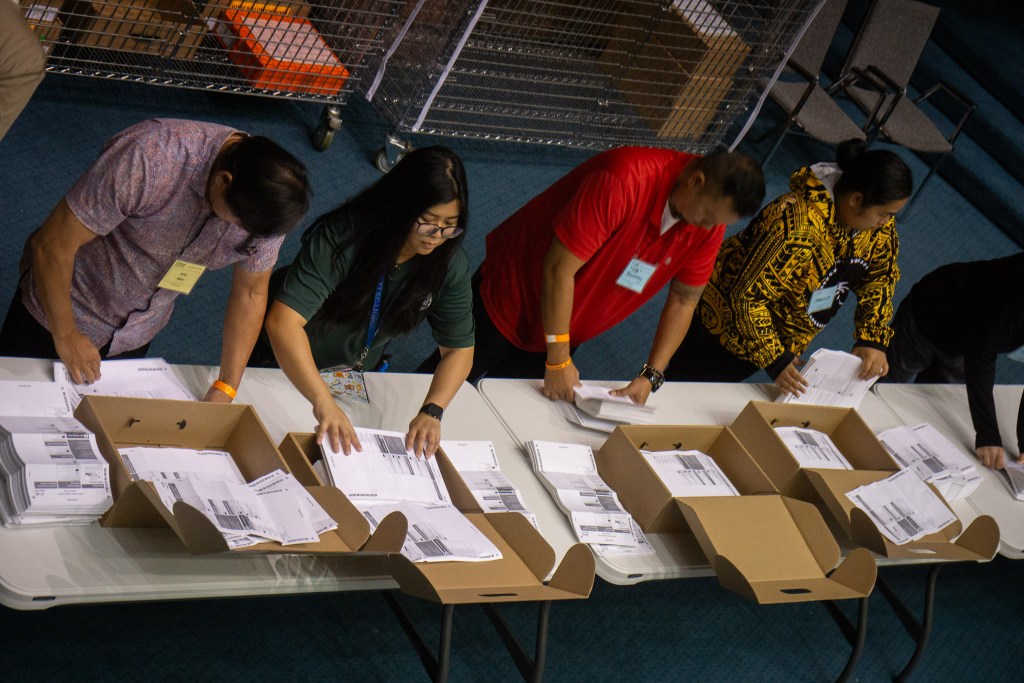
The day after the primary, the state listed 36 mail envelopes in House District 43 as “invalid,” which often means a ballot was flagged for a signature problem. Voters whose mail ballots were flagged had until Aug. 14 to fix them. The morning after the deadline, 33 envelopes were listed as invalid.
What we don’t know is the votersʻ party affiliations, whether they were contacted and how many unfixable ballots were simply late or canceled. Flagged envelopes stay sealed unless they’re fixed. Still, we do know that between the recount and the final count, the race gained just three mail votes, one for District 43 incumbent Kanani Souza and two for challenger Sheila Medeiros. That was enough to turn Souza’s one-vote lead into a tie.
For this upcoming election, voters can make sure their own ballots are counted by signing up for BallotTrax, which tracks your ballot and notifies you if there’s an error you need to fix. But most other solutions are up to the Legislature, which has left the rules for fixing ballots, breaking ties and sharing election information unclear enough that the state Supreme Court has already urged lawmakers to fix one of them and ordered Chief Election Officer Scott Nago to write rules for another.

Ideas showcases stories, opinion and analysis about Hawaiʻi, from the state’s sharpest thinkers, to stretch our collective thinking about a problem or an issue. Email news@civilbeat.org to submit an idea or an essay.
Fixing a flagged ballot is called curing. When a mail ballot envelope comes back unsigned, with a signature that doesn’t match the one on file or with “another condition that would not allow the counting of the ballot,” the county clerk must “make an attempt to notify the voter by first class mail, telephone or electronic mail,” and the voter has five business days after the election to fix it.
That’s about all the statute says. Results can keep coming out while voters are still curing, and a clerk’s failure to reach a voter “shall not be grounds for a contest for cause.”
The reporting is just as thin. The state’s daily voting reports list “invalid” envelopes without saying what makes an envelope invalid, Honolulu’s detailed cure numbers come out months later, and when I asked about House District 43, the city’s elections office told me it is “unable to confirm, by district and precinct,” how many envelopes were flagged or fixed.
Oregon And Arizona Offer Alternatives
Other states give voters and campaigns more to work with.
Arizona requires county recorders to send qualified political parties a daily list of voters with signature problems. Oregon keeps those names private until the 15th day after an election, then allows their release while voters still have several days to fix their ballots.
In Honolulu, the elections office told me it “does not compile a list identifying voters whose ballot return envelopes have been flagged for signature-related issues.”
A list like that raises fair privacy questions, but Oregon’s delay and Arizona’s list for parties show they can be answered. Hawaiʻi could also make BallotTrax opt-out instead of opt-in, as Maui County did in 2024, and require counties to report flagged and cured ballots by district once the window closes.

The District 43 case revealed other gaps, too.
On primary day, two voters registered in a District 40 precinct were mistakenly handed ballots for a District 43 precinct. That created a two-ballot overage in the House district and denied two Senate District 20 voters a vote for state senator in a race that ended tied.
State law requires a list of overages and underages to be kept as a public record, but the Supreme Court called the law “confusing and ambiguous.” Compiling the report took elections staff about four hours, and the court said it “could have been and should have been publicly posted and made available to candidates long before election contest deadlines.” As of Oct. 10, the primary’s report still wasn’t posted on the state’s results page.
Kurt Fevella’s case shows why that matters. Kanani Souza asked for the overage report two days after the drawing and challenged the House result in time. Fevella, who lost the Senate drawing, didn’t file until Sept. 9. He argued that the two lost votes could have changed his tied race, and the court agreed that one vote could have, but it unanimously turned him down, saying he “could also have proactively requested information after learning of the tie.”
Under current law, the court noted, nothing required that the report “be publicly posted or that the public or candidates involved be timely notified.” In my view, that’s the problem. When election officials know about an error that could change a result, it shouldn’t be up to a candidate to go looking for it.
District 43 Do-Over Election Is Problematic
The House re-run has its own problem. The Nov. 3 ballot will label the race “Republican Party Voters Only,” but no voter has to declare a party, and all of the district’s roughly 16,600 registered voters will get the race on their ballot. Only 1,684 votes were cast in this race during August’s Republican primary, and I’m pretty sure the vote count will be higher this time.
I support all-party primaries, where every candidate is on one ballot, every voter can take part and the top two advance even if they share a party. That’s close to what this re-run is since our voters don’t register by party, and there’s no way to enforce the “Republican Party Voters Only” rule.
My guess is that it will favor Souza, who has had some very public breaks from her party. But that system is a major departure from what we have now — a primary where voters can choose only one party’s ballot. On Nov. 3, Democrats and independents could determine which Republican represents House District 43 simply because the courts had to step in.
Lawmakers Need To Address This
All of this points to the same problem. Hawaiʻi has been too reluctant to implement election reforms and leaves too much of its election law undefined.
Our cure law ends with a catch-all, “another condition that would not allow the counting of the ballot,” and when I asked Nago what it covers, he said he wasn’t sure, though he suspects “the Legislature put that in as a catch-all.” Our tie law says only “by lot.” Our overage law requires a public record but not a public posting.
Other states have already filled in many of these details. Oregon gives voters 21 days to fix a flagged ballot and allows the list of those voters to be made public partway through, while Arizona sends one to the political parties every day. Maui County showed that BallotTrax can sign everyone up unless they opt out.
On ties, most states draw lots as we do, but according to the National Conference of State Legislatures, 12 states call a new election instead, and Missouri and Texas let tied candidates agree to draw lots rather than hold one. And on overages, the Supreme Court has already pointed the way: The report could have been posted soon after the deadline to fix ballots, long before candidates had to decide whether to challenge a result.
The Office of Elections received a lot of criticism for the drawing, and as ridiculous as it looked, I think a drawing is a perfectly valid way to settle a tie.
Nago’s office has now proposed a rule, with a public hearing Oct. 26, that spells out how to run one. But a lot should happen before a race goes to chance: making sure flagged voters were reached, checking the overage report and deciding when a tie should go back to voters instead.
Lawmakers should write those steps into law when they return in January. Until then, voters can sign up for BallotTrax and watch their own ballots, so their votes are counted before anyone reaches for the basket.
 Sign up for our FREE morning newsletter and face each day more informed.
Local reporting when you need it most
Support timely, accurate, independent journalism.
Honolulu Civil Beat is a nonprofit organization, and your donation helps us produce local reporting that serves all of Hawaii.
ContributeAbout the Author