Makana Eyre: Polynesian Health Overlooked In Buzz Over Landmark Study
The study provided insights into the origins of Native Hawaiians. More consequential is what this “genetic treasure trove” means for people with rare DNA mutations.
October 26, 2026 · 6 min read

About the Author

In 2017, Keolu Fox, a human geneticist at the University of California San Diego, began analyzing what would soon become an extraordinary collection of genetic information: the genomes of more than 1,000 Polynesians.
From the start, Fox and a team of colleagues worldwide knew they were creating an unprecedented dataset. They expected that analysis of these 1,050 fully sequenced genomes would shed light on how the Pacific was settled more than a millennium ago. And it did.
These scientists found evidence that ancient voyagers settled the far reaches of the region in a step-by-step migration process beginning at Mangareva, not the Marquesas as some scholars had believed.
But something else stunned him. It turned out that the migration process that allowed him to retrace the sequence of Pacific settlement — what he describes as genetic bottlenecks — also sharply increased the frequency of certain mutations. Some of these mutations cause disease. Many appear at unusually high frequencies among Polynesians.
“It was a genetic treasure trove hidden in plain sight,” Fox told me. And remarkably, all of it came from the genomes of just a thousand people.
The study that grew out of this research was published on the cover of Science earlier this month. It felt like a landmark. It made local, national and international news.
Yet the media coverage has been surprisingly narrow — and sometimes flat out false. Most of the stories have emphasized the study’s findings about how the Pacific was populated — an interesting yet partial telling of the story.
More bewildering is that some media — including Reuters, whose story was picked up by the Honolulu Star-Advertiser and other local outlets — have inaccurately claimed the study found that Hawaiians originated in Rapa Nui. Fox’s research did find a close genetic relationship between the indigenous people of Hawai‘i and Rapa Nui. But it did not conclude that voyagers from Rapa Nui settled Hawai‘i.

Ideas showcases stories, opinion and analysis about Hawaiʻi, from the state’s sharpest thinkers, to stretch our collective thinking about a problem or an issue. Email news@civilbeat.org to submit an idea or an essay.
What has gotten lost in all this coverage is what may be the most consequential part of Fox’s findings – the urgent and unmet public health implications.
While Fox and his colleagues didn’t specifically study mutations among Native Hawaiians, they did explore them in Tahitians. The discoveries are astonishing.
The researchers found that three mutations linked to serious inherited diseases occur at unusually high frequencies. These mutations can cause vision loss, early-onset dislocation of the eye’s lens, and an ultra-rare kidney disease that can result in renal failure.
What This Could Mean for Hawaiians
That inevitably raises a critical question: What could be lurking in the genomes of Hawaiians?
Fox strongly suspects that further study would reveal unidentified mutations and could help explain why the population appears to have greater susceptibility to inflammation, metabolic diseases, type 2 diabetes and autoimmune disorders.
While we wait for what Fox discovers, there’s a bigger lesson to take. Now that we have an indication that Polynesians could be at higher risk for certain inherited diseases, our state leaders should begin a conversation about how we should reform public health policy.
The findings make a strong case for exploring how Hawai‘i could introduce genetic screening for Polynesians.
Screening, Fox believes, is the most effective way to detect diseases early on and lead to direct recruitment into clinical trials.
This is hardly uncharted territory. The United States has several precedents for population-specific screening. We already screen the Amish — half the population size of Hawaiians — and people with Finnish or Ashkenazi Jewish ancestry for certain mutations.
So why not Hawaiians? Why not Polynesians? Without a satisfying answer, these questions speak to larger inequities in research and medicine.
Most genetic sequencing so far has been done on people of European ancestry. Any medical implications, then, relate primarily to them.
This leaves thousands of underrepresented communities largely invisible in medical research. What crucial information could be found in their genomes? What drugs could we develop as a result?
Of course, there’s the dilemma of how to ethically collect more diverse genetic data. Researchers can’t just extract it from people they’ve historically overlooked — and in some cases mistreated.
A New Model For Studying Populations
Fox is trying to build a different model. He’s an advisor at the biotech startup, Variant Bio, which seeks to turn genetic information from understudied populations into drugs.
Unlike other biotech firms, though, Variant Bio has established a benefit sharing policy with the communities that provide genomic data.
Since its founding in 2018, the company has signed major research partnerships with Novo Nordisk and Boehringer Ingelheim, a vote of confidence for their approach. It was also a research partner for Fox’s study, helping provide and analyze data.
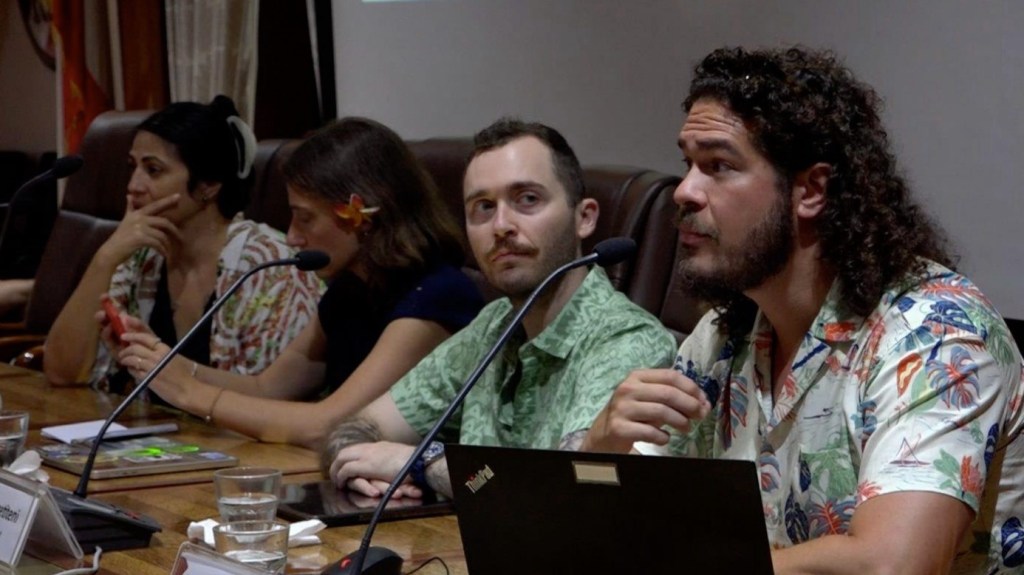
In some ways, the work of a human geneticist is like those early voyagers — neither fully sure what they might find or what they might do at the other end of the exploration. Science and society now have the obligation to make sure the journey ends safely.
There’s no doubt that many Hawaiians will find a great deal of interest in knowing about how their ancestors set out to sea and put down roots in Hawai‘i. Many non-Hawaiians who grew up in Hawai‘i — myself among them — are equally fascinated by what Fox has been able to demonstrate.
Ultimately, though, ending that journey safely — making the most consequential use of this research — means applying its findings to clinical practice. Now, it’s up to our policymakers to make it happen and for the public to demand it.
 Sign up for our FREE morning newsletter and face each day more informed.
Local reporting when you need it most
Support timely, accurate, independent journalism.
Honolulu Civil Beat is a nonprofit organization, and your donation helps us produce local reporting that serves all of Hawaii.
ContributeAbout the Author