How Keiki Are Rewriting The Rules Of Civic Engagement And Voting
Kids Voting Hawaiʻi has changed my life — giving me and other high schoolers a sense of hope and a grounding in the electoral system.
October 18, 2026 · 7 min read

About the Author
One of our nation’s greatest challenges is civic engagement – getting people involved in their community, volunteering, keeping up with the news, and taking other steps to participate in our democracy, including casting an informed vote.
Sadly, the United States ranks low in civic engagement compared to other countries, according to the Pew Research Center. Hawaiʻi, meanwhile, has the lowest voter turnout of any state. That’s one reason that Kids Voting Hawaiʻi is working to give young people a grounding in how elections work and prepare them for a lifetime of voting.
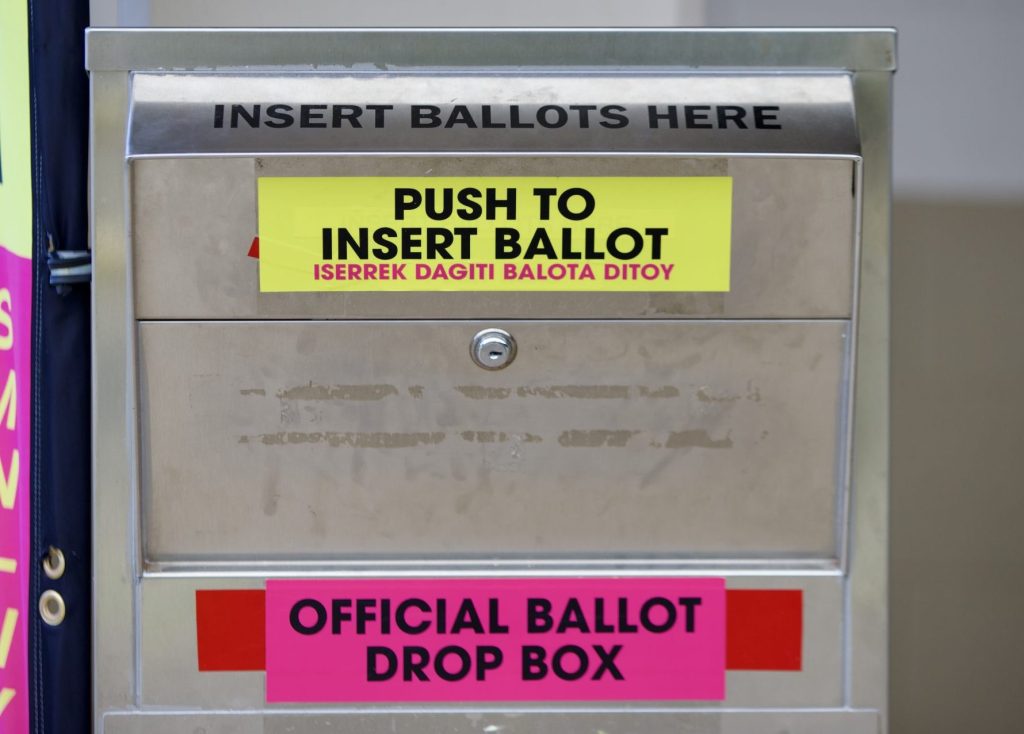
We are a group of high school students who seek to educate our peers and our parents about casting votes, partly by organizing mock elections – in which students register to vote, research candidates and issues, and vote like their parents would, although with results that are unofficial.
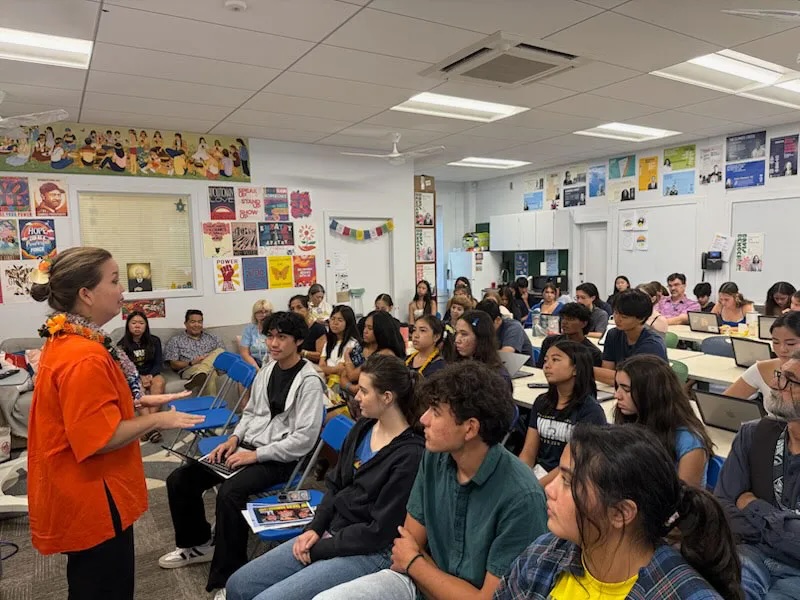
Many of our friends and family ask: Why do we do it? Part of the answer is we want to fight against indifference. I was once one of those uncertain if I could have an impact. Young people can make a difference. We already are.
Kids Voting Hawaiʻi is an affiliate of Kids Voting USA, a nonpartisan voter education program that started in Arizona in 1988. It was launched after three of its founders visited Costa Rica and were stunned by the high turnout there, over 80% at that time.
It has since expanded nationwide. In 2024, more than 345,000 students voted in KVUSA elections, making the point that every vote counts.

Kids Voting Hawai‘i began in 1996 with 18 schools in the Farrington and Baldwin complexes in Maui. Two years later, we expanded statewide with 237 schools under the direction of Lyla Berg. Some 50 Rotary Clubs across the state helped staff official polling sites for keiki. American Savings Bank was our primary sponsor, and the Office of Elections printed education materials for students and the community.
Aloha Airlines flew the physical ballots thrice a day from the outer islands to O’ahu, where they were tabulated, and the results were presented. Voting was digitized in 2002.
Since then, the Civic Education Council has played a pivotal role in KVH’s success. They organize our ballot, manage relations with HDOE, and more. None of this would be possible without their support.
We held our first student-run election in 2024 with the support of the Civic Education Council and the Davis Democracy Initiative, where roughly 35,000 students voted, representing nearly 20% of students across Hawaiʻi.
Our work led to Hawaiʻi having the highest voter turnout percentage in the entire nation in Kids Voting USA! Now, we’re gearing back up for the 2026 midterms. And we’re shooting to break our record.
Twice a week, I find myself huddled in a classroom along with the rest of the KVH Student Leadership Committee: Lulu Cole ‘27, Riley Joe ‘28, and Ren Taira ‘28. Over tea and donuts, we’ve been laying out our game plan for the 2026 midterms.
Lulu works with school-level ambassadors and schools across the state to get their schools registered to vote, and Riley champions our publicity team and public outreach. Ren heads our sticker competition – in which students prepare their own original stickers that say, “I voted” – that runs prior to our election.

In 2024, we distributed around 60,000 stickers and over $250 in prize money. This year, with over 45 submissions, our judge panel – Ren, Solomon Enos, Kamakani Konia, and Mark Recktenwald – selected the five finalists. Then, the public voted on our winner, choosing the submission by Lexus-Jane Crawford ‘30. Her winning design will be sent to schools across the state.
As KVH’s Elections Director, I’ve been writing questions that will appear on our ballot. I wanted the topics covered to be relevant to the issues affecting keiki, so the ballot will explore areas such as law enforcement duties, AI usage and social media restrictions.
I’ve also been coordinating interviews with the congressional and gubernatorial candidates; we have met with Adriel Lam, a Republican running for the 1st Congressional District, and the two candidates running for the 2nd Congressional District, Republican Brenton Awa and the Democratic incumbent, Jill Tokuda. Their answers will be distributed statewide along with other civic education resources and our ballot materials to the school-level ambassadors.
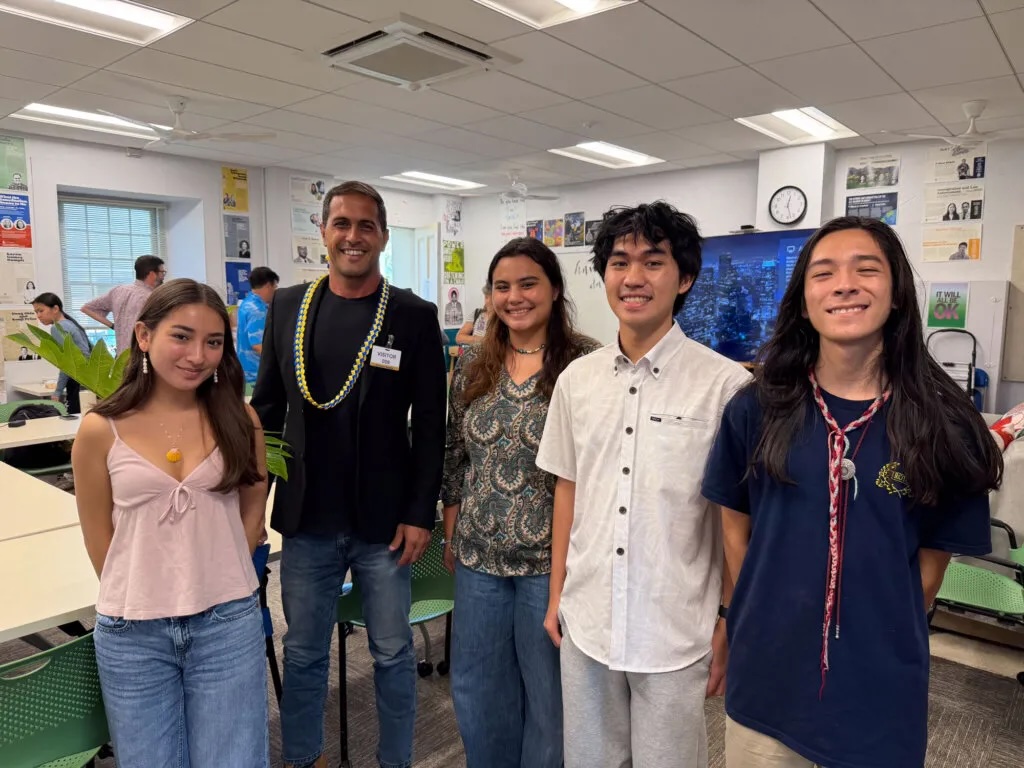
Lulu, Riley, Ren, and I have been working on this since October 2025, and we’ve put in innumerable hours.
My first experience with Kids Voting Hawaiʻi was in my freshman contemporary issues class. Every day we’d cover the most recent news cycles, and I couldn’t help feeling hopeless. The world was still burning, war was still rampant, and what could a 14-year-old do about it?
I found myself infected with one of the most malignant maladies: apathy. This continued until late October when my teacher handed out little slips of paper to everyone.
“Today we’ll be voting with KVH,” my teacher announced. “You’ll get to decide who wins.”
I returned to class a week or two later and learned that the candidate receiving my vote had lost by less than 1,000 votes. If half a percent more students had voted the same as me, the candidate would have won.
Again, I was sad. But I also learned something new. A handful of votes could change everything.
These kinds of small margins have swayed the passage of bills, the election of legislators and who sits in the Oval Office. Sure, staying on the sidelines is the easiest option. But that is not how change is made.

In 2024, I was at an election watch party hosted by the Davis Democracy Initiative. For the entire day, the room was packed with people of all ages.
Middle schoolers would color maps, predicting who would win each state, while high school students gave presentations about foreign policy and election predictions. The KVH Student Leadership Committee discussed how civic education extends beyond the classroom.
A study from Tufts University found that when high school teachers teach about voting, students were half as likely to believe “voting is a waste of time.” Another study found that taking a government class in high school boosts voter participation by 7 to 11 percentage points for students whose parents are not politically active.
“E pluribus unum.” Out of many, one.
If you’ve ever examined the coins in your pocket, you’ve probably seen this phrase. Penned for our nation during its founding, it represents not only the unity of our people, but also the power of our votes. Your ballot will go on to shape local, state, and national outcomes; it will affect the lives of millions.
So the next time you go to vote, whether it be with KVH, in a midterm, or a presidential election, you should remember: Every single citizen of the United States is granted the power to change the world. So don’t waste it.
 Sign up for our FREE morning newsletter and face each day more informed.
Read this next:

Local reporting when you need it most
Support timely, accurate, independent journalism.
Honolulu Civil Beat is a nonprofit organization, and your donation helps us produce local reporting that serves all of Hawaii.
ContributeAbout the Author