Watching Paris Burning From Hawaiʻi
I wouldn’t let my Kohala High School students draw conclusions without facts. But world leaders do it regularly, and too often get away with it.
October 27, 2026 · 6 min read

About the Author

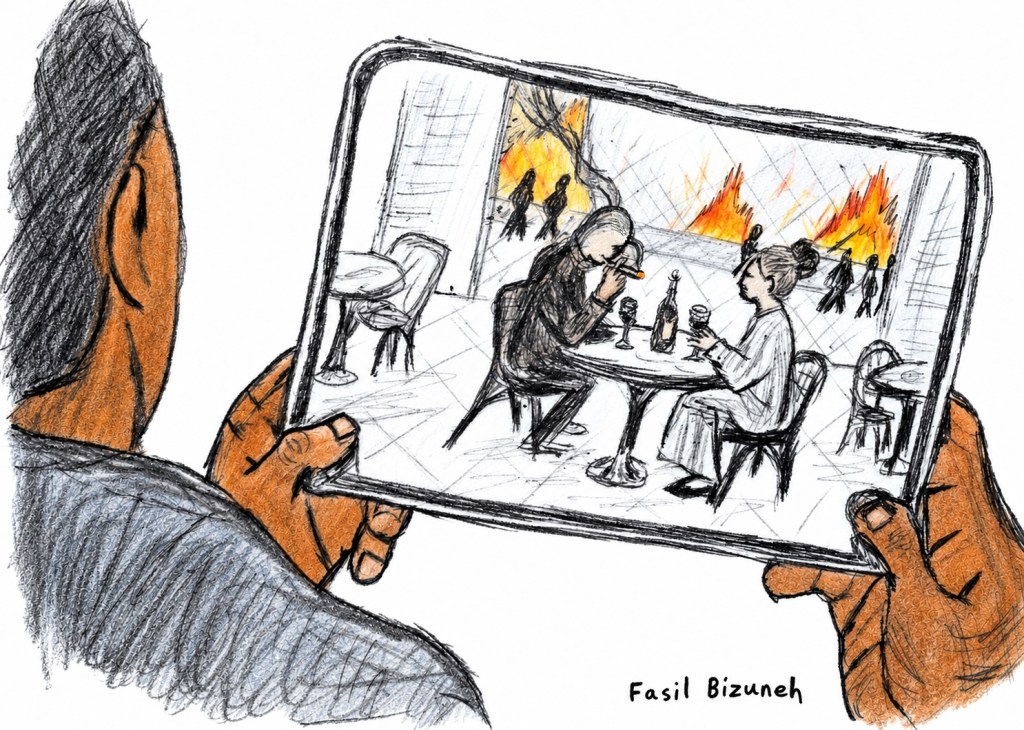
The window glass is thick enough to muffle the sirens, but not the heat. Inside, the bistro tables are marble and steady, crowded with the modest architecture of an ordinary evening: half-empty wine glasses, a ceramic ashtray, a small amber glow at the tip of a cigarette.
Outside, the street has been handed over to the fire. Flames lick upward against the stone facades, throwing long shadows across the pavement where the crowd moves like smoke: urgent, indistinct. The older French couple continue their conversation after dinner. Throughout the now-viral video, neither turns to look outside. The video was recorded on October 17 at a café near the Arc de Triomphe in central Paris.
I wanted the image to reassure me. The couple’s composure seemed to say that the spectacle outside was less threatening than it looked. But I did not know whether they felt safe, supported the demonstrators, or simply wanted to finish their conversation. I did not want to draw conclusions from a recording of people, thousands of miles away.
I am watching from North Kohala, on Hawaiʻi Island, where my conversations are about what time to meet for spearfishing this weekend. I, too, am behind glass watching someone else’s fire on a screen.
My misreading costs no one anything. President Donald Trump and Prime Minister Benjamin Netanyahu of Israel watched the same fire and drew conclusions they asked their audiences to act on. Trump’s party faces voters on November 3; Netanyahu is campaigning for an election of his own. Each treated the unrest as proof of policies he already favored. Mine was a feeling. Theirs was a claim, backed by power.
Protests Fueled By A Range Of Issues
The images of burning bins and shattered storefronts traveled around the world, often detached from the grievances that brought people into the streets. Hundreds of thousands of people demonstrated across France on October 17 over the cost of living, deteriorating public services, school conditions and inequality; most marched peacefully while smaller groups engaged in looting, arson and confrontations with police. A second round of protests occurred Saturday.
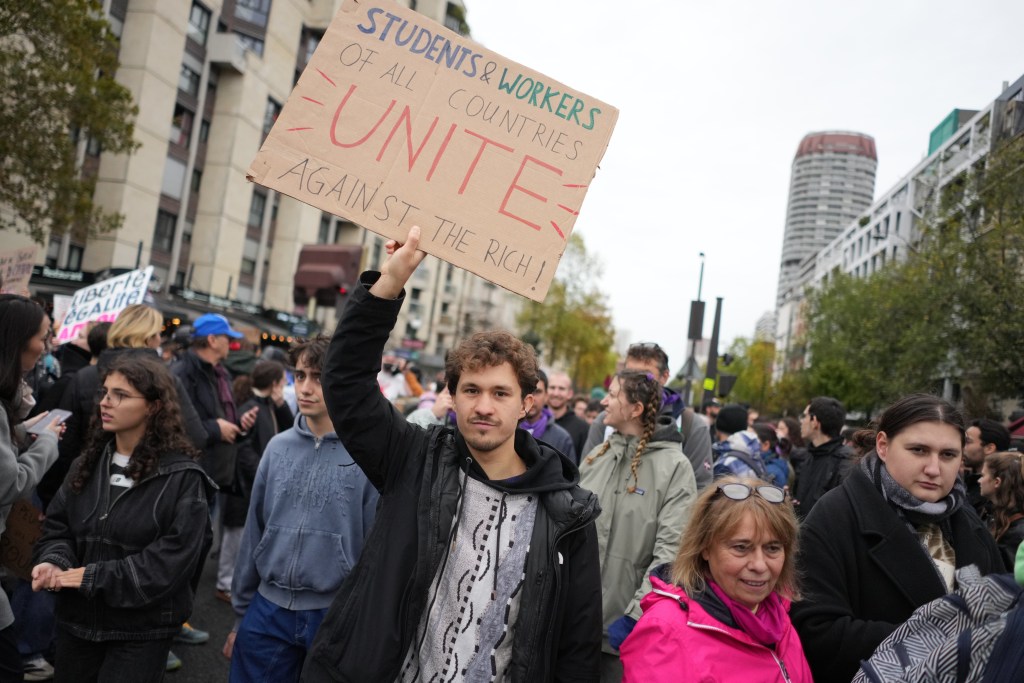
Those grievances help explain the demonstrations. They do not identify everyone responsible for the violence or establish their motives.
I teach high school mathematics on Hawaiʻi Island. My school is more than a grass parking lot, a collection of buildings, outdoor walkways and a line on a budget plan. The conditions shape what teachers can teach, what students can learn and whether families believe their children are being given a fair chance. The details of French schools are not necessarily the details of my classroom. But when people take to the streets over deteriorating public services and school conditions, I see legitimate concerns that cannot be addressed by simply identifying an enemy at the border.

Ideas showcases stories, opinion and analysis about Hawaiʻi, from the state’s sharpest thinkers, to stretch our collective thinking about a problem or an issue. Email news@civilbeat.org to submit an idea or an essay.
On October 19, Trump told reporters the unrest was about “immigration, not schools.” I recognized the move: a student writes down an answer and shows no work. It might be right, but without the work, no one can tell. Trump asked his audience to look past one set of grievances and toward another, more politically useful threat.
Trump urged French President Emmanuel Macron to close his borders and described France as a country being ruined by people who did not love it. At a Kansas rally, he warned that the fires in France were what the Democrats wanted for the United States.
Violence in France does not establish that immigrants caused it, that Democratic immigration policies would reproduce it or that tighter borders would prevent it.
Netanyahu offered a different version of the same logic. On October 20, following the unrest, Israel’s prime minister declared that France had succumbed to an “invasion of extremist Islam.”
He said he had warned Macron after the Hamas-led attacks of October 7, 2023, that if Israel did not eliminate Hamas in Gaza, France would face the consequences in Paris; “exactly what is happening,” he said about the unrest. A French crisis becomes an argument for a war thousands of miles away.
Reframing Reality To Advance Agendas
In both cases, the same transformation takes place. A complicated event is reduced to a single threat. A crowd becomes an enemy. A fire becomes a forecast. And political leaders position themselves as the people who can protect us from the future they say the images reveal.
On October 19, Noa Tishby, a popular Zionist activist, posted a 2025 video from Paris. The video showed people marching in the street with Palestinian flags and hijabs, and then cut to scenes of graphic violence overlaid with an ominous soundtrack.
The caption read, “Last year, I was attacked at a pro-Hamas terror rally in Paris, France. This is what’s happening in Europe and Western societies around the world today. Unchecked lies turn into violent hate. It needs to be stopped.”
In another post she wrote, “And now, the same mob is waving the same flags and chanting the same chants while Paris burns.”
Footage can document an attack. It cannot show that a crowd in 2025 and the crowds of October 17 shared one aim.
The danger is not only that politicians may misrepresent a protest. It is that their interpretations can turn fear into permission: permission for broader restrictions, harsher enforcement and policies that would be harder to justify without the spectacle of disorder.
We should take violence seriously. We should hold those responsible accountable. We should also resist the demand that every fire tell us whom to fear next.
When one of my algebra students at Kohala High School hands me an answer with no work, I can’t be sure what to think. Did they copy, guess or write down the answer they wanted to be right? So I ask them to walk me through it. The question is never “is this correct?” but “how do you know?”
I can still feel reassured by the couple’s composure. What I cannot do is treat that feeling as an account of the street outside. For that, I need reporting that identifies the participants, distinguishes the events and tests the explanations attached to them.
The couple finishes their wine. Outside, the flames continue.
The fire is evidence of a fire.
 Sign up for our FREE morning newsletter and face each day more informed.
Community Voices aims to encourage broad discussion on many topics of community interest. It’s kind of a cross between Letters to the Editor and op-eds. This is your space to talk about important issues or interesting people who are making a difference in our world. Column lengths should be no more than 800 words and we need a photo of the author and a bio. We welcome video commentary and other multimedia formats. Send to news@civilbeat.org. The opinions and information expressed in Community Voices are solely those of the authors and not Civil Beat.
Read this next:
Local reporting when you need it most
Support timely, accurate, independent journalism.
Honolulu Civil Beat is a nonprofit organization, and your donation helps us produce local reporting that serves all of Hawaii.
ContributeAbout the Author