Pacific Fisheries Should Commit To Biodegradable Fish Aggregating Devices
Research shows that bio-FADs can offer comparable fishing performance to conventional designs while reducing persistent marine debris.
November 4, 2026 · 5 min read

About the Authors


The science is clear. Solutions exist. And resources are within reach.
Non-entangling and biodegradable fish aggregating devices (bio-FADs) — made from bamboo, hemp, cotton, and other organic materials — offer a sustainable, effective alternative to conventional drifting FADs.
There are real consequences to the continued use of conventional FADs made with plastic and synthetic materials, which can damage the marine ecosystem when lost or abandoned.

Ideas showcases stories, opinion and analysis about Hawaiʻi, from the state’s sharpest thinkers, to stretch our collective thinking about a problem or an issue. Email news@civilbeat.org to submit an idea or an essay.
Fishers use FADs to harvest more than 38% of the tropical tuna catch, and between 19,000 and 40,000 FADs are deployed or re-deployed annually in the Western and Central Pacific Ocean. It has been estimated that only 6% of FAD buoys in that region were retrieved from the ocean by purse seiners or other vessels; the rest were stranded (11.3%), abandoned (44.8%), or had an unknown fate (37.6%).
Recent research on FADs stranded on the Hawaiian Islands and Palmyra atoll showed that the average time from deployment to stranding was approximately two years and could be as long as seven years.
Sustainable Fishing Best Practice
The Western and Central Pacific Ocean produces more than half of the world’s tuna catch. By not requiring its fleets to transition to bio-FADs, the Western and Central Pacific Fisheries Commission is out of step with its peer tuna regional fisheries management organizations: the Inter-American Tropical Tuna Commission, International Commission for the Conservation of Atlantic Tunas and Indian Ocean Tuna Commission.
After passing binding bio-FAD resolutions, the three tuna commissions are guiding their fleets toward fully biodegradable FADs by 2028 (ICCAT) and 2030 (IOTC and IATTC).
(For the Inter-American Tropical Tuna Commission, the 2030 deadline excludes flotation components. The requirement to use fully biodegradable FADs, including the flotation components, is expected to take effect in 2031, subject to regulatory approval.)
In contrast, the Western and Central Pacific Fisheries Commission has been “encouraging” bio-FAD use since 2017. This year, the WCPFC Scientific Committee agreed that “a stepwise introduction of biodegradable dFADs is technically feasible.”
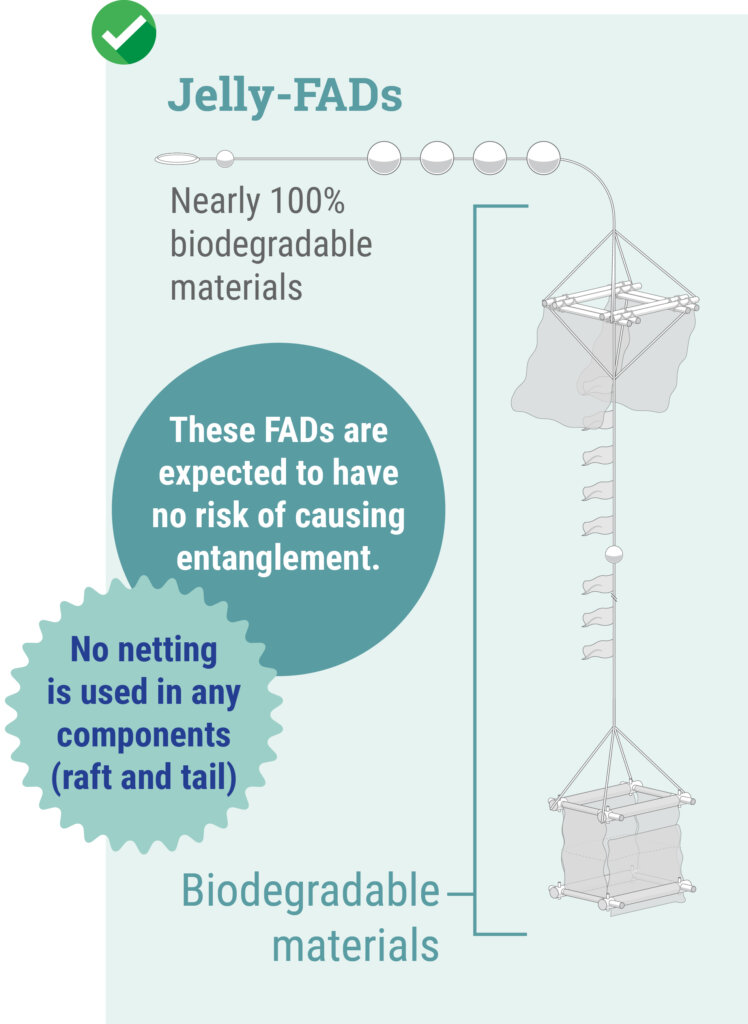
ISSF has led research on bio-FAD designs for more than 10 years and pioneered the “jelly-FAD” — an innovative design inspired by the drift and buoyancy of jellyfish and co-designed with fishers. Thousands of jelly-FADs have been tested by fleets in all three oceans, including in the Western and Central Pacific Ocean by fleets from China, Chinese Taipei, the Federated States of Micronesia, Japan, Korea, Papua New Guinea, the Republic of the Marshall Islands, and the United States, through a project led by Lauriane Escalle from the Pacific Community in collaboration with ISSF.
Governments, fleets, market actors, scientists, and NGOs recognize that using bio-FADs is the next step in responsible FAD management. WCPFC must follow suit and agree on a bio-FAD transition timeline at its annual meeting in December.
Productivity, Durability, Flexibility In Design
Bio-FAD designs have been developed through years of collaboration among scientists, vessel owners, fishers, NGOs, government agencies, and tuna regional fisheries management organizations, with positive results:
- Trials in the Pacific and Indian oceans show comparable catch performance between biodegradable and conventional FADs, with jelly-FADs outperforming conventional FADs in Eastern Pacific tests.
- Bio-FADs are feasible for use at commercial scale. Fleets have tested thousands, including jelly-FADs, in the Pacific, Indian, and Atlantic Oceans.
- Bio-FADs typically last long enough for fishing operations but degrade before becoming persistent drifting debris. Jelly-FADs have average lifespans of nine to 12 months.
- Fishers can customize components and structures using local organic materials to suit fishing conditions. Jelly-FADs, for example, can incorporate different woods and plant fibers.
Bio-FAD costs are also comparable to conventional FADs.
The availability and affordability of organic materials will vary, and some regional supply chains face constraints. Remote Pacific islands and atolls that are members of the Western and Central Pacific Fisheries Commission may face higher transition costs.
However, these practical barriers can be overcome. To support commission members and fleets, the International Seafood Sustainability Foundation has launched a research project mapping fleets, ports, manufacturing facilities, and natural materials across the Western and Central Pacific Ocean. This factor should be considered when setting the timeline but is not a reason to avoid developing one.
Support For A Successful Rollout
Bio-FADs are only one element of holistic FAD management, which also requires thorough FAD data collection and tracking, limits on the number of FADs, higher FAD recovery rates at sea and on land, and comprehensive monitoring coverage — through both human observers and electronic monitoring.
The Western and Central Pacific Ocean region has made, and continues to make, strides on these important components through measures adopted by the Western and Central Pacific Fisheries Commission and initiatives launched by the Parties to the Nauru Agreement, individual purse seine fleets, and partner NGOs.
Fishers will face learning curves, and bio-FAD designs will evolve as more is discovered through deployments and ongoing collaboration between scientists and fishers. But the commission should not let “what ifs” delay implementation of innovative, known technological solutions to real problems.
Setting a transition timeline does not require science to anticipate and solve every potential challenge first. In fact, setting a time-bound goal can help drive problem-solving and allow fleets to plan and prepare.
The commission will not navigate this transition alone. The International Seafood Sustainability Foundation and other NGOs stand ready with data, tools, and expertise. Scientists and fishers are eager to exchange technical knowledge, and peer regional fisheries management organizations can share lessons learned.
Bio-FADs are the way forward — a needed next step in the continuous improvement of FAD management and a solution for reducing tuna fishing’s impact on marine ecosystems. The Western and Central Pacific Fisheries Commission has the science, practical solutions, and international precedents it needs to commit to a bio-FAD transition timeline this December.
 Sign up for our FREE morning newsletter and face each day more informed.
Community Voices aims to encourage broad discussion on many topics of community interest. It’s kind of a cross between Letters to the Editor and op-eds. This is your space to talk about important issues or interesting people who are making a difference in our world. Column lengths should be no more than 800 words and we need a photo of the author and a bio. We welcome video commentary and other multimedia formats. Send to news@civilbeat.org. The opinions and information expressed in Community Voices are solely those of the authors and not Civil Beat.
Read this next:

Local reporting when you need it most
Support timely, accurate, independent journalism.
Honolulu Civil Beat is a nonprofit organization, and your donation helps us produce local reporting that serves all of Hawaii.
ContributeAbout the Authors