Makana Eyre: Rapa Nui’s Ruin Wasn’t ‘Ecocide.’ Stop Blaming The Victims
The colonizers not only wiped out the population of Easter Island but convinced the world the islanders caused their own collapse.
November 9, 2026 · 5 min read

About the Author

This is probably a familiar story to you: the people of Rapa Nui, famous for carving the great moai, caused their own demise.
If you grew up between the 1990s and 2010s, you probably heard some version of it in the classroom about the remote isle that Europeans called Easter Island.
As the theory went, the Rapa Nui overexploited their island’s meager natural resources. They chopped down trees to transport the moai. Their own foolishness prompted famine, warfare, and ultimately, cannibalism.
Our teachers presented it as a cautionary tale. Jared Diamond made it part of a best-selling book. They argued this was a parable of ecological sin, of a civilization so feckless it brought about its own collapse.
But what if they had it all wrong?

Ideas showcases stories, opinion and analysis about Hawaiʻi, from the state’s sharpest thinkers, to stretch our collective thinking about a problem or an issue. Email news@civilbeat.org to submit an idea or an essay.
For the better part of three decades, scholars have made that argument. Little by little, they undermined almost every element of the hypothesis. Was there actual evidence for reckless deforestation, pre-contact population collapse, catastrophic warfare, or cannibalism? Mostly no, they said.
Yet their research never changed our collective understanding. In fact, several large universities in the United States, Canada and Europe still teach some form of the self-inflicted collapse theory.
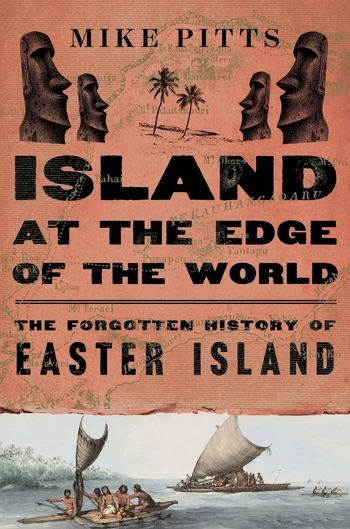
A recent book by the British writer and archaeologist Mike Pitts might finally debunk it once and for all.
In “Island at the Edge of the World,” Pitts dismantles the narrative we’ve all heard. In a synthesis of the most recent research alongside his own exploration into historical sources – all packaged for the general reader – he offers a radical revision of the history of this little island some 2,300 miles off the coast of Santiago.
With Rapa Nui in the news more than usual – mostly related to the new genetic study I wrote about a few weeks ago – now is the perfect time to reappraise the story.
So, what does Pitts conclude? Here’s an overview.
Did an enormous pre-contact population, consumed with worship of the moai, exhaust their island’s resources and descend into warfare and cannibalism?
No. Pitts offers a far more plausible alternative. Over the centuries, the Rapa Nui developed a sophisticated set of systems that enabled them to thrive in an acutely difficult environment.
A population collapse did occur, but it followed European contact in 1722. In fact, the ensuing slave raids, kidnapping, smallpox, and colonial conquest were so cataclysmic that in just 15 years starting in 1862, the population fell from about 5,000 to little more than 100, with just 26 women.
Was Rapa Nui a wasteland when Europeans arrived?
No. Pitts offers accounts from some of the earliest visitors who reported highly productive, carefully maintained gardens. Islanders made use of wind breaks, crop rotation, mulching and green manuring alongside a keen understanding of how the rocks that made walking so difficult kept the soil fresh and damp.
What about deforestation? Pitts tells us that some native trees still existed on the island when Europeans arrived. Sheep ranching, grazing and deliberate burning – mostly at the hands of settlers – caused the final devastation.
Crucially, Pitts calls on us to reframe our line of thinking, to ask not about the circumstances of collapse but instead how the people of Rapa Nui did so well for so long?
That raises another question. Given all the scientific evidence, why has the old story proven so difficult to dislodge? Two answers seem to offer the best explanation.
The answer to the first one is a pop science writer affiliated with UCLA. In 2005, Diamond published “Collapse: How Societies Choose to Fail or Succeed.” In this abiding bestseller, he wrote at length about how the Rapa Nui destroyed their own environment – and thus themselves.
Diamond might not have invented the theory of Rapa Nui’s collapse. But he did more than anyone to popularize it.
And he carried the argument even further. Rapa Nui, he believed, is the perfect analogy for our planet. Like Rapa Nui, earth is finite, isolated and subject to destruction if its inhabitants consume resources without any regard for the consequences. Beware of such folly, he warned, his writing laced with moral condemnation.
Diamond’s thinking dovetailed perfectly with the second reason: what environmentalists desperately wanted to alert the world to.
As they saw it, Rapa Nui was a tragedy of the commons, a term that originated with cattle herders who overgrazed a common pasture. It was the exemplar of ecocide that teachers and professors could weave into curricula on ecology and environmental protection. With Rapa Nui as a case study, a whole generation of students could learn how not to destroy the planet.
It was all a little too convenient.
The great tragedy of the received version of Rapa Nui’s history is that it blames the victims for misdeeds they did not commit.
In Rapa Nui, the colonial playbook was so effective it not only wiped out the population but convinced the world that its people were to blame for their own destruction.
It started with Dutch explorers in 1722. Then Spanish sailors laying claim to the island, Peruvian slave traders abducting citizens, French missionaries suppressing traditional practices and Chilean colonial rule. Rapa Nui’s modern history has been one of exploitation, disease and dispossession.
In Pitt’s book, we have a chance to correct the record. Let’s hope it will start unraveling the narrative we’ve followed for so long, that it will begin to undo the harm done to this fascinating island nation that deserves a lot more recognition than we give for succeeding in a windswept, volcanic island with no permanent streams and fragile soil.
 Sign up for our FREE morning newsletter and face each day more informed.
Local reporting when you need it most
Support timely, accurate, independent journalism.
Honolulu Civil Beat is a nonprofit organization, and your donation helps us produce local reporting that serves all of Hawaii.
ContributeAbout the Author