Sen. Brian Schatz Has 'A Fair Amount Of Hope' In Congress And The Country
Civil Beat met up with the Hawaiʻi senator when he was home in Honolulu last week for a freewheeling discussion on the state of national affairs.
May 10, 2026 · 19 min read

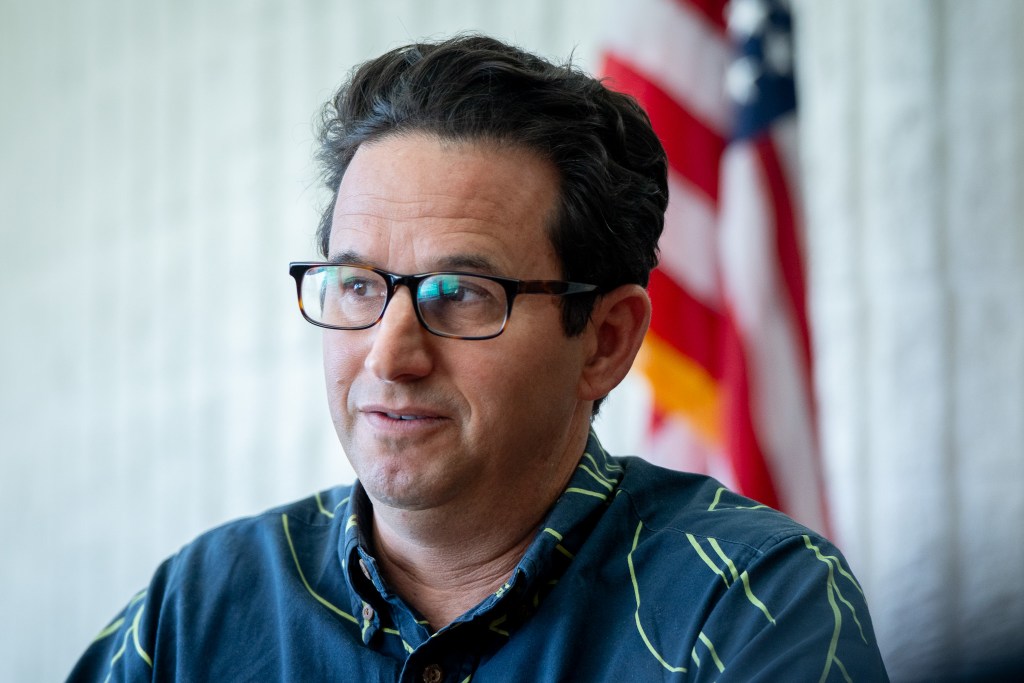
About the Author

Editor’s note: This interview has been edited for length and clarity and with an eye toward using some material in future stories.
Hawaiʻi’s senior U.S. Sen. Brian Schatz generally has a lot to say, not much of it good, about the Trump administration and his GOP counterparts.
His floor speeches quickly become social media posts that tend toward clever, biting criticisms of what the Republicans are doing wrong, whether it’s federal health care and social services cuts, immigration enforcement, or Pete Hegseth and the war in Iran.
Political skirmishing is much of the job these days for Schatz, who has become one of the most powerful politicians in the country, the heir apparent to take over Senate Democratic leadership from Chuck Schumer of New York in a few years. He’s currently the chief deputy whip and on the Senate Appropriations Committee among other key leadership positions.
So it was a bit of a surprise to hear him say Congress “is starting to feel slightly more normal” despite what would seem to be non-stop shockers from President Donald Trump and his staff.

“I think the thing that’s giving me a fair amount of hope is that we’re still working together on a bipartisan basis in the Senate to get appropriations done,” Schatz said during an interview in his Honolulu office last week. “And that’s been one of the main ways in which Congress is asserting its constitutional prerogatives, quietly and less spectacularly” than people might realize.
Lawmakers are still building budgets and overseeing departments that come before his committee and still have to be accountable. And there are bipartisan opportunities, too, like solving a national housing crisis, or energy development based on new technologies for geothermal and nuclear or battery storage, he says.
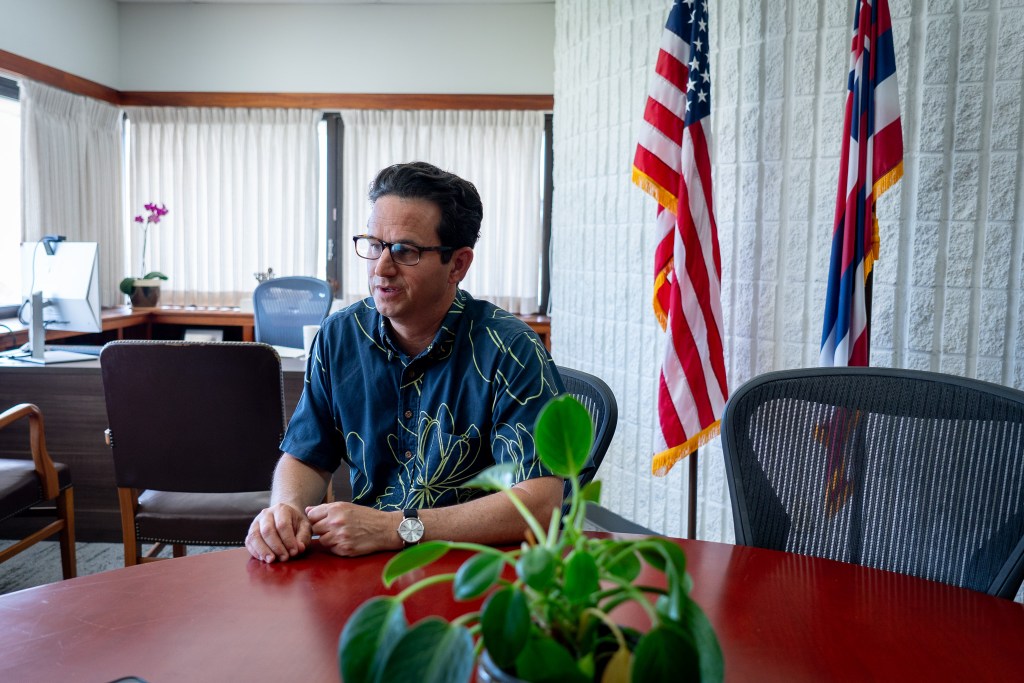
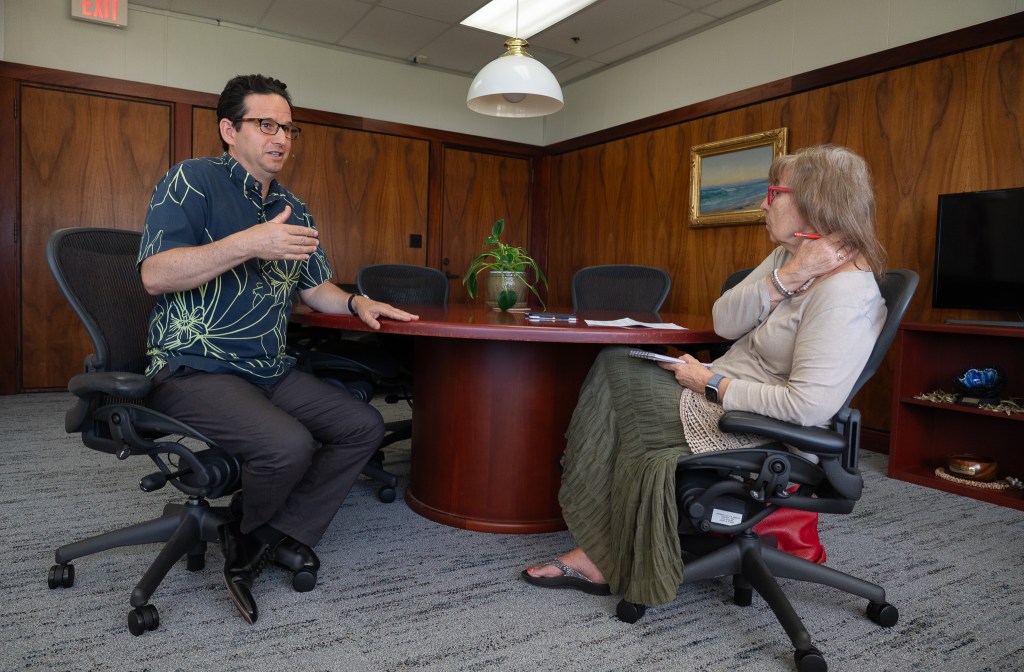
Schatz was home in the islands last week while Congress was on recess and squeezed me in for a 30-minute interview. My thought was to chat about leadership and what he, as one of the most influential political leaders in the country, can actually do to, well, lead. We can all watch his Instagram and see what he has to say about opening the Strait of Hormuz or Department of Homeland Security funding. But what’s he going to do to bring the country back together if given the chance?
He was of the same mind, as it turned out, as he ticked through a list of the things that are important to him these days, including that he is feeling generally more positive about Congress.
“And then the reason I’m sort of not covering the obvious stuff is because it’s the obvious stuff,” he said. “There are moments where you try to find common ground, but then if you must, you stand your ground. And the fighting against Trump’s presidency in terms of the domestic policy, the Medicaid cuts, the SNAP cuts, the attacks on immigrants and LGBTQ individuals and union members, all of that is intuitive. I know how to fight against that.”
“I think people already know that I’m doing that stuff … and that that’s not all I spend my time doing. There is important work, kind of underneath the level of what’s interesting on Instagram.”
OK great. But first, I just have to ask, what is the weirdest stuff that you’ve had to deal with? I heard you talking about the ballroom recently, for instance. Is there anything that just comes to mind as the weirdest thing that the administration has done?
I think it is the ballroom. Because whatever you may want to say about Trump’s political operation, you know, they’ve won twice, and they’ve won pretty spectacularly. So for all of our technical savvy and our white papers and our policy savvy and our addiction to polls, they just went and kicked our butts. Twice. And so I have come to understand they are good at politics, just not in the way that I understand politics.
But this ballroom is different, because there is no universe in which this is secretly very smart for them. This is about a guy in his final term, trying to build stuff that he finds personally interesting, and I’ve talked to Senate colleagues who will remain nameless who can confirm that he’s very, very animated by and interested in not just the ballroom, but, I mean, the type of gilding at the Kennedy Center.
He is sort of a construction manager of the arch, the Kennedy Center and the ballroom. And I initially thought it was an exaggeration to think that this guy was fixated on building stuff for himself as a monument to himself. But I have now confirmed that with my Republican colleagues — this is the thing that gets him up in the morning.
So it’s clear that you have gone from let’s just say humble beginnings to really one of the most powerful, influential guys in the country. And so I guess maybe my starting point is a lot of people do think this country is broken, maybe beyond repair with all the partisanship and discord. So how are you feeling about the state of the country and, now that you’re in this position, how can you fix it?
Well, democracy is not what we have, it’s what we do. And so do I worry that this president is uniquely dangerous and does not understand the obligation of being president in the same way that almost every other president has understood it? Yes, I worry about that.
Do I worry that the country has fundamentally changed, and that’s why we elected Donald Trump? That doesn’t worry me. I believe that people understand that the American experiment is worth preserving, and we lost a bunch of people because the election wasn’t about the American experiment. It was about, frankly, people were angry about Covid, angry that we had an 80-year-old standard bearer who couldn’t explain his policies, and angry that prices were too high. And now we have a president who can’t explain himself very well, and prices are even higher.
I think there are some big opportunities for people who aren’t afraid of the future.
And so I think public opinion is a pendulum, and it is swinging back in the direction of people being a little more sane and a little more rational. And I do think our next president — every executive — is an answer to the previous one. It may not be the right answer, but it’s a reaction to the previous executive. And I think our next president is likely to be viewed as the smartest person in the room. Not necessarily the person you want to get a beer with, but there will be wreckage, and we’re going to want a really sharp individual who understands how to piece things back together again.
I think now people are going to be looking for something a little bit more interesting, a little bit more inspirational, than just we’re going to put everything back together again. I think we have to build new things from this wreckage. And it does give us an opportunity to do so. You know, the USAID enterprise has been dismantled, but in the process now we’re putting it back together in a way we think it might even be more effective. It’ll take five years to get back on track, but that’s a good example of even if I could wave a wand and change everything back to exactly how USAID operated, I wouldn’t do that. I would change it.
And so I think there are some big opportunities for people who aren’t afraid of the future. One observation I’ve had is that growing up, it was Bill Clinton, Barack Obama. We were the party of the future. We were the party of modernity, of science, of tech. But just generally speaking, we weren’t terrified about everything. But I think somewhere from Covid to Trump 2.0, pollsters and activists and everybody got fixated on the thing they are most worried about, the things they are most terrified about.
Meanwhile, the Trump people were having a blast. And there are a bunch of people who pay only passing attention to politics and thinking which group of people would you rather affiliate with and identify with? People want to be with the people who are singing “YMCA” and having a blast, as opposed to the scolds who are saying, you can’t sing that song. But it’s a hell of a thing to be an antidote to all that joy.
Now, all of that joy, there was an illogic to it and all the rest of it, but frankly, most successful political coalitions are in tension with themselves on substance. You just have to live with the contradictions.
So if the Democrats do gain control of the House, and if you guys get control of the Senate, which some people think might happen, how do you actually govern, instead of just always being about the next election cycle? What do you do differently than what’s happening now?
So a couple of things. The immediate action we should take is to restore the Affordable Care Act tax credits and to reverse the Medicaid cuts. And if this war is still ongoing, to stop the war. And so those are sort of short-term issues. They’re important, but they’re relatively short term.
I also think we want to take another big, bold action on climate, but we should do so in the context of everybody’s pocketbook. And I think that’s totally possible and even necessary as a political matter. But part of what’s happened on the climate side is that we used to have to make an argument about externalities and future costs and insurance costs and unaccounted for costs. Now we can simply look people in the eye and say the cheapest electrons are generated from clean and renewable sources. And so we’re going to lean very heavily into that.
One piece about AI, because I think there’s lots of justified worry about what it’s going to do to intellectual property, to the education system, to energy use, to people’s sense of what it means to be a creative person. But two positive use cases that I’m very excited about. One is there are incredible opportunities in medical treatment, medical research, and we should lean as heavily into that as we can. And the other is that AI, as it relates to interacting with bureaucracies, can cut both ways. And let me give you an example.
We now know that some insurance companies are using AI to reject claims without having them even be reviewed by a medical professional. And so that’s like a really evil systematic use of AI that I think we should regulate to not permit. On the other hand, so much of an individual interacting with their government has to do with sorting. Waiting. Talking to a person. Or going on a website and sorting.
“Am I on the right website? Am I filling out the right form?” That is the kind of thing that is custom built for an LLM.
I think that in this day and age, people want to see a little bit more of you as a human. And if it is frustrating, they don’t want you to hide it.
I think the person running in 2028 should make a brand proposition, as if it’s an American corporation, and say “You shouldn’t have to spend more than 10 minutes on the phone with your government before getting what you need from your government.” We are the most advanced civilization ever. We have this incredible new technology. Let’s use it for something other than micro-targeted advertisements.
And making the government actually function properly is an underrated aspect of what I think Democrats need to lean into. It’s not as politically satisfying, because some of the stuff that scratches the itch among your supporters is whether or not you’re for all the right things. But I have seen a lot of instances of us passing a really important piece of legislation, and it takes seven, eight, nine years to be implemented.
If the Democrats believe that government is there to help people, the fact that everything takes so long is not some technocratic side question, it is the question. Because I think people are willing to pay taxes, but they want to know that it’s going to something useful and not into a pile.
I think a lot of Democrats want to see the Democrats get tougher, fight fire with fire, slam back and all of that stuff. If you have the opportunity to do that, do you see that as something that the Democrats might do? What’s your answer to this possible escalation of a political war?
I think that we need to be ruthless, but ruthlessness should not be equated with how expressive you are. If an elected official is executing a smart strategy, it may be that they are presenting themselves in a way that makes them successful. And everybody has a different role, but I play a very specific role, and my job is not to show everyone at all times how flustered and frustrated I am. My job is to be steady, but also to be clear-eyed about the level of threat that the country and the state is facing. But I’m of no good to anybody if I’m just flopping around on the deck freaking out about how everything’s going to shit. I have to be reassuring and still realistic and that’s the balance that I try to strike.
And so you don’t see yourself in this perhaps new position that you might continue to rise into being sort of a bomb thrower? You see yourself more, it sounds like, as a negotiator?
Yeah, I mean, I think the job is the job. And I think and so much of this is just dispositional, like you can be very tough as a negotiator and not have foam coming out of your mouth. And you can be the kind of person who makes a really good speech that performs well on TikTok, but not executing in your primary duties, which are to make laws.
And so I think it’s a balance. And I think I have evolved a bit in that. I think that in this day and age, people want to see a little bit more of you as a human. And if it is frustrating, they don’t want you to hide it. So it’s not like I don’t understand the need to communicate my alarm. I just think no matter what’s going on, I’m no good to anybody if I don’t keep my head on straight.
Well, you are in the national media a lot now. And what do you think of the press these days? Do you think the press could be doing a better job?
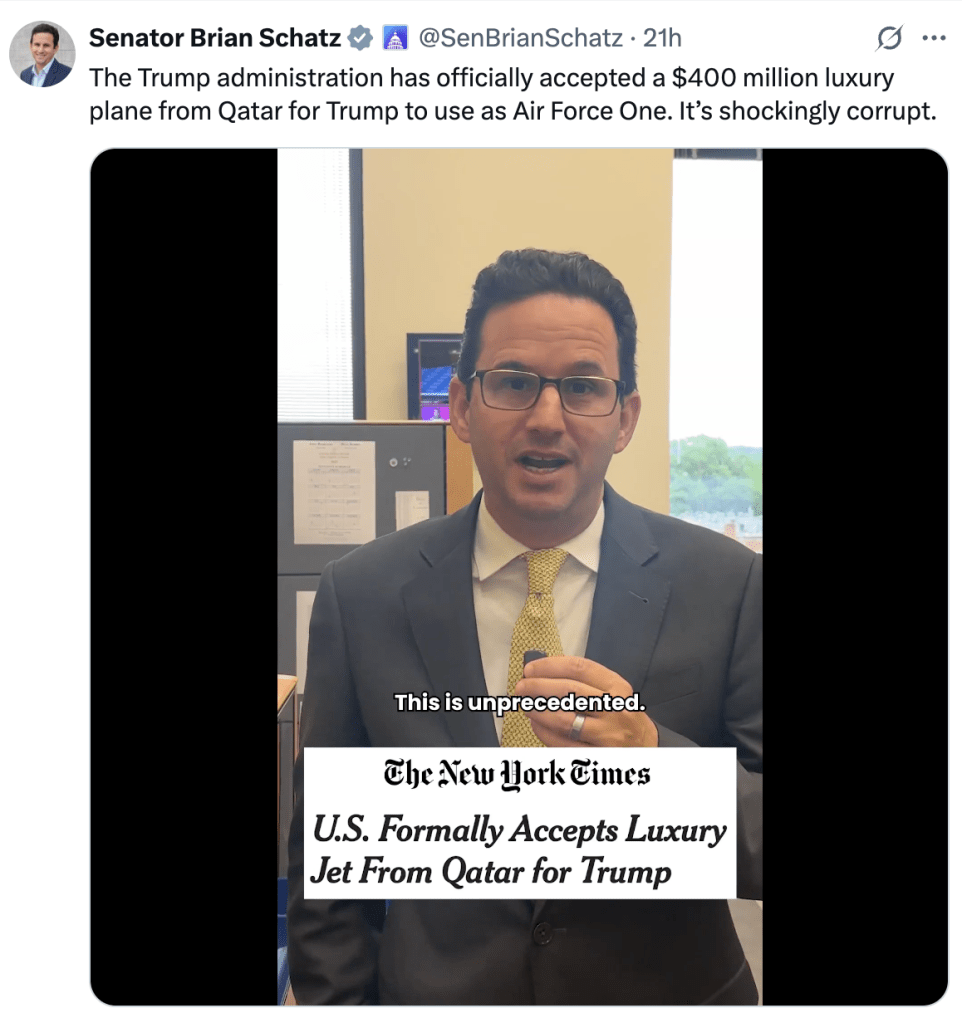
I don’t have any criticisms of the Fourth Estate that wouldn’t have applied last year or last decade or the last three decades. And I’d also say that one thing that I have internalized is that owning platforms, controlling channels, manipulating news and information is not working. And I think one of the things that we saw from Musk’s takeover of X is that it actually is counterproductive for Republicans, because once you’re inside of a filter bubble, you can start to persuade everyone else in that bubble that you’re doing just great. Everything you’re doing is popular, that you’ve got a mandate, and that everything is going fine politically.
And frankly, Twitter was like that for progressives. I don’t know what year it was, but five or six years ago. And so it felt good, but voters outside of that little bubble were sort of going “No, we’re not with this.” And we were caught in that ecosystem.
And so I think, as it relates to broadcast news and the FCC trying to literally bully people into coercing the kinds of speech that’s permissible and all the rest of it, that’s terrible. But I am less worried that people aren’t going to get their information.
And I’ve been talking to my staff, for instance, about the war in Iran. There is nothing that anybody can say that is going to persuade a regular person that this war makes any sense. And likewise, I could give a soaring speech about how foolish all of this is, and it also wouldn’t move the number, because people can see with their own eyes that this is not working.
And so there are instances where I have my own media criticisms, and there are instances where I think, at the margins, how something gets covered really changes history. But I think for that, for instance, the reason Virginia swung back so strongly in the Democratic direction is the price of everything. And you can’t spin that. You go and you pay what you pay, and eggs cost what they cost, and milk costs what it costs, and gasoline costs what it costs.
And, we learned this during the Biden era, there’s no barnstorming of America to persuade people that they’re actually doing great. And I think the Trump people are learning that the hard way, and weirdly the second time, because they’re the ones that had the instinct that Democrats were not understanding the economic frustration, and now they’re just making it worse in two ways. One, they’re making the same set of mistakes around thinking they can talk people out of their own economic concerns.
And say what you want about Biden, but he didn’t intentionally increase the cost of everything in quite the same way that Trump did with Medicare, with food, SNAP, with tariffs and the war. These are all policies that were available to him to not do, and he did them all, and now the price of everything is going up. And it’s impossible to make a TikTok to tell people that that’s not what’s actually happening.
So I know you were interested in the social media stuff for a while, especially when it came to kids. And now you’ve talked about AI a little bit. Are there a few issues that you’re going to champion this year? If you had three or four top things to work on in Congress what would it be?
It’s Native Hawaiian funding.
It’s Kids Off Social Media Act, which I’ve done with Ted Cruz. That is a full ban for kids under 13, and then from 13 through 17, the algorithmic boosting of the feed is banned. So it would be like the old Facebook where it’s your actual friends, or whoever you are connected to as a friend. Someone saw a sunset, someone’s dog is cute, that kind of thing, but not being fed algorithmically upsetting stuff.
And then I think there’s still room for energy policy and permitting reform. Sheldon Whitehouse and Martin Heinrich and I are three of the most aggressive climate action members, and we’re kind of bullish on the possibility that we can do some real reforms. Most of the people who are in the clean energy space and model scientifically what needs to happen in order for us to achieve our clean energy goals are saying the tax subsidy is a part of this. But at this point the great limiting factor is our ability to move energy from one part of the country to the other, and we just can’t right now.
Since you are becoming much more of a national and really even a global figure, how do you balance your work in that space — the national and global landscape — with Hawaiʻi? How do you kind of pay attention to both and do justice to the local folks?
It’s always Hawaiʻi first. It really is. I try to when I come home have some sense of normalcy. And I got my food spots, and I get in the ocean and do those kinds of things. See my mom, hang out with my in-laws. That, I think, is the most important aspect of grounding me.
But my only desire ever was to represent the state of Hawaiʻi, and so if putting me in a leadership position helps Hawaiʻi, I’ll do it, and if it doesn’t, I won’t. And so I don’t feel torn in various directions in quite that way. And I’m pretty disciplined. The way you really allocate your self is through the schedule, and I just make sure that if there’s ever a choice between a Hawaiʻi priority and something else, Hawaiʻi wins.
 Sign up for our FREE morning newsletter and face each day more informed.

Local reporting when you need it most
Support timely, accurate, independent journalism.
Honolulu Civil Beat is a nonprofit organization, and your donation helps us produce local reporting that serves all of Hawaii.
ContributeAbout the Author