At the time, Josh Stanbro figured it was just bad luck when his childhood home and apple orchard burned down in 1992, a casualty of the infamous Fountain Fire that destroyed 300 houses and displaced several thousand people.
But looking back at it, Honolulu’s chief resilience officer sees the climate signal in the blaze that ultimately scorched 64,000 acres in northern California. It was part of an escalation of fires there over the years — and that’s what he’s seeing in Hawaii now.
People often picture the western United States when they think of wildfires. But as a percent of total land area, Hawaii’s wildfires burn as much or more land each year than any state, studies show.
“Here in Hawaii, we always talk about sea level rise and that’s been the main focus. You can see it and put metrics on it and it grabs attention,” said Stanbro, who leads Honolulu’s Office of Climate Change, Sustainability and Resiliency.
“But the hurricane stuff, the heat stuff and the fire stuff is what I think will really impact Hawaii before sea level rise gets a chance.”
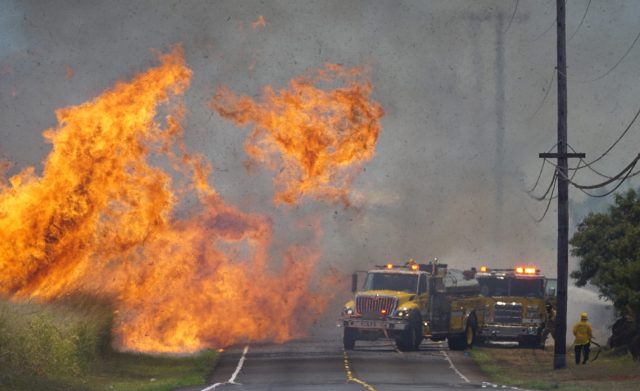
That impact extends far beyond burnt farmland, lost buildings, injuries and the occasional death.
University of Hawaii professor Camilo Mora recently reviewed 12,000 scientific studies and found at least 30 different types of impacts of climate change related to fires, hitting health, food, water, infrastructure, security and the economy.
Wildfires affect mental health and spread disease, degrade air quality and harm coral reefs, threaten freshwater supplies and deter tourists, the studies showed.
University of Hawaii wildland fire researcher Clay Trauernicht has found that the area burned annually by wildfires in Hawaii has increased fourfold in recent decades.
But it’s not just a product of climate change, though that’s making the situation much worse.
This interactive map shows the perimeter of wildfires in Hawaii between 1999 and 2018. Zoom in to see details of each island. (Source: University of Hawaii Wildland Fire Program)
Forecasts of wetter and stormier winters coupled with drier and hotter summers will only heighten the threat of wildfires in the islands, he said.
But changing economics have also led to more destructive wildfires, beginning in the 1960s when tourism started driving the state instead of large-scale farming and ranching. Hawaii has abandoned tens of thousands of acres of agricultural land as sugar and pineapple plantations steadily folded.
Much of that land has laid fallow for years, invaded by African grasses and shrubs. Guinea grass can grow six inches a day, creating an enormous amount of self-replenishing fuel while replacing native vegetation.
“What it does is make us way more vulnerable for the changes that are going to come with climate change,” Trauernicht said.
Stronger El Niños throw a twist in Hawaii’s weather patterns, bringing wetter summers. That means rapid growth of grasses and shrubs in all the fields that are no longer in production. So it may look especially lush and green during those months, he said, but that should be a sign to get ready for a potentially dangerous winter when dry conditions arrive.
Crews Fight Maui Brushfire Near Paia from Honolulu Civil Beat Inc on Vimeo.
This isn’t some far-off climate threat. It’s now.
The mean annual area burned in Hawaii from 2005 to 2011 accounted for 0.48 % of Hawaii’s total land area, which was greater than the proportion of land area burned across the entire U.S. mainland (0.30%), and even across the 12 states in the fire-prone western U.S. (0.46 %) over this same time period, Trauernicht wrote in his 2015 study.
Even for two of the worst fire years on record for the continental U.S. in terms of area burned, Hawaii had a larger percentage of its land area burned, his study says.
In March, Hawaii became free of drought statewide for the first time since 2015. But a dry spring and record-high temperatures this summer quickly reversed that, especially on the leeward sides of the islands that are already typically much drier than the windward sides.
It was the perfect setup for the wildfires that burned nearly 10,000 acres last month on Maui. Thousands had to evacuate towns on the west coast, two major roads were closed and flights were diverted due to smoke.
Firefighters were battling another brushfire Friday just outside Paia. While helicopters dumped water from overhead, backhoes worked to dig trenches to create fire breaks and tanker trucks spread water on flames that crept close enough to the Hana Highway that people on the other side could feel the heat.
Much of that fuel came from non-native grasses and shrubs that have taken over the lands that the Hawaiian Commercial & Sugar Co. had in production until it shut down in 2016. It was one of the last sugar and pineapple companies still in operation in Hawaii.
“The risk of fires is not going to go down,” Trauernicht said. “It’s only going to increase.”
Managing Wildfires Is Becoming A Problem
Other effects of climate change compound the problem.
Sea surface temperatures are warmer than normal around the Hawaiian Islands and are expected to be so through November, creating warmer air temperatures in the region. That means more tropical storms could reach the state, especially in the southeast, according to the National Interagency Fire Center.
That extra rain grows more fuel for wildfires. And with dry conditions in between storms, the center expects an above-normal risk of significant fires in the eastern half of the Hawaiian Islands through November.
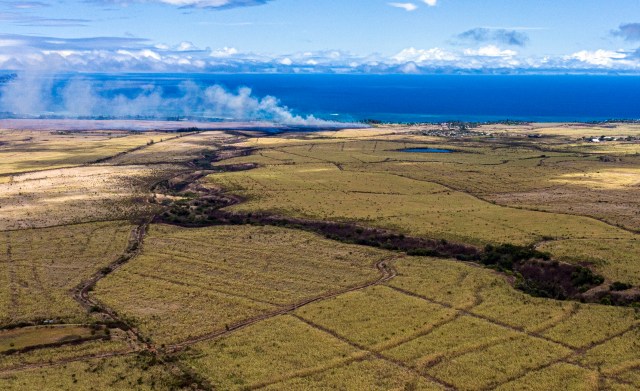
Hawaii used to have seasons for wildfires, said Michael Walker, the fire lead in the state Division of Forestry and Wildlife. The division is responsible for 1 million acres of forested watersheds, about 25% of the total land in Hawaii, and partners with the counties and federal agencies to cover another 30%.
July and August are often still the worst months, but Walker said in the past few years he has seen a year-round fire season.
In January and February, Walker said crews woke up to frost on the trees while fighting fires up on Mauna Kea on Hawaii island and they dealt with whipping winds battling a blaze on Maui that forced a few dozen visitors and residents into emergency shelters.
Winds from tropical storms passing through the Pacific literally fan the flames, a “climate change double-whammy,” as Stanbro put it.
“Our real problem is a fuels problem,” Walker said. “We have all this open grassland that we’re not managing. And if we don’t manage them, these fires are going to continue.”
The Department of Land and Natural Resources requested an extra $300,000 to fight wildfires in each of the next two years, which the Legislature approved in April. The money goes toward paying overtime and contracting with companies to provide heavy equipment and helicopters, which cost about $1,100 per hour. For example, there were three choppers fighting Friday’s brushfire on Maui.
DLNR Chair Suzanne Case, who requested the funds from lawmakers in January, specifically cited climate change as a reason more money was needed to fight wildfires.
The Human Factor
Humans are almost entirely to blame for wildfires in Hawaii, starting many of the fires. But unlike some global warming challenges, experts said this one is solvable at the local level.
Lightning rarely sparks a blaze in the islands, and usually just on the Big Island. But arson and unintentionally set fires are rampant, particularly on the west side of Oahu.
There are about 35 ignitions, as fire researchers call it, per square mile each year in Waianae. Elsewhere on Oahu and on the neighbor islands, there are between two and nine ignitions per square mile annually, which is still higher than the national average, Trauernicht said.

Eric Enos, who heads Ka’ala Farm, a community nonprofit that has served the Leeward Coast since 1976, has been working on solutions.
He received state funding to develop a plan after applying in January for a $1 million grant from the Legislature for the Waianae Kai Wildfire Prevention and Mitigation Project.
In his application, Enos recounted his experience last August with a brush fire in the area that ultimately burned 9,000 acres.
Two school buses of families were at the farm for a daylong experience with kalo, growing and cooking the Native Hawaiian staple and connecting to ancestral wisdom. Then three fires were set mid-day.
“We were trapped for hours like an apocalypse,” Enos said.
The wind was fierce and blowing downhill but the fire still jumped the road and headed toward them. They had a bucket brigade and shovels fighting the fire as families huddled with children.

He recalled wondering where they’d go if the wind shifted. Fire trucks took seemingly forever to respond as companion fires were started in adjoining valleys.
“The entire town of Waianae was black with smoke as the junkyard of acres of cars exploded like a bomb,” Enos said.
It was difficult to breathe and people were evacuated, including his own family in Makaha.
“The roads were filled with miles of cars unable to move,” Enos said. “Waianae town was visibility zero.”
His plan, which is still being developed, is multifaceted. The goal is to increase security in the upper valley, implement best management practices to prevent fires and increase water availability for firefighting.
It could involve installing a gate in the back of Waianae Valley, similar to the one at Kaena Point, that would limit access to where many of the fires are started.
“There’s a large population of pretty dysfunctional people — not well — that frequent the area,” he said.
In March, Micah Araneta was arrested after a few fires were started in Waianae. Police tased him along the side of the road after a standoff that Sen. Maile Shimabukuro filmed while riding the bus home from the Capitol. He was holding what appeared to be a blowtorch.
Maui’s Fallow Ag Land Fertile For Fires from Honolulu Civil Beat Inc on Vimeo.
‘This Is Nuts’
Enos also wants to educate the community, beginning at a young age, about the importance of protecting native forests.
“Your forest is a sacred place even though it’s dry,” he said. “People who start fires have no connection. They’re totally cut off from those values. They weren’t exposed.”
Enos has seen an improvement over the past 15 years in the community’s overall awareness of this longstanding problem. He attributes the turnaround to increased involvement of community nonprofits stepping up, noting groups like Hoa Aina o Makaha and Malama Learning Center.
“The impact they have is tremendous,” he said, adding that it’s unfortunate these and other nonprofits struggle financially to fulfill their missions.
Enos feels the urgency of reducing the number of fires that get started and increasing the ability to put them out faster before they burn even larger swaths of land and threaten lives.
“The risk of destructive wildland fires will only increase as climate change continues to create drier conditions for the Waianae Moku,” he told lawmakers.
Waianae native William Aila, the director of the Department of Hawaiian Home Lands, wants to see more funding put toward preventing these fires from spreading up into the forests. He envisions a longer term solution involving the planting of “edible fire breaks” — growing large breadfruit or mango trees that shade out the invasive grasses.
“We can kill two birds with one stone,” he said, noting the state’s goal to double its local food production by 2020.
Aila also wants the secondary impacts of wildfires to be included in the “cost” that authorities calculate.
He said it’s critical to add the cost of debris that ends up in the ocean along with all the soil that’s no longer held by the plants that were there. It smothers the coral reefs, which threatens fisheries as well as the state’s tourism-dependent economy.
Stanbro recalled firefighters telling him in California how some of the fires are now so hot they create their own weather.
“This is nuts,” he said. “We have crossed a threshold.”
 Sign up for our FREE morning newsletter and face each day more informed.
About the Author


Help power essential news and information
More Stories In This Special Report
-
 Part 1
Hawaii 2040: Climate Change Is Already Here. And We’re Running Out Of Time
-
 Part 2
Fight Against Climate Change Is ‘An All-Out, All-In War’
-
 Part 3
Fighting Climate Change Will Cost The State Millions
-
 Part 4
Massive Flood Risks Don’t Deter Kauai Homeowners From Rebuilding
-
 Part 5
We Have To Move Our Homes And Businesses Away From The Shoreline. But How?
-
 Part 6
Developing An Action Plan For Oahu: ‘The Climate Is Not Waiting For Us’
-
 Part 7
Should Hawaii Tax Carbon Emissions To Combat Climate Change?
-
 Part 8
These Rare Seabirds Are Having Babies On Oahu’s North Shore
-
 Part 9
Study: Moving Ourselves Away From The Shoreline Is Hard But Doable
-
 Part 10
Losing A Beachfront Home Isn’t Just A Rich Person’s Problem
-
 Part 11
Many Climate Change Bills Are Still Alive, Including A Carbon Tax
-
 Part 12
Neutralizing Our Carbon Footprint, One Tree At A Time
-
 Part 13
Buyer Beware: Oceanfront Homes Keep Going Up Despite Rising Seas
-
 Part 14
Hawaii Lawmakers Have Largely Dropped The Ball On Slowing Climate Change
-
 Part 15
VIDEO: What Is A Carbon Tax?
-
 Part 16
Dozens Of Climate Change Bills Went Down The Political Drain This Session
-
 Part 17
Podcast: Our Journey To The Last Wild Place
-
 Part 18
‘We’re Not Scared’: Hawaii Confronts Next Wave Of Climate Change
-
 Part 19
This Rare Island Waterbird Is Becoming Citified
-
 Part 20
Climate Change Is Making Hawaii’s Beaches More Dangerous
-
 Part 21
Trump Weakens Protections For Hawaii’s Imperiled Plants And Animals
-
 Part 22
Hawaii Is Losing As Much Of Its Land To Wildfires As Any Other State
-
 Part 23
Air Travel’s Carbon Footprint Takes A Big Environmental Toll In Hawaii
-
 Part 24
How Climate Change Will Affect Hawaii’s Favorite Fish
-
 Part 25
We’re Ramping Up Our Climate Coverage. Here’s Why
-
 Part 26
Will Hawaii Lead The Renewables Revolution?
-
 Part 27
Bans, Trade-Ins and Take-Homes: Ideas For Reducing Food Packaging in Hawaii
-
 Part 28
With Sea Level Rise, The Fate of Hawaii’s Most Vulnerable Roads Is Uncertain
-
 Part 29
Why The Growing Demand For AC Threatens Hawaii’s Renewable Energy Goals
-
 Part 30
Is This The New Normal? Hawaii Wrestles With Record Heat
-
 Part 31
Report: Climate Change Is Hurting Oceans — And Us — More Than Expected
-
 Part 32
Record Heat Thrusts Hawaii Corals Into ‘New Era’ Of Bleaching
-
 Part 33
Fish Poop: Our Secret Weapon Against Beach Erosion
-
 Part 34
Why Hawaii Still Has So Few Electric Cars
-
 Part 35
Hawaii’s Push To Plant Millions Of Trees
-
 Part 36
Conflicts, Antitrust Questions Raised Regarding Maui Solar Farm
-
 Part 37
Honolulu’s First ‘Climathon’ Tackles The Challenges Of Green Tourism
-
 Part 38
Hawaii Gas Faces Uncertain Future In State’s Renewable Energy Push
-
 Part 39
Fighting To Save This Rare Maui Forest Bird From Extinction
-
 Part 40
Why Gonzo Artist Ralph Steadman Drew The Endangered Kiwikiu For Us
-
 Part 41
My Slog To Find Rare Birds In A Remote Maui Rainforest
-
 Part 42
How Will Climate Change Affect Surfing In Hawaii?
-
 Part 43
How A Doctor And A Reverend On Oahu Became Climate Warriors
-
 Part 44
Poll: Oahu Voters Want Action On Climate Change
-
 Part 45
They’ve Watched Our Climate Changing For Decades From High Atop Mauna Loa
-
Part 46
How The Gas Company Plans To Fight A Bill Banning Gas Water Heaters
-
 Part 47
Deadly Mosquitoes Are Killing Off Hawaii’s Rare Forest Birds
-
 Part 48
Assessing Hawaii’s Zika Risk And Avoiding Carbon Offset Scams
-
 Part 49
Hawaii 2040: What We Learned About Climate Change
-
 Part 50
Six Feet Above: Where To Draw The Line On Sea Level Rise
-
 Part 51
The Future For Fishing: Managing A Lucrative Resource In The Face Of Climate Change
-
 Part 52
How Do You Talk To People About Climate Change Without Freaking Them Out?
-
 Part 53
Maui Is No Longer Safe For Hawaii’s Endangered Birds, Biologists Say
-
 Part 54
Climate Change Threatens To Worsen Health Disparities In Hawaii