Trump's Actions Prompt Surge In Public Forums As Worries About Cutbacks Climb
Hawaiʻi’s elected leaders are using town halls to help people understand what’s happening and what they are doing about it.
April 6, 2025 · 6 min read

About the Author

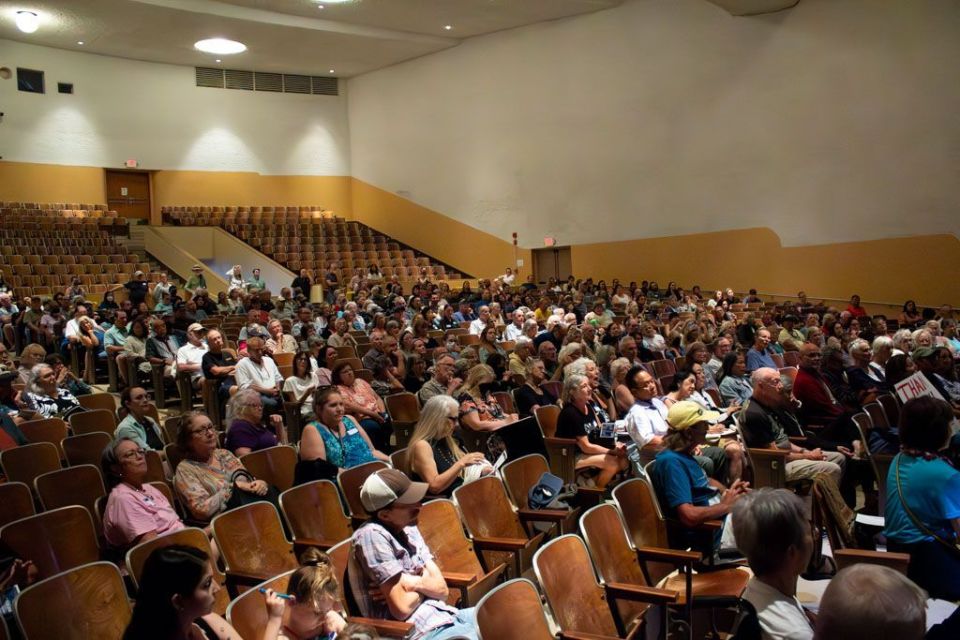
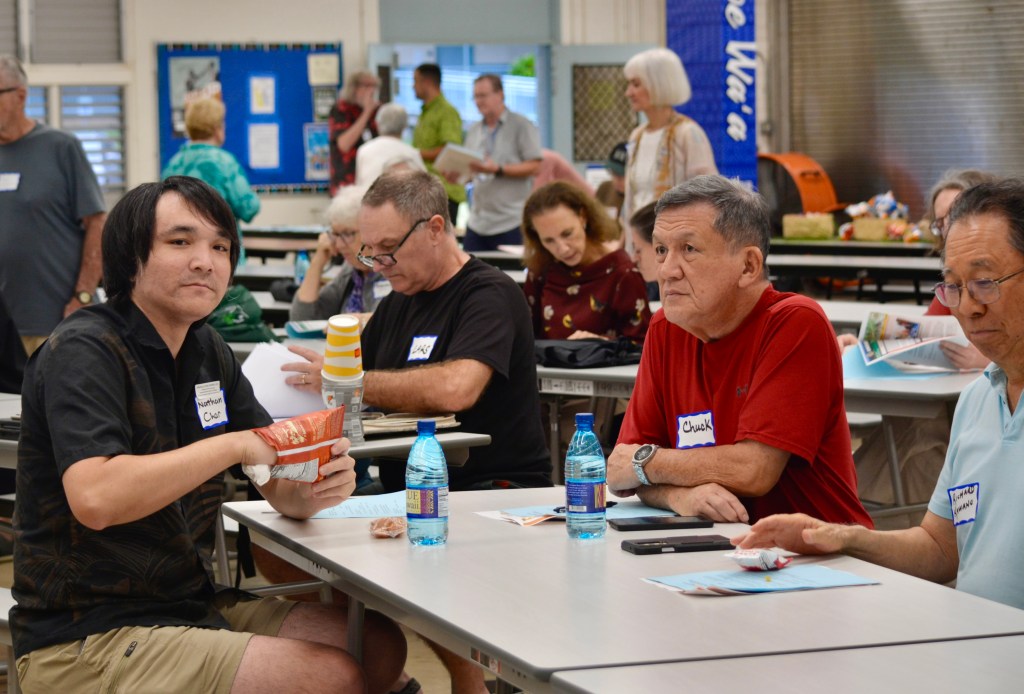
On a muggy night in Makiki in March, as rain clouds darkened the skies above Stevenson Middle School, dozens of residents gathered inside the school’s cafeteria to learn about a more consequential storm brewing nationwide.
The occasion was a town hall for the Maikiki-Punchbowl-Papakōlea neighborhoods, organized by state Sen. Carol Fukunaga and featuring two other elected officials, state Rep. Della Au Belatti and Honolulu City Councilman Tyler Dos Santos-Tam.
The primary topic that evening was the draconian funding cuts that are coming out of the two-month-old administration of President Donald Trump.
As Fukunaga warned in her invite to the town hall, any significant cuts may mean essential programs and services “that our communities rely on every day” could be severely impacted.

Town halls are a hallmark of American democracy. Typically, they include discussions of public safety, pending legislation and neighborhood concerns. Of late, many have focused on current crises such as invasive species.
But the actions of the Trump administration have raised anxiety and uncertainty to a new level. Constituents are looking to local leaders for answers — and help.
Town halls are a direct way to share what local government is doing about it. For the Legislature, that includes possible special sessions the weeks of Aug. 25, Sept. 29 and Nov. 17. Those align with when Congress must approve a new federal budget agreement, which is operating on a continuing resolution until the end of September.
Belatti spoke first that night, underscoring Fukunaga’s alert. Hawaiʻi and its people, she said, need to brace themselves for the harsh realities that are likely coming, especially cuts to federal entitlement programs like Medicaid and others that so many in Hawaiʻi depend on.
“When we talk about what’s been happening at the federal level, and the chaos and the executive orders and saying people are going to be fired and people are going to lose their jobs over cutting grant funding — when those things come down, it affects directly our community,” she said. “And that’s the kind of thing that the three of us have been monitoring for the last three months.”
“It feels like it’s been five years,” she said.

Belatti, a progressive Democrat, rejected arguments from the president and his advisor, Elon Musk of the ad-hoc Department of Government Efficiency, that federal funds used locally amount to fraud, waste and abuse. She said she sees firsthand how the monies are helping people get by.
“It’s actually going to communities that are doing the work that we tasked them to do,” she said, mentioning especially support for the sick and poor.
Belatti choked up a little, her eyes brimming. She asked the audience to give her a second so that she could “get a little emotional, because it’s been very much a whirlwind moment in time I have never seen in my 18 years of government.
“I thought Covid was bad,” Belatti said. “This is actually worse than Covid because of the chaos and uncertainty that we’re all living in.”
‘Everyone Is Hands On Deck’
Trump has been in office less than 100 days, but the speed of his executive orders and the shredding of federal agencies by DOGE have been dizzying, disorienting and unending.
The biggest threat from Trump-Musk for many legislators is to Medicaid. U.S. Sen. Mazie Hirono, citing data from the U.S. Congress Joint Economic Committee, said in a recent press release that nearly 20% of Hawaiʻi’s population is covered under the health care program for low-income individuals and families.
It can be very confusing to keep track of all that is going on. But in a small blue state like Hawaiʻi, lawmakers like Belatti, Fukunaga and Dos Santos-Tam are leveling with constituents, refusing to sugarcoat the seriousness of what they describe as an unprecedented and growing crisis.
The idea of holding special sessions later this year, said Belatti, is to be able to respond to any fiscal shortfalls or needs that arise. While the state has set aside several hundred million dollars in emergency funding in the event it has to draw on the money to compensate for federal cuts to programs, the lawmakers said it may not be enough.
Belatti said she is on calls with legislators all over the country, comparing votes and planning for what’s next.
“That’s how critical this situation is,” she told the crowd at Stevenson Intermediate. “Everyone is hands on deck, because this is going to potentially affect communities.”
At The Federal Level
Town halls have not been limited to state and county offices. U.S. Reps. Ed Case and Jill Tokuda have been holding their own forums in the islands since Trump’s inauguration, some in person, some by phone, some online.
For Case, it included a “talk story” in February where he said that Americans are living in dangerous times. Tokuda’s forums included one on Maui where she said many in attendance expressed fear, anger and frustration at what’s happening in D.C.
Join my short-notice Tele-Talk Story this Monday, February 10th, at noon Hawaiʻi time, to address the confusion and chaos of Trump 2.0. Here’s my e-newsletter with how to join and more. https://t.co/QUD0jgyIVe pic.twitter.com/sRdf2yDJH3
— Rep. Ed Case (@RepEdCase) February 8, 2025
Hawaiʻi has no Republican representative in Congress, and county offices are nonpartisan. At the Legislature, Senate Minority Leader Brenton Awa said he was not planning any town halls in his district about the Trump cuts. And House Minority Leader Lauren Matsumoto said nothing is planned during session for her caucus.
“We are probably going to do our listening tour again this summer but not specifically about Trump,” she said.
Mahalo to all who attended my Maui Town Hall yesterday. Over 400 people came out to voice their concerns for Hawaiʻi & share stories about how they've been personally impacted by the Trump Administration. I feel your frustration—and we will continue to fight together to protect… pic.twitter.com/vKWUG64qtp
— U.S. Rep. Jill Tokuda (@RepJillTokuda) March 20, 2025
At the March 18 Makiki town hall some local issues — condo insurance, little fire ants, fireworks, schools — were on some people’s minds. But the Trump-Musk cuts dominated the remarks from the legislators.
Belatti said she is worried that the Legislature has not set aside enough money in the event the state has to shoulder more of the costs of federal cuts.
“We did put $200 million in the rainy day fund,” she said. “I will tell you, that’s not going to be enough. It’s just not. The Senate is moving a grant-in-aid bill that’s going to potentially help address kind of the human, medical, health care resources, those kinds of nonprofits that are our partners. But again, I don’t know that that’s going to be enough as well.”
Fukunaga also worried that monies set aside by the House and Senate to protect social services may not be enough. Her chamber recently passed the grant-in-aid bill, Senate Bill 933, which she described as a “kind of a catch-all bill” that would temporarily fund nonprofits that have lost federal funding or positions. But it’s only a temporary fix.
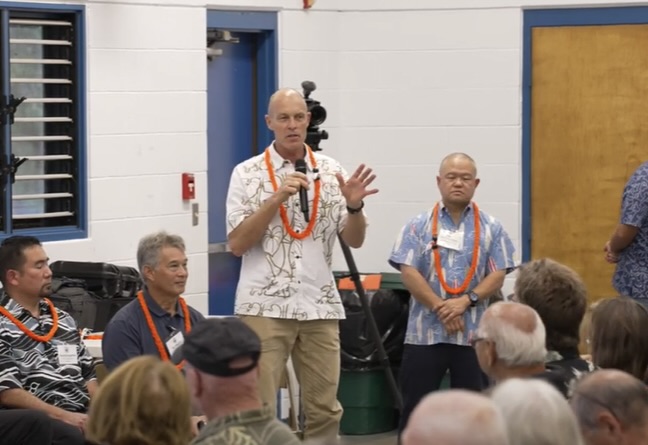
When it comes to budget decisions, Fukunaga said she and her colleagues are “taking each day one step at a time, and at least trying to put different vehicles in place so that if there are specific emergency areas that we can respond quickly.”
She said that the Legislature is in close contact with the congressional delegation and the governor and lieutenant governor. She also encouraged people in the audience to be engaged, and to donate time and money to groups in need.
“This is really a time to start thinking about how we all get together so that we can mobilize our communities to survive whatever lies ahead,” she said.
Anne Smoke, who lives in a condo in the Punchbowl area, said she was grateful for the Makiki town hall and for the work of her representatives in government.
“I’m concerned about what’s happening,” she said in an interview after the forum. “I feel for all of them, because they are really carrying a burden. There isn’t probably a minute that goes by that they’re not watching to see what’s next.”
“They’re on it — that was my impression — and they’re trying to prepare.”
Concerns At County Level, Too
Budget cuts will roll down to county level.
Dos Santos-Tam, chair of the City and County of Honolulu’s budget committee, told the audience that 12% of Honolulu’s $4 billion budget comes from federal funds. The Department of Transportation Services, which runs Skyline and the bus system, is among the most dependent on that funding.
What “keeps me up at night,” he said, are possible cuts to homeless services.
“If they don’t have the staff, if they lose grant funding, there’s just not going to be people to go out and do these sorts of services,” Dos Santos-Tam said.
Mayor Rick Blangiardi has set aside about $30 million for stop-gap purposes in case of federal cuts, something Dos Santos-Tam supports.
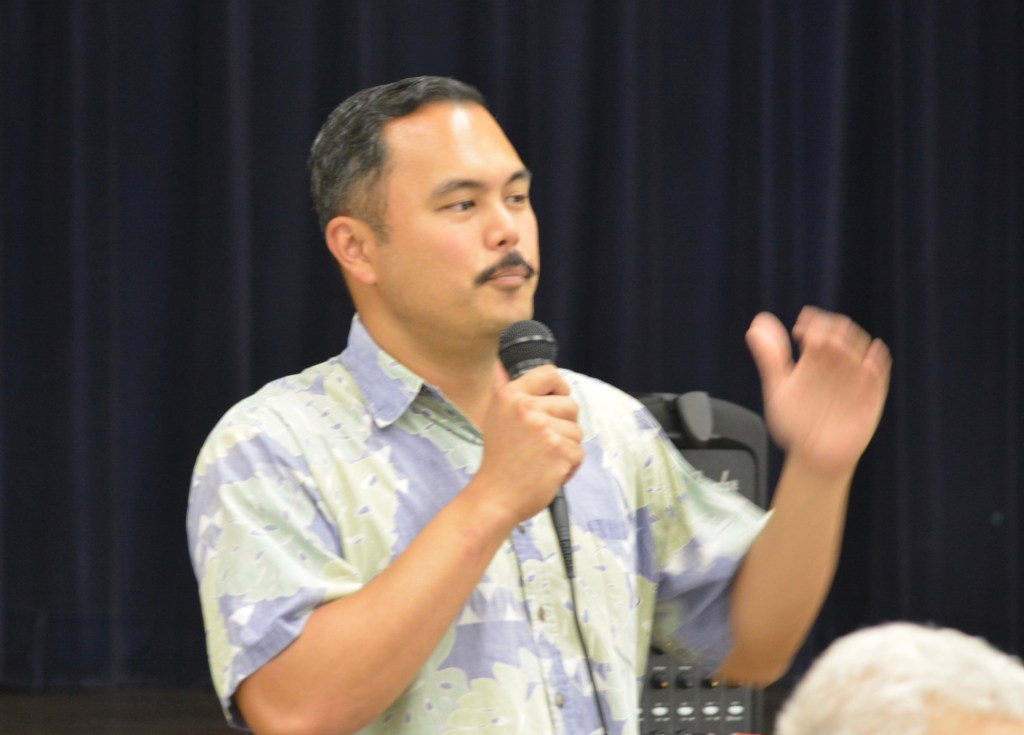
“But I’m also deeply concerned that $30 million is not enough,” he said at the town hall. “What do we do after that $30 million is exhausted? We can’t just sit on our hands and let people in our community suffer, but we don’t have all the answers. We’re limited in terms of our property taxes.”
Dos Santos-Tam said he was not trying to scare people, but he made clear at the town hall that constituents should be concerned about possible serious cuts to programs they depend on.
Concerns about county funding extend to the neighbor islands, which also receive funding from D.C.
Heather Kimball is a Hawaiʻi County Council member and president of the Hawaiʻi State Association of Counties. She and state Rep. Matthias Kusch held a town hall at Honokaʻa People’s Theatre March 30, one of several held recently by area lawmakers on the Big Island.
Kimball told Civil Beat that about 10% of Hawaiʻi County’s revenue comes from intergovernmental sources that are the direct result of federal funding that passes through the state to the county. That figure currently is around $96 million, and Kimball said the county officials are concerned “about how much of that is actually going to come through, directly or indirectly.”
Like Dos Santos-Tam, she said cuts would primarily strike mass transit, housing and social services.
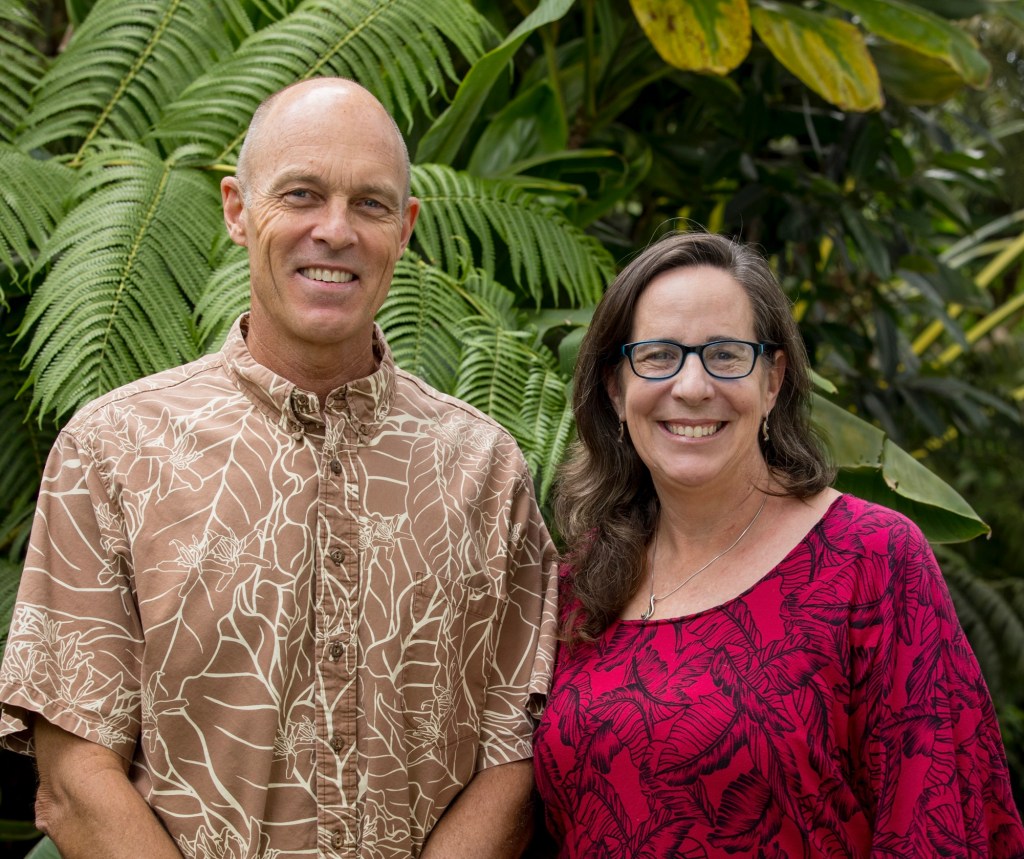
Kimball said she is not yet at a “point of panic.”
“I strongly believe in the constitutional protections of a three-branch system and the role of bureaucracy, and it’s getting tested regularly,” she explained. “Let me say that optimism is tested regularly on a daily basis.”
Kimball also spoke at an online briefing March 28 sponsored by the Hawaiʻi Alliance of Nonprofits, where she elaborated on her concerns about federal cuts — namely, to Medicaid.
“From our standpoint, health services are primarily managed through the state, but the indirect impacts of reduction in funding and SNAP benefits, TANF benefits or other Medicaid services could have an impact on the ability of the state to pass through some critical funding to all four counties.”
Kimball’s advice to the counties and nonprofits that received federal funds for Covid relief and under the Inflation Reduction Act is to make sure those monies are encumbered so that they can be used as intended.
Up Next
Belatti said the Makiki town hall was just one example of community engagement. Up next for her is a forum set for Wednesday evening at Waiwai Collective on University Avenue.
“Our Kuleana: Fighting for Hawaiʻi’s Future,” which will focus on federal and state budget cuts, features Kai Kahele, chair of the Office of Hawaiian Affairs Board of Trustees; Deb Zysman, Hawaii Children’s Action Network’s executive director; Noelani Goodyear-Ka‘opua, a UH Mānoa professor; Will White from Hawaii Appleseed; and state Rep. Tina Grandinetti.
The forum will be moderated by state Rep. Ikaika Hussey. Echoing other lawmakers, he told Civil Beat the state is not only facing the likelihood of huge cuts to federal monies but also a reduced revenue stream locally.
“There’s the revenue that we’re no longer getting because of the tax reforms that were just passed in the last session,” he said. “So there’s a pretty hefty amount that we need to cover.”
That conversation, said Hussey, should include discussion of shifting away from depending on imports by growing the size of the local economy.
 Sign up for our FREE morning newsletter and face each day more informed.

Local reporting when you need it most
Support timely, accurate, independent journalism.
Honolulu Civil Beat is a nonprofit organization, and your donation helps us produce local reporting that serves all of Hawaii.
ContributeAbout the Author