Why Do Legislative Leaders Refuse To Change Old Ways Of Doing Business?
In a dysfunctional end to conference committee, the most important reform measure is shot down with no explanation.
April 27, 2025 · 9 min read

About the Author

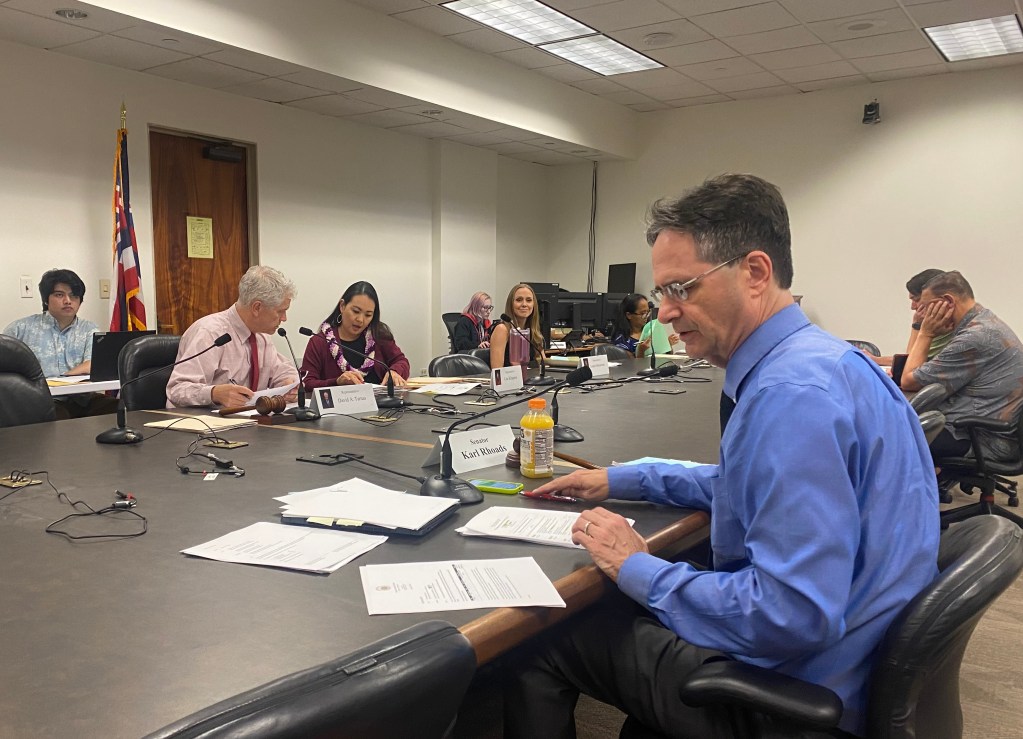
Itʻs hard to imagine a bleaker end to the Hawaiʻi Legislatureʻs conference committee period than what unfolded Friday night in Room 325 at the State Capitol.
Senate Judiciary Chair Karl Rhoads could barely bring himself to look up, leaving House Judiciary Chair David Tarnas to announce the death of their attempt to finally meaningfully address the pay-to-play corruption that infests Hawaiʻi politics.
Not in the room were the measureʻs silent assassins, House Speaker Nadine Nakamura, Senate President Ron Kouchi and the money committee chairs, Rep. Kyle Yamashita and Sen. Donovan Dela Cruz.
Nakamura and Kouchi had already watered down the proposal behind the scenes so that it basically wouldnʻt apply to legislators, without explaining their actions. Rhoads and Tarnas acquiesced to those changes in hopes of salvaging part of House Bill 371.
Then on Friday Yamashita and Dela Cruz refused to “release” the measure, which they should have no say over in the first place since it didnʻt call for state appropriations. They too did not explain their actions.
In one sense, it was business as usual. Money chairs have long wielded freakishly excessive powers to determine the fate of any bills that come their way through committee referrals — 67% of measures this session. Without their blessing, all such bills die.
Itʻs a big reason that pretty much every major reform proposal has failed since bribery scandals prompted the House to appoint a special commission in 2022 to suggest a path away from pay-to-play.
But this one was different because of the overwhelming evidence of pay-to-play generated last year in a New York Times/Civil Beat report. It found that more than $24 million in political contributions made in Hawaiʻi since 2006 came from people tied to government contractors — about one-fifth of all donations.
Of that total, about $6 million went to candidates for the Legislature. And make no mistake, without legislative appropriations those state contracts donʻt happen even if they are ultimately awarded by the executive branch.
HB 371 would have prohibited donations from the executives of state and county contractors and grantees as well as their immediate family members.
If legislative leaders are willing to gut and ultimately kill that, what wonʻt they do to maintain the status quo?
“This is an important matter that we do need to address,” said a beleaguered Tarnas. “I pledge to continue working on this.”
Hereʻs a look at whatʻs happened this session to some of the other reform proposals.
Election Reform
The money committee chairs also refused to release a measure to increase the state’s partial public financing program for political candidates. But in a curious twist Friday night, Tarnas said there might still be money in the next state budget to do exactly that.
The budget will be up for a final vote this week. Itʻs so hard to decipher that itʻs no wonder Tarnas didn’t know whether the money is in there or not.
The current program is grossly underfunded and thus underused, but reformers have long sought to offer more public money to qualifying candidates who volunteer to limit their spending.
Itʻs another attempt to thwart pay-to-play politics that generally favor well-heeled incumbents. Therefore, weʻve got to say it, weʻre not holding our breath for an 11th-hour reprieve via the state budget, but weʻll see.

Other measures died earlier in the session:
After massive lines formed at voter service centers last Election Day, five bills would have required more of them to be open for final-day voting, especially on Oʻahu. None received a committee hearing.
Lawmakers also showed no interest in making the state insurance commissioner an elected position. It’s now appointed by the governor and longtime commissioner Gordon Ito recently retired.
There was some interest in reforming the state Elections Commission itself. The nine-member board has become increasingly polarized in recent years, and House Bill 141 would have given the Senate the power to confirm commission members.
It passed the House before dying in the Senate.
The same fate befell a Campaign Spending Commission-driven bill that would have prohibited contributions to state legislators while they are in session. Fundraising events are already banned in-session, but not donations.
Speaking of the commission, the state budget currently contains $200,000 to allow its five-member staff to expand for the first time since it was created in 1973. The additions would include the CSCʻs first-ever investigator.
Ethics And Accountability
One way a measure can survive conference committee is for a chamber to belatedly agree to the otherʻs amendments. Thatʻs what happened with a bill to expand lobbyist registration and reporting requirements to people who advocate for significant projects through the executive branch by meeting with the governor, staff and agency directors.
Just before deadline last week, the House agreed to Senate amendments to House Bill 412, which is now on the governorʻs desk. It will be interesting to see what Gov. Josh Green does with that one, since it will require more transparency from people going to see him and his appointees about their pet projects.
No such luck for a measure to prohibit the governor from suspending the public records law during a state of emergency, as happened during Gov. David Ige’s administration when it was dealing with the coronavirus pandemic.

Different versions of Senate Bill 353 passed both chambers unanimously, but it died when no conferees were named to resolve the differences. Green’s administration opposed that bill mainly because it contained a section that would allow the Legislature to end a governor’s emergency proclamations in certain circumstances.
But again, there was no explanation from anyone as to why that bill stalled.
A bill to strengthen Hawaiʻi’s public records law was inspired by the recent controversial hiring of a new University of Hawaiʻi president. Senate Bill 1255 would have ensured that records and information produced by contractors working for the state are turned over to the public as required by the Uniform Information Practices Act.
That did not happen during the UH president search because UH had inserted a special condition into the contract with the executive search firm. That made information about the candidates collected by the search firm off-limits to public records disclosures.
Opposed by agencies who worried it might allow for release of trade secrets and other proprietary information, the measure died in the Senate. Public records advocates plan to work on it during the interim and bring it back next year.
Another measure that did clear conference committee clarifies that Oʻahu’s neighborhood boards can discuss information brought up at meetings by government representatives — the police, for instance — who give reports at every meeting even if the exact subject isn’t on the agenda.
So did House Bill 126 that “increases transparency and accountability” surrounding the stateʻs much-maligned asset forfeiture law. But the original intent to prohibit forfeitures except in cases of felony convictions was amended to prevent property seizures only until a felony charge is filed.
And three more dead ones: Bills to create external auditing committees for the University of Hawaiʻi and the Department of Education, and Senate Bill 1545 to clarify that the legislative branch isn’t exempted from state anti-nepotism policies.
Civic Education
The Legislature just canʻt seem to get on board with expanding civic education to make for a better-informed citizenry.
House Bill 763 was about the only bill introduced this year covering civic education after several measures failed to get any attention in the past couple years.
It would have established a Hawaiʻi Civic Education Trust Fund that could combine public and private money to create programs for schools. It also would have created new positions within the DOE for teaching civic education, initially requesting $200,000 for two positions and another $84,000 for programs.
The measure passed the House but couldnʻt get a hearing from the Senate Education Committee.
How The Legislature Operates
Way back in January during the honeymoon period for Nakamuraʻs House speakership, there seemed reason to hope this session could bring some reform from within. In a refreshing change, she actually asked her Democratic colleagues what changes theyʻd like to see in the rules by which the House operates.
Among those suggested: limiting the power of conference chairs, preventing the money committees from controlling non-fiscal matters and requiring that legislators be informed from the start about the potential costs of bills through “fiscal notes.”

Ultimately, the changes she proposed were underwhelming. And even though any legislator can propose rule changes, no one was looking to go over the new speakerʻs head.
Nakamura also introduced a measure calling for a full-fledged study of converting to a full-time Legislature. Then she backed off.
In the end, a study of how other states do fiscal notes was approved via Concurrent House Resolution 61.
A study. Of something thatʻs already done in every other state in the nation.
That this is something to celebrate tells you the state of reform in the Hawaiʻi Legislature.
 Sign up for our FREE morning newsletter and face each day more informed.

Local reporting when you need it most
Support timely, accurate, independent journalism.
Honolulu Civil Beat is a nonprofit organization, and your donation helps us produce local reporting that serves all of Hawaii.
ContributeAbout the Author