

Legislative Leaders Want Pay-To-Play Bill Significantly Watered Down
House and Senate negotiators have been polishing the major reform proposal all session. Leadership added new wrinkles at the finish line.
Leaders in the House and Senate want to weaken a key reform measure that had sought to ban campaign contributions from people who win substantial government contracts.
House Bill 371 would include officers, their executives and family members of businesses who do government work and also extend to state and county grant recipients.
But changes being pushed by the House speaker and Senate president would apply the contribution ban only to companies doing business with specific branches of government, essentially continuing the status quo for most elected officials and their campaign donors.

HB 371 appeared to be on its way to passage this session after lawmakers took note of a Civil Beat/New York Times investigation last year that revealed that, for the last 20 years, people with ties to contractors have contributed millions of dollars to campaigns despite a law intended to ban those contributions.
HB 371 would have prevented donations from a large segment of contractors, their executives and their immediate family members
But now, amendments being called for by House Speaker Nadine Nakamura and Senate President Ron Kouchi would narrow the provisions of the bill.
Rep. David Tarnas, chair of the House Judiciary and Hawaiian Affairs Committee who has been a primary supporter of the bill, wouldn’t say Wednesday what the changes to the bill are.
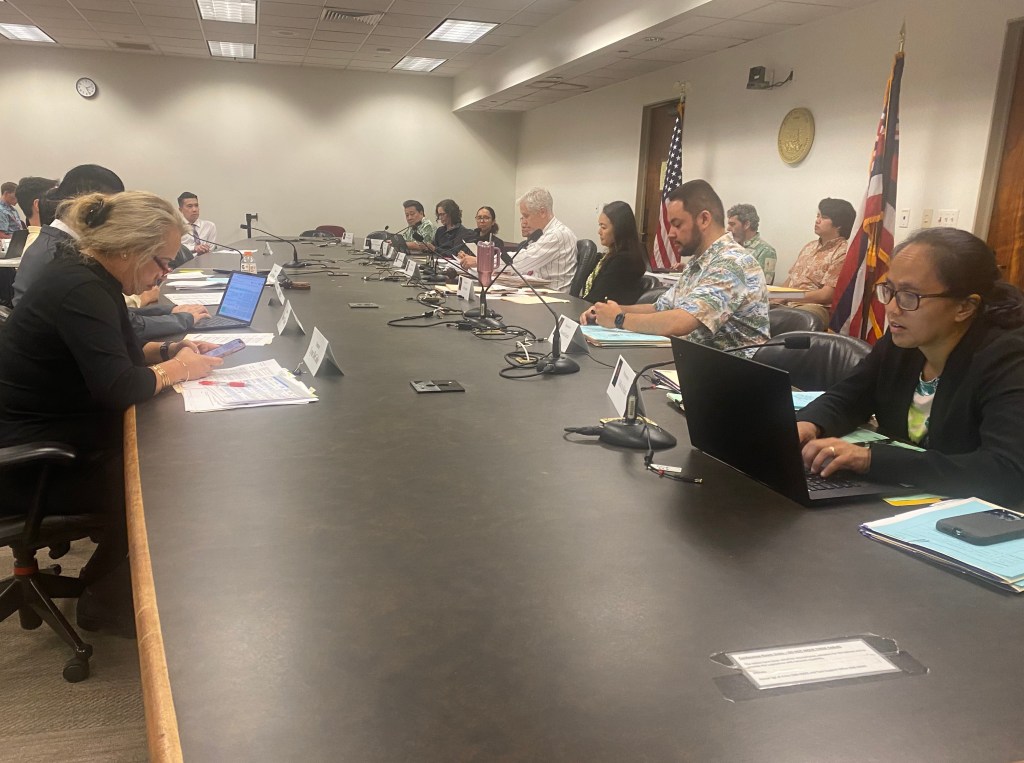
“Let me just say it: it won’t be as strong as the bills we have produced,” he told a conference committee meeting on the bill. “But it’s something we need to get through. And I’m supportive of getting something through even if it might not be as strong as I had wanted.”
Both Tarnas and Senate Judiciary Chair Karl Rhoads said during the hearing that leadership had gotten involved in the bill in recent days.
But a source with knowledge of the latest drafts said that the legislative leaders want a bill that would prohibit only contractors who won contracts from the Legislature from donating to legislative candidates while contractors with jobs awarded by the executive branch wouldn’t be able to donate to candidates for governor or lieutenant governor.
In the last four years, the House has issued contracts to only three companies while the Senate has issued contracts to just two, according to the state’s contract database.
A search of campaign spending data revealed none of those companies have officers who donated to candidates for the Legislature.
Candidates for governor and lieutenant governor would feel the impacts much more heavily since all state contracts are approved by executive branch agencies.
The new provisions are based on Connecticut’s law, enacted after a series of scandals involving elected officials in both the Legislature and the executive branch.
However, Connecticut has six elected officers in the executive branch: the governor, lieutenant governor, secretary of state, treasurer, comptroller and attorney general — some of whom have direct authority over awarding contracts.
Tarnas had initially thought he might model a bill after Connecticut’s but rejected the idea after more closely examining its provisions and deciding it wasn’t the right fit for Hawaiʻi’s situation.
The changes put forward by House and Senate leaders are a major departure from previous versions of HB 371 that passed on unanimous votes in both the 51-member House and 25-member Senate.
Even after the bill switched chambers, Senate Judiciary Committee members pulled together a bill that sought to close loopholes and address decades-long concerns that state contracts were being awarded to companies and their owners who donated heavily to lawmakers’ political campaigns.
Earlier this week, Tarnas, the House’s lead negotiator, said he was ready to agree on a bill that was similar to the Senate’s draft of the measure – which would collect information on contractors and their officers on a password-protected website accessible only by candidates. That version of the bill also would limit the ban on campaign contributions to contracts for services over $100,000 and contracts for construction over $250,000.
But when the conference committee gaveled in on Wednesday afternoon, the situation had changed.
Tarnas told Rhoads he had a new draft to send over to him. Rhoads responded that “leadership has gotten involved.”
Tarnas conceded after the hearing that Nakamura and Kouchi are key players in the changes in the measure.
Kouchi and Nakamura are involved with the bill “because this is something of critical importance,” Tarnas said.
But, Tarnas said, “The last draft was not as strong as I wanted it to be.”
Kouchi and Nakamura didn’t respond to inquiries Wednesday afternoon.
Both Tarnas and Rhoads said HB 371 will pass in some form this week.
“I can tell you something will pass, I don’t know exactly what will pass,” Rhoads said.
“I’m relentless, I’ll keep working on it,” Tarnas said.
More changes to the bill could still come. The conference committee is set to reconvene Thursday at 2:15 p.m. in conference room 325.

