Kirstin Downey: New Protections Sought For Kailua Neighborhoods
Concerned about gravesites and a new law to quicken development, the Preservation Commission wants area added to historic register.
August 1, 2025 · 8 min read


About the Author

The Oʻahu Historic Preservation Commission is taking action to have Kailua’s prime beachside neighborhoods, including Lanikai, Coconut Grove and Kalama, included on the state and national historic register.
The panel unanimously decided Tuesday that the widespread discovery of graves there indicates that the area is a sacred burial ground that requires particular protection. The commission is trying to stave off what many describe as a mounting crisis of accidentally exhumed human remains, some exposed in recent pool construction projects, in the face of new state legislation that will make it harder to preserve historic areas that do not already have explicit protections.
A historic register listing or even a nomination identifies properties worthy of preservation or heightened sensitivity in development. But it doesn’t guarantee preservation because owners of these properties maintain their own rights to develop them as they choose.
The nomination process isn’t a certain thing, either, as it also allows owners to object to inclusion on the list if they wish.

Ideas showcases stories, opinion and analysis about Hawaiʻi, from the state’s sharpest thinkers, to stretch our collective thinking about a problem or an issue. Email news@civilbeat.org to submit an idea or an essay.
The commission was informed that two weeks ago, two more human bodies were unearthed, this time at a residence on North Kainalu Drive. Kailua residents told the commission the remains were handled cavalierly, having been covered up by a black plastic sheet and placed under a gutter downspout, with a loose dog allowed to wander in the vicinity.
The city’s Department of Planning and Permitting had authorized a pool construction project on the site to proceed without a state historic preservation review although human remains had been found throughout the neighborhood.
Some 338 sets of human remains, known in Hawaiian as iwi kūpuna, have been encountered in Kailua since 1930, including at least 157 since the passage of Hawaiʻi state burial laws in 1990. Public concerns were heightened in 2023 when a pool construction company operating in Kailua on an unmonitored site scraped up and then dumped a pile of excavated sand containing human bones in a horse paddock in Waimānalo.
At that time, the Association of Hawaiian Civic Clubs asked the commission to declare the Kailua sand berm a “highly sensitive area of significant adverse impact on iwi kūpuna.”
Protection For Remains Long Sought
For the past two years, the commission has taken testimony and analyzed reports about the issue. In addition to the Civic Clubs, the Society for Hawaiian Archaeology, the Office of Hawaiian Affairs, the Oʻahu Burial Council and the Kailua Neighborhood Board have all asked the commission to find a way to enhance monitoring and require more sensitive handling of sites likely to contain human remains. No one is asking for construction to stop.
The Commission has found that as many as 3,000 people were likely buried in the Kailua sands under ancient Hawaiian customs.
More than 100,000 properties in the United States are registered historic sites, including more than 40 burial grounds. The sites remain privately owned but are officially recognized as having special historic significance and, in some cases, properties become eligible for tax credits.
All over the country, historic preservation commissions launch the process toward historic register designation. This is new to Oʻahu because while most major American cities and counties have had such commissions for decades, Honolulu only recently authorized the commission’s creation.
The commission’s action to seek historic-registration status for the community reflects growing tensions between historic preservationists, lawmakers and real estate developers about what government officials should be doing to protect Oʻahu’s historic sites, including those that contain human remains. Developers and construction companies have said that historic preservation reviews delay their projects.
In June, the commission convened officials from the state, city and community groups to discuss ways to increase collaboration on the issue between the city’s Department of Planning and Permitting and the State Historic Preservation Division. They agreed to work together to draft a memorandum of understanding between state and city officials to identify areas that are likely to contain burials, in order to ensure they receive enhanced monitoring. Officials then indicated they would collaborate on the plan.
The groups were subsequently dismayed by Gov. Josh Green’s decision in July to sign a bill making it easier for residential development projects to avoid historic preservation review. He had previously suggested he would veto the legislation.
The law provides an exemption to the review process for residential construction projects in “nominally sensitive” areas that have already been “substantially disturbed” and that are not included on the registers of historic places.
Assault On Historic Preservation
The problem is that historic preservation efforts in the state have been sadly weak and inconsistent, and many historic sites have been destroyed without anyone taking note of the importance of what was once there, or what might remain as ruins. This legislation would permit sites to be further damaged just because they had been somewhat damaged in the past or because no one had previously recognized their significance.
Commissioners had voted unanimously to express their opposition to the bill, which they labeled “wretched,” “ridiculous” and an assault on historic preservation throughout Oʻahu, and asked the governor to veto it. They were angered by changes that had occurred in the bill during the legislative process, after they had supported the original version. Revisions sought by developers changed the substance of the legislation bit by bit but the commission, which meets only monthly, could not respond rapidly enough to make timely comments to lawmakers.
A strict interpretation of Sunshine laws insisted upon by the city’s corporation counsel meant the commissioners were repeatedly precluded from discussing emerging issues because they were told they had not placed the legislative item on the public agenda one month earlier, as they were told the law required. This made it impossible for the commission to react to fast-changing and morphing legislation that they viewed as highly damaging to historic preservation.
The state preservation office has been notoriously overworked and understaffed, leading to review delays.
Ultimately, they hung their hopes on convincing Green that the law would seriously injure historic preservation and that he should veto it. They were initially hopeful he would do so, but he opted to sign the legislation anyway.
City officials have since told the commission and community groups that the new state law may prevent them from seeking state historic preservation review of sites in Kailua the commission has repeatedly identified as particularly sensitive.
The city does not currently employ archaeologists or historians who are qualified to analyze historic sites and so the city depends on state preservation officials to do that work. But the state preservation office has been notoriously overworked and understaffed, leading to review delays.

Defining The ‘Jaucus Sands’ District
The only specific protection provision in the controversial new law is for properties that have already achieved designation on the historic register, which is a complicated, time-consuming and costly process. That is the particular opening the commission has indicated it intends to pursue in an effort to ensure that more properties obtain appropriate historic consideration.
Commission chair Kehaunani Abad, an archaeologist who is a vice president of Kamehameha Schools and previously director of community affairs at the Office of Hawaiian Affairs, is drafting the historic register application herself, with the assistance of a colleague on the commission, retired University of Hawaiʻi archaeologist Tom Dye.
Dye has led the commission’s efforts in seeking an improved process for protecting gravesites. In a recent meeting, he emotionally described having repeatedly witnessed “crushed babies” and “broken skulls” in backhoe buckets during his long career in archaeology in Hawaiʻi.
These soils and gravesites are found in many other parts of Oʻahu as well, such as Waimānalo and the Waiʻanae coast.
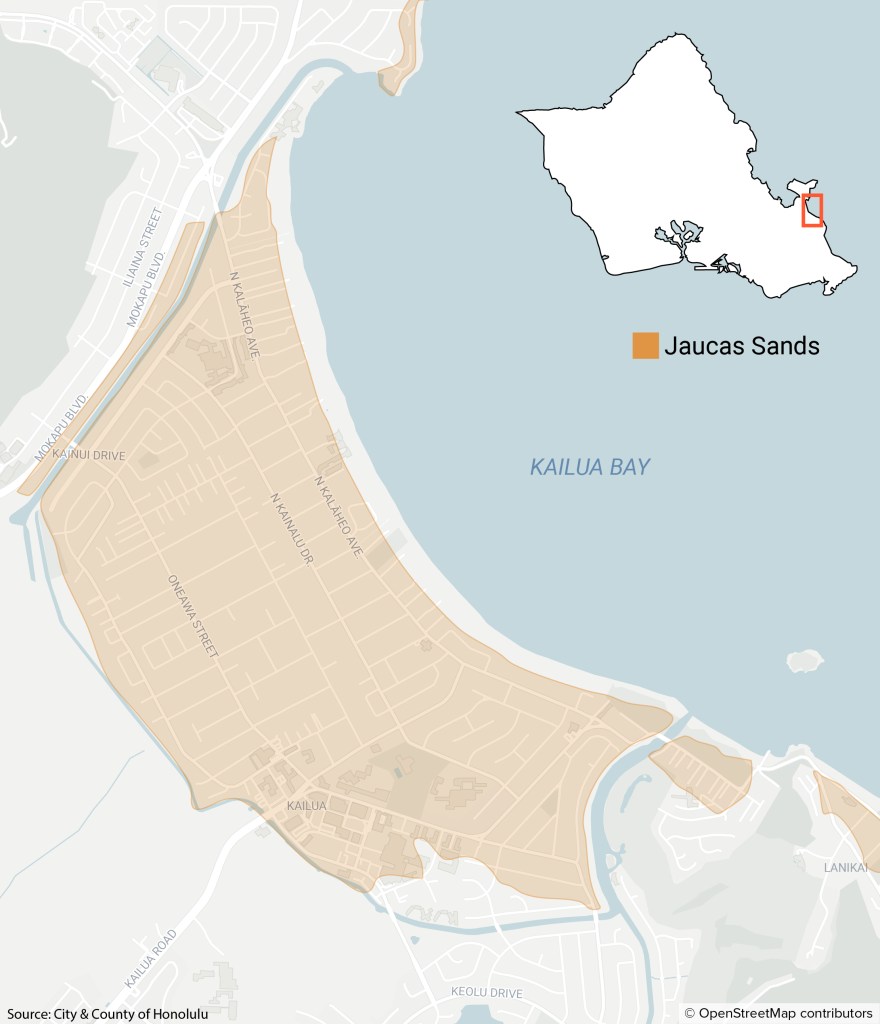
The commission voted unanimously to nominate the “Jaucus sands” district of Kailua to the state and national register of historic places. Places with Jaucus sands, which are quick-draining, rapidly permeable soils common to vegetated beach areas, were particularly favored by Hawaiians as graveyards. In Kailua, the Department of Planning and Permitting has defined the Jaucus sands area as roughly bordered by South Kalāheo Avenue on the makai side to Kihipai Street on the mauka side, on the north by Mōkapu Boulevard and to Lanikai on the south.
But these soils and gravesites are found in many other parts of Oʻahu as well, such as Waimānalo and the Waiʻanae coast. Others at the meeting suggested that historic register designations could be used to protect other communities where many gravesites have been found.
The commission also passed a resolution stating that the burial ground area of Kailua is not “nominally sensitive,” but is in fact highly sensitive.
Other stakeholders at the commission meeting, including historic preservationist Kamakana Ferreira, lead compliance specialist for the Office of Hawaiian Affairs; Makoa Caceres, chair of the Oʻahu Burial Council and Nick Belluzzo, president of the Society for Hawaiian Archaeology, said they supported and would endorse the commission’s actions.
 Sign up for our FREE morning newsletter and face each day more informed.

Local reporting when you need it most
Support timely, accurate, independent journalism.
Honolulu Civil Beat is a nonprofit organization, and your donation helps us produce local reporting that serves all of Hawaii.
ContributeAbout the Author