Honolulu Police Chief Search: It's Deja Vu All Over Again
The Honolulu Police Commission can and should do some things better this time around.
September 7, 2025 · 11 min read


About the Author

“I’m literally experiencing PTSD.”
Honolulu Police Commissioner Doug Chin pretty much nailed it during a recent commission meeting as the board began talking about how to move forward with hiring its third police chief since 2017. The first was indicted on federal corruption charges and went to prison. The last two didn’t last more than three years each and both quit under fire.
The current search process is shaping up to be similar to the last one, so forgive those of us who are cynically wondering if it’s just going to produce the same results. Another chief who needs to go after just a couple years.
That’s partly because so far the commission is largely following the same playbook as the last two times: Hire a search firm, wait for the consultants to do the work and then pick from among the three to five finalists.
Exactly what happened last time. And the time before.
It will take until at least November just to onboard the search firm, the commission predicts. And then months more to pick a new chief.
“March if we’re lucky,” commission vice chair Laurie Foster, who is leading the search, has said a few times.
I guess we need to be mostly OK with that since there doesn’t seem to be another option with this commission. This is an important job not only from the public’s perspective but for the sake of the more than 2,000 employees of the Honolulu Police Department who have now been put through three failed chiefs in a row.
But that’s where the same old, same old should stop. Here are four things that the commission should do to be more proactive and more engaged.

Seek Meaningful Public Input Early And Often
In 2017, the Police Commission hired the search firm EB Jacobs to round up applicants and vet them. The firm surfaced seven finalists using a combination of written tests, mock press conference scenarios and other screening tools. The finalists’ names and information were revealed to the commission — and publicly — just a short time before commissioners interviewed candidates and made a decision. Yet the run-up, including hiring a consulting firm led by Joe Hinish, took nearly a year.
Four years later, recently departed chief Joe Logan was part of an initial group of 20 applicants brought forward, again by Hinish. This time his firm was called PSI Services and it began its work in December 2021. In May 2022, the applicant group was whittled down to four finalists who were sent to the Police Commission and publicly named.
Again, that was the first that commissioners — as well as the public — knew who was in the running. Yet just two weeks later the commission gave the job to Logan.
It’s only fair to wait to name them until finalists are settled. But two weeks isn’t much time for interested groups, the employees or the press to really look into the applicants or provide meaningful feedback.
That year, the four finalists took part in a 90-minute PBS special. Questions from the public were submitted but screened and then asked by the host, not the people themselves. There was no live audience or public forum.
Two days after the PBS show, on a Saturday, the commissioners privately interviewed the four, although they split the assignments so not all commissioners interviewed all the applicants. They traded notes.
The next week the four attended a commission meeting and answered a few more questions from commissioners, who then immediately selectd Logan after a moderate debate.
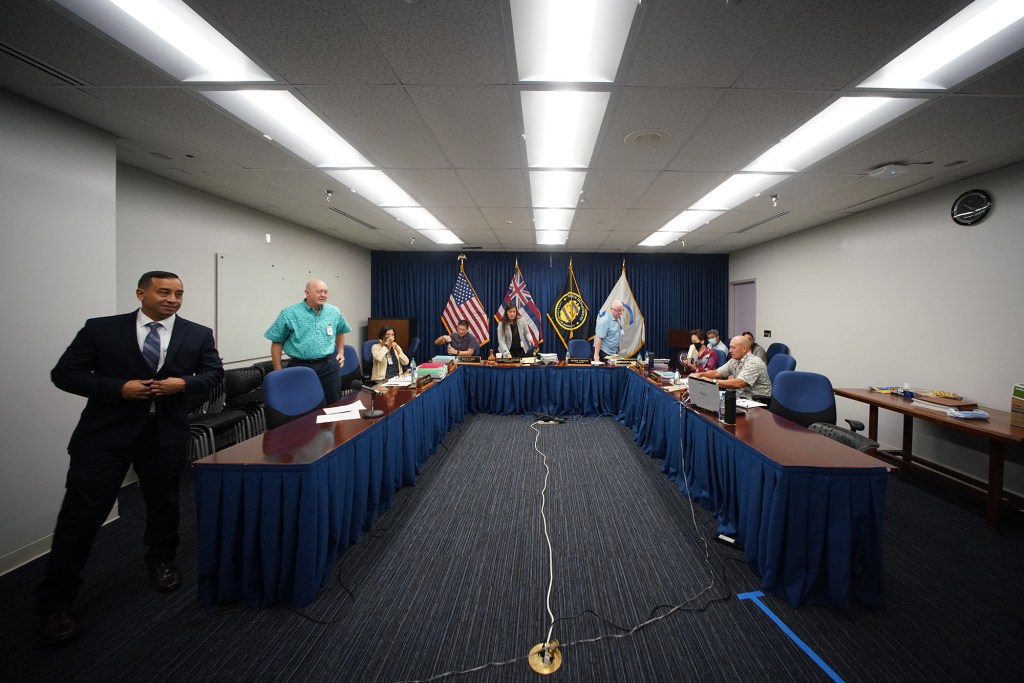
But so much more could and should be done. Commissioners and their staff should already be reaching out to community groups and advocacy organizations who take an interest in policing. The Westside. Kalihi. Central Oʻahu. The Micronesian community. The social justice and good government groups. Youth organizations. Churches. Business groups.
Advice to commissioners: Get out of that small hard-to-access commission meeting room, which is unfortunately locked away inside the police department, and hold special listening sessions all over the island. Don’t wait for people to come to you.
Meanwhile, form a public advisory group made up of thoughtful members of the diverse constituencies already mentioned, people who have had experience working with the police.
In 2021, community advocates under the umbrella group called the HPC Task Force asked the commission to put in place a community advisory group to help with the selection process and proposed a framework. But commissioners refused and only allowed minimal community participation.
That shouldn’t happen again. The commission needs to establish relationships now. Once the finalists are named it will be much easier to let those folks help organize public forums for the broader community.
Take a page from the town hall-style meetings that the mayor, council members and lawmakers have popularized. Get out into the community and engage with the residents and business owners who are depending on you.
Don’t Let Consultants Hijack The Public Process
In 2021, the commission paid PSI Services more than $145,000 to collect important information on each of the candidates and rate them on points. They compiled dossiers on the leading contenders, including written essays that answered questions on policing strategies and styles. They ran the candidates through mock press conferences to see how they’d do in a tough situation. They met with a few community stakeholders and conducted an online survey.
But all the information they collected was off-limits to the public. Civil Beat asked for the dossiers of the four finalists but PSI — and the commission — insisted that the work was proprietary. Even the mock press conference scenarios were considered too sensitive to reveal. The consultants argued they might need to do a similar screening for another client someday and it would undermine them if a potential candidate saw the scenario in a news story.
Ultimately, under a public records request, the commission released parts of Logan’s dossier that included his resume and his handwritten answers, a sentence or two each, to numerous questions. But little else was made public including the rankings by PSI that showed how he stacked up to the other candidates. We never knew if he was No. 1 or No. 4.
In contrast, a few months later when the Hawaiʻi Police Commission named finalists for the chief’s job on the Big Island that ultimately went to Ben Moszkowicz, all the interview and background materials including written tests were readily made public. No resistance.
More recently, the University of Hawaiʻi hired a search firm to find a new president. That contract specifically gave all rights to the material collected by the firm to the firm and not the university.
Public records advocates, including Civil Beat, cried foul and two influential senators this past legislative session introduced a bill aimed at making sure the information and documents collected as part of a public search for a high level employee would be subject to disclosure under Hawaiʻi’s public records law. Some issues were raised and the bill didn’t pass. But advocates are ironing out the flaws and plan to introduce it again in January.
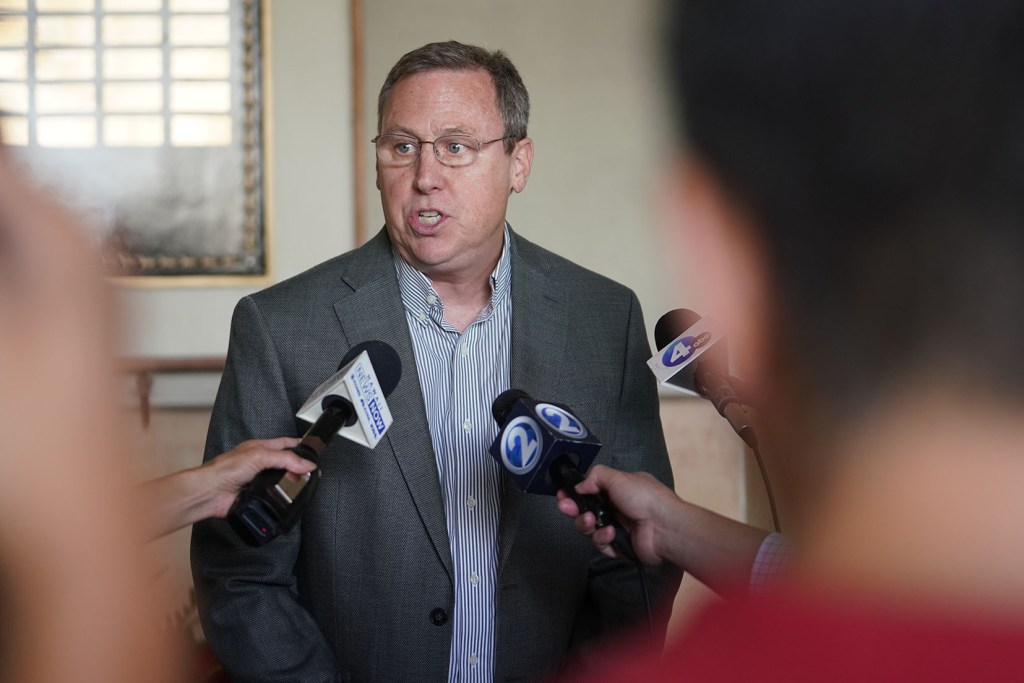
Meanwhile, UH learned from that legislative debate and the next executive search contract issued by the university, this one for a new athletic director, included language that ensured the search material belonged to the state, not the search firm, and would be made available under public records laws.
The Honolulu Police Commission needs to learn that same lesson and make sure any material collected by a search firm that would give the public insight into the new chief be made publicly available in accordance with state law.
Get The Mayor Involved. Now
Honolulu Mayor Rick Blangiardi is rightly angry about how he was treated by the Police Commission in 2022 when Logan was named chief. The mayor has said he was given little information about the choice, just a courtesy briefing, and that was that. It’s the Police Commission, not the mayor, that hires and fires the police chief in Honolulu so he really had no official say.
Yet, as Blangiardi has pointed out, it’s the mayor, not the Police Commission or even the police chief, who takes the brunt of public criticism when crime is on the rise or the Westside suffers from gun violence or traffic jams block commuters trying to get home ahead of a tsunami.
The mayor is not taking a backseat this time and has already inserted himself into the growing public debate over who the next Honolulu chief should be and how that person is chosen.
Moreover, there’s a serious move afoot to use the Honolulu Charter Commission process to make substantial changes to the Police Commission, including perhaps taking the chief’s hiring away from the volunteer board. The Charter Commission already has received at least one detailed proposal giving that authority to the mayor. More along those lines are expected.
The Police Commission is making some effort to acknowledge the mayor’s role this time. It recently set up a small advisory committee to help it select a search consultant and to its credit included Blangiardi administration officials.
Commission Chair Ken Silva also has said publicly he’s committed to meeting with the mayor at least once a month.
And Blangiardi is in the midst of choosing two new police commissioners who, if he can get them through the City Council confirmation process, will play key roles in selecting the next chief. A third commissioner’s term expires in December, well before finalists are expected to be presented to the commission, giving the mayor another opportunity to help steer the selection.
Get The Cops Themselves Involved. Now
Honolulu City Council member Andria Tupola recently introduced a resolution directing the Police Commission to give serious consideration to what the rank-and-file officers and support staff want to see in a chief. It shouldn’t take a vote of the City Council to get the commission to do the obvious, but it seems that’s been necessary.
Foster, the Police Commission’s police chief hiring lead, assured Tupola and the council members at a committee hearing last month that the commission was interested in the rank-and-file’s views. She mentioned that commissioners had recently been briefed on an employee survey by the State of Hawaiʻi Organization of Police Officers.
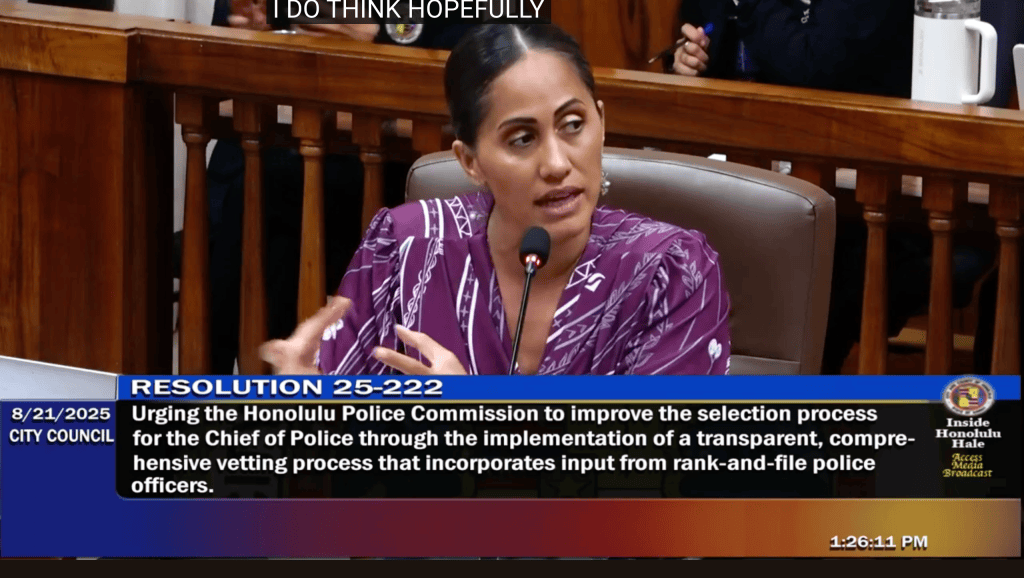
And this year the union itself is making a big effort to get out in front of the police chief selection. Between public testimony at the commission and the council and as many media interviews as SHOPO leaders can do, they are intent on being heard.
“For the first time frontline police officers would have a chance to have their voices heard,” SHOPO treasurer Nick Schlapak told the council’s Public Safety Committee.
Civil Beat had its own lengthy discussion with Schlapak and other union leaders recently and they definitely have perspectives that commissioners should take into account this time around when it comes to a new chief.
“They don’t need someone who will do what they say,” SHOPO’s Honolulu chapter chair told the Public Safety Committee. “They need someone who will listen to what they have to say.”
Thoughts For The Commission
I’ve been watching the Honolulu Police Commission meetings for some time now, as part of our “Let The Sunshine In” effort to keep an eye on government when it comes to accountability and transparency.
Even before Joe Logan decided to call it quits and the commissioners were, reluctantly, forced down this path of finding a new chief, it’s always struck me how little enthusiasm this particular group of commissioners seems to have for the role of public watchdog.
If they had been pressing the chief on the many troubling public safety issues facing Honolulu, would Blangiardi have needed to step in the way he did?
Now they have a real opportunity to correct the mistakes of the past and help guide the police department to a future that is accountable not only to the officers who are struggling more than ever to keep Honolulu safe and healthy but also to the public who expects a professional and capable 21st century policing effort.
Please, commissioners. Get more engaged in this one. This time do what’s best, not just what’s easiest.
 Sign up for our FREE morning newsletter and face each day more informed.

Local reporting when you need it most
Support timely, accurate, independent journalism.
Honolulu Civil Beat is a nonprofit organization, and your donation helps us produce local reporting that serves all of Hawaii.
ContributeAbout the Author