'There Can Be Peace': Hawaiʻi Gov. Josh Green Wants To Heal The Country
In a wide-ranging conversation, the governor makes it pretty clear where his head is at when it comes to combining his ongoing efforts for Hawaiʻi with his future national ambitions.
September 28, 2025 · 25 min read

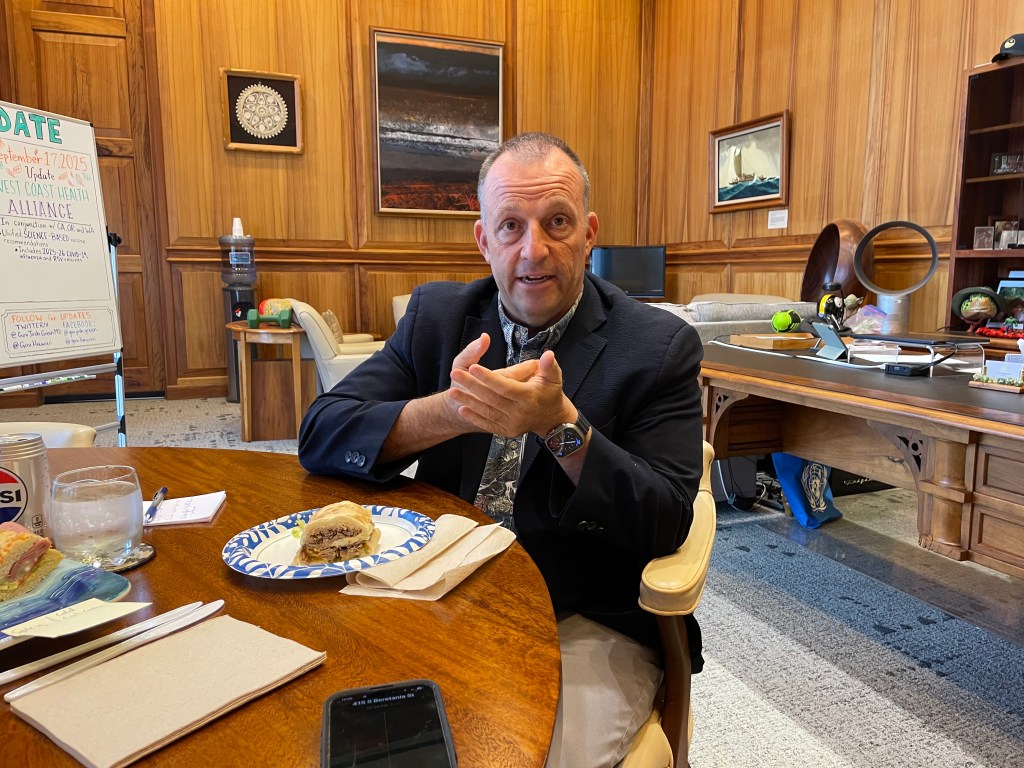
About the Author
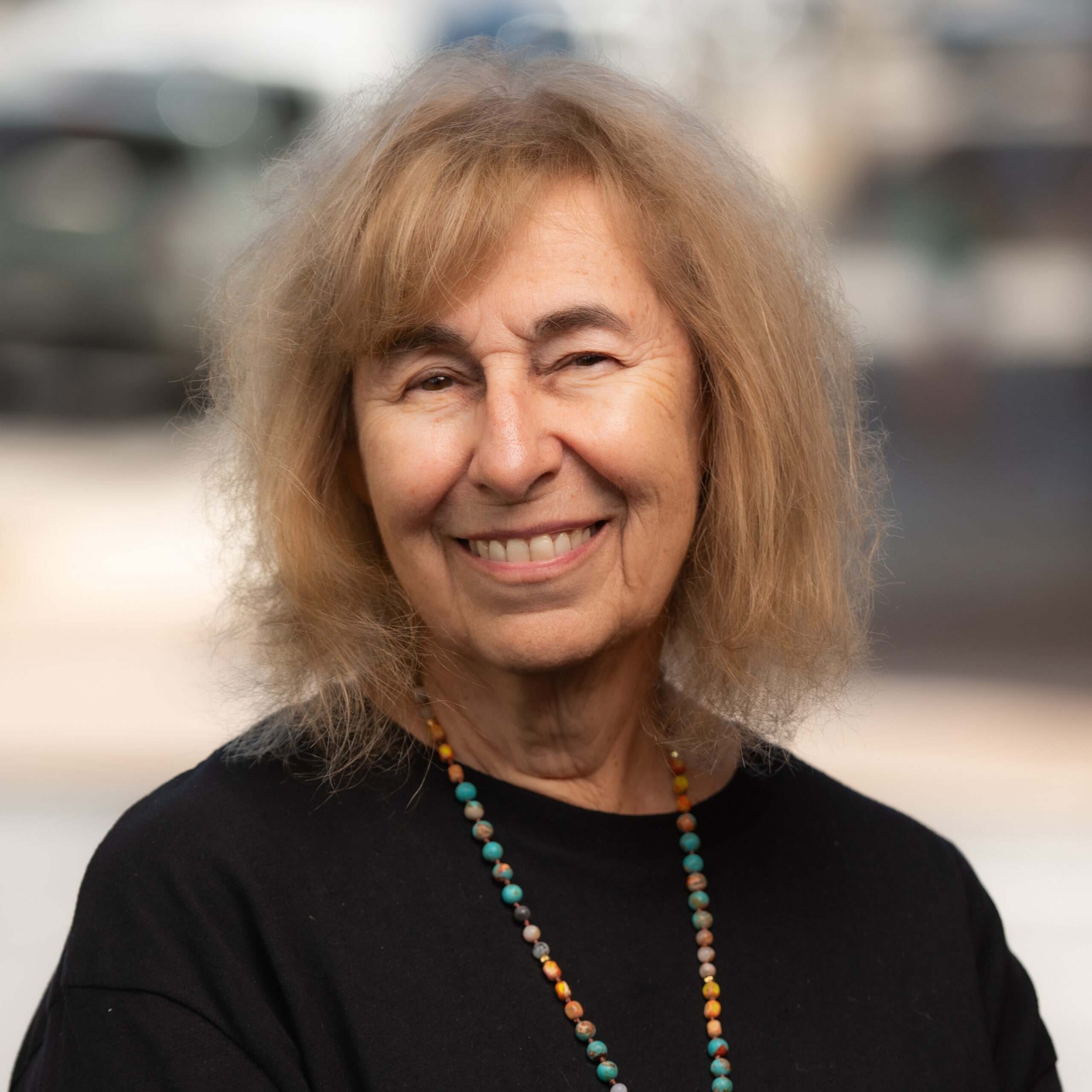
Editor’s note: This interview has been edited for length and clarity.
Hawaiʻi may sit out here in the middle of the Pacific Ocean, the most isolated inhabited place on Earth, but we’re certainly not immune to the federal government’s actions rolling across the country like a new political tsunami every day.
University of Hawaiʻi political scientist Colin Moore laid out the continuing loss of democratic norms in an essay for Civil Beat last weekend. He had some thoughts on what democracy’s backsliding is doing to Hawaiʻi as well as some suggestions about what the state could do to try to save itself from federal overreach.
I sat down with Gov. Josh Green on Tuesday to talk about just that, eight days before Wednesday’s deadline for Congress to pass a federal spending bill or the government will shut down.
The governor has been open about his intent to get deeply in the middle of national affairs, traveling to Washington, D.C., frequently — sometimes on the taxpayers’ dime, more recently mostly on his own or paid for by foundations — to advocate for both Hawaiʻi’s interests and the country’s. The two are not mutually exclusive and, as it turns out, both are fueling his vision of playing a bigger role in American governance once he’s out of office in Hawaiʻi.
He’s not talking about running for president. That news item from a few weeks ago was, he says, just an offhand remark after a conference, taken out of context by a reporter.
Instead, he says he’s working to build relationships with people at all levels of government and in civic organizations throughout the country, first and foremost to help Hawaiʻi, including to stave off pain from a White House bent on demolishing democratic norms.

A role as a national peacemaker is something he’s working to develop and he points to the fact he’s been asked to speak at a number of forums, particularly on health care, including earlier this year when he was the only Democrat at a congressional panel inquiring about states’ pandemic responses. He famously lobbied several times against Robert F. Kennedy Jr.’s selection as secretary of the Department of Health and Human Services but then traveled again to meet with Dr. Mehmet Oz, administrator of the Centers for Medicare and Medicaid Services, and to facilitate a panel with both Oz and Kennedy at the National Governors Association annual conference in July.
At the meeting in Colorado Springs, Green was elected to the NGA’s executive committee and will become chair of the 13-state Western Governors Association next summer. He plans to host the governors in Hawaiʻi at some point.
He’s also been serving as president of the bipartisan Council of State Governments, which paid for a trade mission that took him to Rome, where he met Pope Leo XIV and invited him to visit the Kalaupapa Hansen’s disease colony before the last remaining survivors die.
At all events, he says he’s made issues important to Hawaiʻi like rural health care and climate change his main talking points.
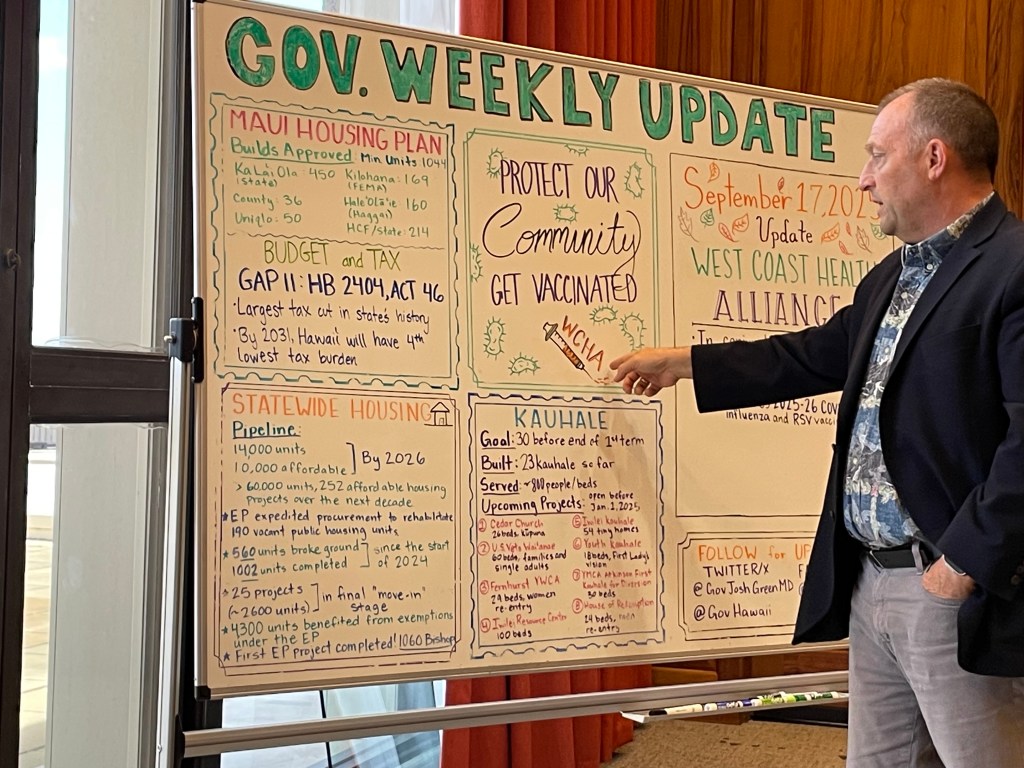
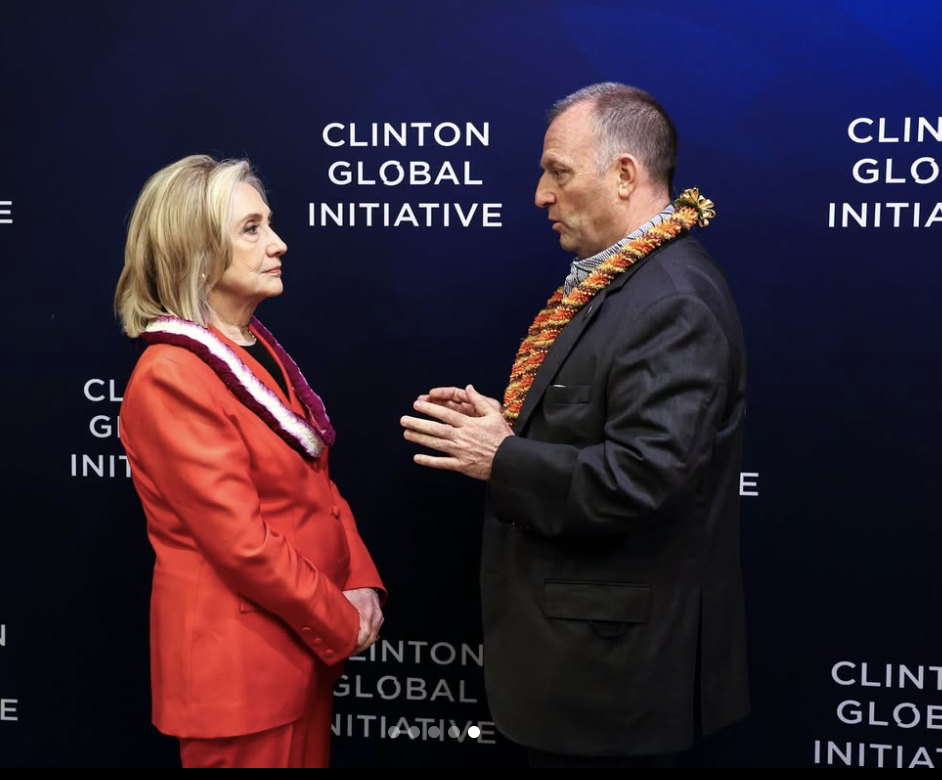
Over a lunch of Subway sandwiches (his choice, not mine) in his State Capitol office last week — the day before he took off to New York to speak about community resilience and “leadership in these turbulent times” at the Clinton Global Initiative annual meeting — Green started the conversation by hopping over to his always present whiteboard to underscore his points.
He highlighted the initiatives he’s been working on the past three years as governor and issues that have come up suddenly — housing, kauhales, health care, the next hurricane, Supreme Court rulings, land leases for the military, even drought on Maui that has taken down a national golf tournament.
“And then there’s the new piece, which is the feds and it’s often mind-boggling because of the decisions that come from there,” he says, adding that he’s reaching out nationally a lot more.
“I think that Hawaiʻi will probably escape most of the harsher federal decisions, but not all of them. “
At the Clinton meeting, he says, he intended to emphasize that “we need to have values — and science-based decision making in uncertain times … data-driven decision making in a partisan era.”
Green says he is trying to take advantage of the opportunity that comes “as one matures as a governor.”
“Some people do it with much more ambition even than I have, and — I know this is the elephant in the room — my hope, my plan is to serve a whole second term.”
“If people will have me — please, please, please, make sure you write that — if people decide to have me for a second term, and it’s their choice, my plan is to serve the whole term.”
OK. Well, here’s what I want to talk about. And part of it is what you just actually alluded to and that is leadership in turbulent times. I think what everybody’s talking about right now is the national stuff, the national angst, as I call it. And especially with the Charlie Kirk killing, and then all the fallout from that. And so talk a little bit about how you feel about all of that, personally. And then where I want to get to is how is all of this affecting Hawaii? There’s such divisiveness and it’s terrible, right? How do you feel about that? And how do you deal with that as governor?
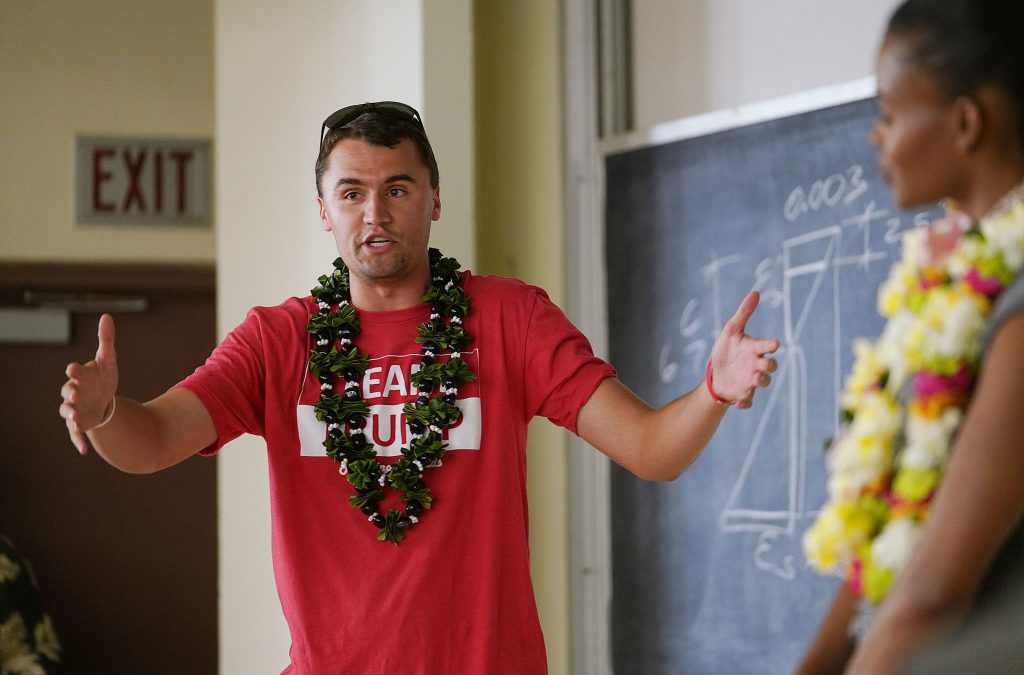
Yeah, that’s a great question. So I feel terrible that the country is divided, because I tend to get along with people of different ideologies, but I see how this ideological chasm is tearing people up. It made me physically sick to see Charlie Kirk get shot and killed, and I felt the exact same way when the assassination occurred against the state representative in Minnesota. It’s tragic, and it’s happening on both sides of the political spectrum, and it’s got to stop. I mean, it’s horrific.
I also really shuddered when they attacked my friend, Josh Shapiro (the governor of Pennsylvania). Josh and I are friends, and he’s the governor of the state I grew up in. They tried to kill him on a Jewish holiday so it was both anti-semitic and political, from my perspective. And it was just unbelievable.
And it was just unbelievable to see someone try to shoot then-candidate but now President Trump.
It’s so horrible that something has to change. And we really do have to heal the country. That’s where I come back to. We’re going to have to bring people back together.
And I think that’s something I want to focus on. And frankly, I think everybody who’s elected has to focus on it passionately because it starts with people just pointing fingers at each other and saying terrible things about one another, and it ends with these horrible moments.
And I’m definitely not blaming for one half a second that someone says something and then they get attacked. I’m saying it’s in the air, it’s in the community. Like when I said, after the Maui wildfire, that climate change contributed to it, we got hundreds of death threats because I was suggesting climate change existed. I was stunned that people left those kind of messages on my personal phone. I mean, they were unbelievable.
They were followed by incredible hatred on social media and emails threatening not just me, but also my family. And all I had said was climate had an effect on the winds and the dry land and the fire. And what I received back was ‘no it was — insert conspiracy — laser beams, people trying to take the land from local people.’ It was shocking.
I really appreciated Spencer Cox (of Utah), another governor I like a lot, and who I consider a friend. I appreciated his approach, which was to call for a peaceful moment after (the Kirk shooting). I hope that once the pain ends for those who knew Charlie in the administration, I hope that they also are able to reflect and do what they can to ask everyone to work peacefully together. And some people are saying that, but we really have to do it.
Do you see the divisiveness increasing here in Hawaii, or do you think we’re pretty mellow for the most part?
I haven’t seen an increase lately. Jaime and I talked about it. We were concerned if this was going to become an even broader national crisis. But I haven’t been told that there’s an uptick in threats against me. I was, though, very careful to make sure I didn’t say anything that would be hurtful to those who care deeply about or knew Mr. Kirk and I was trying to be careful also about the incidents that occurred in Minnesota.
I think some of these issues which historically were just debated are now utterly divisive and cause these threats, and that’s got to stop. One of the very best parts of America is that we don’t censor people, and that we historically could debate like a democracy. And there is a real worry that we could lose that.
I was genuinely concerned when they knocked Jimmy Kimmel off the air — not that I watch his show, I don’t, it’s on too late for me — but I was worried that anyone would pressure someone off (the air) for their opinion. I would worry for both ideologies, the more conservative or the more liberal.
I frankly appreciated it, even though I don’t like the guy, when (Texas Sen.) Ted Cruz said that’s going way too far, having the FCC censor a show or a person. Because he was right. If you do it now, it will encourage the other people to do the opposite.
I feel kind of the same way about the the redistricting of Texas. I think that’s an outrage. And I think (California Gov.) Gavin (Newsom) has no choice but to try to deal with the situation and fight fire with fire, as has been said, but it’s not good for either.
We can’t let the democracy be suddenly seized by one side or the other. Either side can’t be allowed to do it. So that that’s what has to happen. They have to resolve their differences. I would stand down any redistricting. Right or left, red or blue, because Americans should get to vote. So I worry about these divisions, and we’re going to have to pull ourselves back from the brink if we’re not careful.
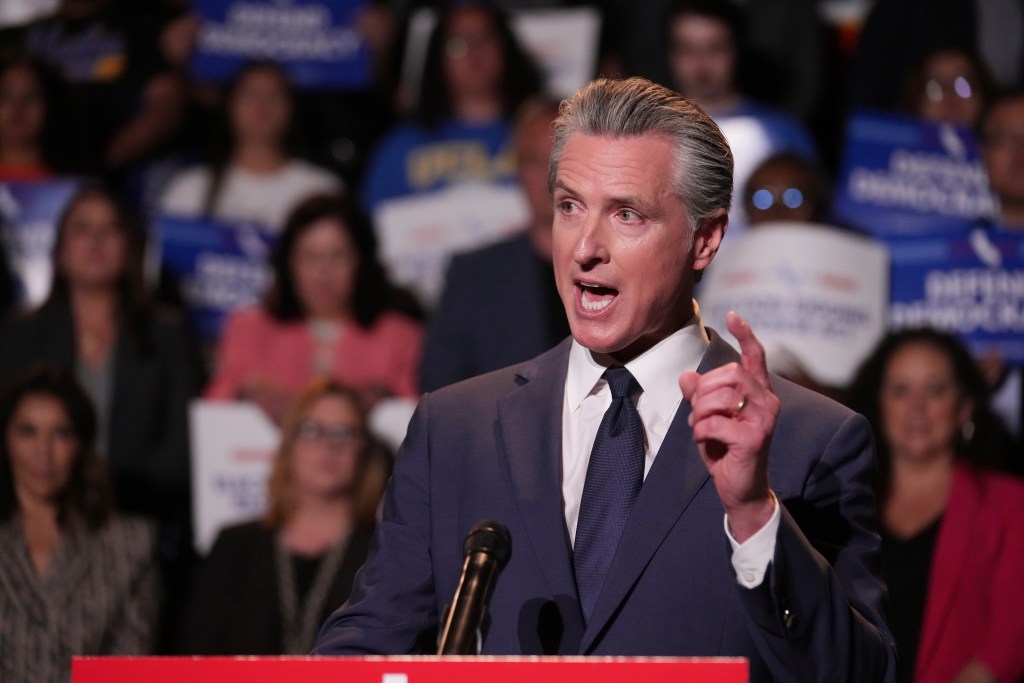
So how does all of this affect Hawaiʻi? Does it have a direct effect? (UH political science professor) Colin Moore, speaking to the Senate and in the piece he wrote for Civil Beat talked about how democratic norms are slipping away, and that Hawaiʻi can and should start getting out in front of things like a federal slowdown in funds coming to the state. I mean, there’s literally something new happening every day. What should Hawaiʻi be doing?
It’s really interesting. The truth is that there’s not necessarily rhyme or reason to what the current administration is doing. But yes, the norms are eroding, and that is a problem. But for our state, they continuously reach out to me, and because I have not been in direct conflict with the president, we are getting many overtures to solve problems or partner.
And most of that, I think, is because of the the current circumstance in the Indo-Pacific. The decision was made even before the president started his second term, that the Indo-Pacific was so central to our national security with the China/Taiwan question, plus the wars that are in Ukraine and Israel/Palestine, that they weren’t going to make any cuts. And so the feds need to have at least a working relationship with me and Hawaiʻi.
I disagree with so many things that they are doing — with ICE on immigration for instance. I will support immigration work on someone who’s a criminal but we’re very much against anyone being forced out of our state if they’re been working and contributing to society. So I instructed our attorney general to make sure they know that we will not help ICE remove any people, human beings, that are just trying to be good citizens.
I disagree with most of their policies, but because I have relationships through these national organizations and going to D.C., I’m able to say wait a second, this is where we really are, and this will be in your interest and our interest. In other words, it will be in your interest, for example, not to suddenly take the land (for military purposes) because there will be mass protests and there will be lawsuits. And it will be in our interest to try to work this out so that we are able to remediate the unexploded ordnances and have the land returned in a fashion that I can give it to DHHL for housing or help us do geothermal research.
And the list goes on. Interestingly, even with my animosity towards RFK Jr. you’ll notice that I often will say something like, look, I agree with Bobby Kennedy on pesticides or on chronic disease, and there are other places that would be good for him to help the country or the president, but on public health matters, I disagree strongly, and I’m going to speak up about it.
But it’s not personal. It’s not even political. It’s just from my perspective, based on the science or based on the values that we have in Hawaiʻi, that’s not what should be done. And by doing that and by not being a pushover, I think I end up having a better chance to keep us going in the right direction, like keep getting our grants.
So back to Hawaiʻi impact. Do you think there needs to be any kind of money set aside in case funding might not be coming through?
First, the Legislature did set aside $200 million. And that was mostly because we anticipate cuts, either to SNAP food stamps or to Medicaid. Now, in the conversations I had with HHS, Oz especially, there are provisions in the president’s bill to do the Medicaid cuts two years later, essentially January 2027, but there are provisions in there to allow the cuts to be delayed till 2029. So that’s one thing. We won’t need the money, hopefully, as much right now.
“If there’s any ambiguity and they shut down certain things that we feel have to be funded, I will gladly participate in a special session with my friends in the House and Senate and fund those immediately.”
And then there’s the rainy day fund, which is at $1.7 billion. And so if tomorrow a list included $15 million to fund the gap on vaccinations to make them fully available for our kids. And a list included monies for rural health clinics that are beginning to close based on prospective budget cuts in the future. You know, I can name 50 things. I think we should fund those things, and I think we should use rainy day funds, because I can’t imagine a period that’s going to be more rainy than this.
Also, there is the specter of a federal shutdown. And so we are already preparing to make sure that if there are services that we feel are essential like public safety or certain health functions those will stay intact.
But if there’s any ambiguity and they shut down certain things that we feel have to be funded, I will gladly participate in a special session with my friends in the House and Senate and fund those immediately.
Do I think we can supplant the entire federal funding? There’s no way.
What kinds of things would compel you to call a special session? What kinds of things would have to fall?
Remember, we’re getting pretty close. It’s almost Oct. 1 and we’re going to be in session actually in January, right?
But any potential loss of access to health care for our citizens would, in my opinion, justify a special session. If there was any threat to food security for our people, I would immediately be inclined to have a special session. If there’s any threat to public safety period. That is supposed to be funded but if let’s say they said they weren’t going to support emergency management funds and we’re still at the tail end of the hurricane season, I would definitely use an emergency session for that.
Our schools will stay open. But if, let’s say, there were some federal funds that were being used for special programs for kids, and it was suddenly going to be that kids with special education needs couldn’t get them because some of it was federally funded, I would use our budgetary money to supplant that so that they didn’t lose any of what I feel to be life-sustaining care.
So that’s kind of how I approach it. And it could happen. I mean it looks to me like we very likely will have some amount of shutdown, though, again, it’s very much in the moment.
I know you talked about this a little bit, but — specifically — how will you use your positions with the Western Governors Association, the National Governors Association, the Council on State Government and the others in the coming year or so to do the kind of leadership you’re talking about?
So I will propose bipartisan opportunities for us to work together to start bridging the gap. For the Western Governors Association, for example, I will get to propose a bipartisan project, and I will likely work on something in mental health care, access to mental health care.
It speaks to obviously desperate moments for people that can hit any political ideology and it also seems to be one of the spaces where we could have some agreement perhaps on gun violence. And I would love to work on gun violence but I know that I could very well run into a buzz saw and people would shut down. Whereas if I work on mental health care, which is obviously in my wheelhouse as a doc, it could get some traction. And I’m going to try to break the logjam of lack of cooperation.
I’m going to go back repeatedly to the idea that we should use data and science to back up our policies. It’s kind of a safe space to try to get people to work through their differences.
I spend a lot of time talking to Democratic governors but I really try to split my time as closely as I can 50-50 with Republicans. I figure if I only talk to Democrats that are governors, we agree. We agreed very quickly, for example, on the West Coast Health Alliance. I mean, there was no fighting. We immediately agreed what kind of had to be done.
And over time, if that goes well, it would be really great if some states that were redder saw that’s working, their rates are lower, they’re not having outbreaks, their economies are still fine. So I’d like to see crossover. But I’m pretty strategic in that way.
I just decided personally that I would focus on values and a scientific approach and make my case that way with the current administration, so that it wasn’t personal and it wasn’t finger pointing. Because I am very aware that some states have been punished and I don’t want that. And I just figured it goes nowhere if I just come out roaring.
So how will all this play out in, let’s say, the coming session? Do you have any plans for the session now that, like you said, it’s almost October?
Oh yeah, we have a lot of plans. So we’re going to stick to our priorities, which is funding housing, completing our goals for homelessness, and we’re going to do all that we can to preserve our financial security so we can keep the tax cuts intact for ALICE families. No matter what, we can’t let families who are vulnerable pay more tax.
“My personal feeling is that sometime after a year of the current administration a lot of that passion they’ve had to push the envelope will begin to fade.”
But I’m aware that if funds get cut steeply, we have to then check everything. Specifically, first, the rainy day fund and any tax breaks that would go to very wealthy people. If we can’t afford that, we have to protect our health care system, our schools. But one thing I’m doing is trying to make sure that we get through each of these two-year cycles, and we’re headed into Year 2.
It’s interesting because most of our policy priorities actually passed in the first three years. I’ve named them several times, right? So we don’t have to pass any new, large policy. We really need to make sure that we execute the current policies — the housing, the homeless, the tax policy, the green fee, all those big policies are now on the books, and we have to build the kauhale. We have to deliver the green fee dollars. We have to continue on with getting development projects for affordable housing up. That’s where I’m focused.
There is going to be some additional focus on food security, because it’s a priority for both me and Jaime, and we still have way too many kids that are food-insecure, and that really worries me. First was making sure that kids who were paying partial costs for subsidized meals didn’t have to do it. And next, we want all kids that would qualify for meals to get them for free. And then, long term, we’d like to have universal free meals.
So where do you see this all going? In your second term, if you get one, and then even beyond that. I mean, for those of us who are wondering if we should just move to Portugal right now, where do you see it all headed?
My personal feeling is that sometime after a year of the current administration a lot of that passion they’ve had to push the envelope will begin to fade. I think the president will likely move more toward legacy questions and away from these kind of contentious issues. And I think the mid-terms will tell us a lot about America. I really think that if if America rewards the current approach to governing with a super-majority again for the Republicans, then I think that’s when we’re going to realize the country is something very different than what Hawaiʻi residents have, by and large, supported.
I don’t think anyone should leave Hawaiʻi. I think everyone should realize that we are in a unique position because they’ve chosen to show a lot of respect for us in general. Our cuts have been less than other places. The ICE activity, while disturbing, has been far less than in Baltimore or California. And certainly the investment in Hawaiʻi, comparatively, continues to be better than it is in other states.
I like to believe it’s because of who we are. And, you know, interestingly, we’re the most diverse state. So if we were going to be targeted for diversity, if any state was going to be targeted, it would be us, except that we’re naturally diverse. We naturally have a diversity based on generations of people coming in, and so we don’t even have a majority.
But I think our real protection lies in the fact that there’s a pretty clear historical relationship between Hawaiʻi and the Pacific. And we’re also a little bit out of sight, out of mind.
But generally do you see this super divisiveness between citizens in general, Americans in general, throughout the country, do you see that easing up? Because I have nightmares sometimes over this stuff. I think a lot of people do.
I think it will depend on who is elected — president, vice president, and who otherwise becomes a national leader in Cabinet posts or just in life. I think if leaders emerge, elected or not elected, that are willing to bring down the heat and work together in that 80% to 90% consensus space, we’ll be fine. And I think the next president will have to go out of their way to diminish the dominant executive prerogative that we’ve seen. I think that that has to happen. I think you’re going to have to have a selfless president who says I’m not going to continue to use this playbook of exceptional executive power. I think that’s not good. I think you’re going to have to have some sacrifice from both political parties. It might require some people to retire and become kind of emeritus diplomatic leaders.
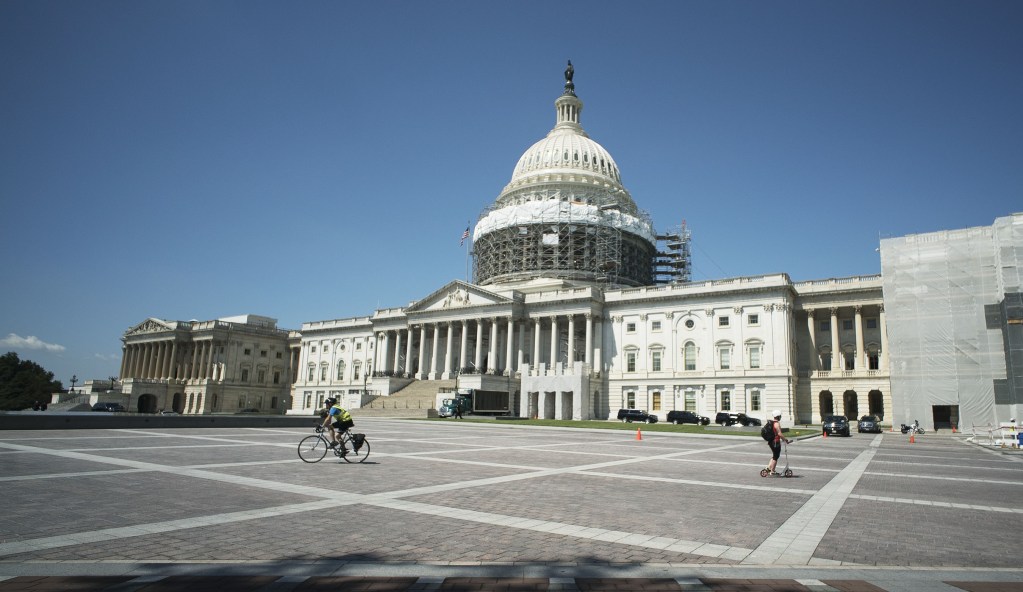
What I will recommend to whichever of my colleagues becomes president, whether it’s a Republican or or a Democrat, I’m going to encourage them to put people from the other party in their Cabinet and to focus on those areas that there’s a lot of consensus on, and I think that will help a lot. Because just like all these organizations where I spend 50% of my time with people from the other party, if the Cabinet looked like that, it would be a lot harder for us to come apart at the seams when there’s a tragic moment like the assassination of Charlie Kirk or the killing of the legislator and their spouse in Minnesota.
I mean it, that threatens to unravel everything. But if everyone is working together across party lines for a few hours of the day, it ends up being harder to be so divisive.
So you are very optimistic. You do sound like you eventually want to step into this national arena a bit more.
So after 2030 — and I’ll say that very directly again — after 2030 I’d like to participate in some form of national healing. I’ll do it as governor until then.
And I may just be uniquely positioned as governor to do it because we don’t have a lot of partisanship here in general and I’m going to use the national positions to bring everybody (governors) here actually for a week or more to be together in Hawaiʻi, which always helps a little bit. And I’ll keep going to these meetings more or less once a month and encouraging them to find some practical common ground.
“Don’t let me suggest for a second that I’m not worried about the country. I’m super worried. America’s supposed to be better than other places.”
They like a lot of the stuff we’ve done. Look, we’ve cut taxes, which is pretty right of center. We’ve built housing villages for homeless, which is pretty left of center. We are using emergency powers to expedite housing rules, which is a little bit right of center. And I’m repaying all the debt of the nurses and social workers, which is left of center. And this is not meant to be a political ad. This is what we actually did, not even just rhetoric.
My calculation is that we should show people that you can take something from each ideology for the good of your state, and then ultimately, for the good of your country. And so I get to impress that on people.
I find it highly unlikely that I would be ever the person in the White House. I think it’s much more likely that I’ll get to support a Republican or Democrat in the White House that can do some of these things and therefore pull us back from the brink. And that’s my real plan, which is to try to have relationships with all of them so I can support whoever becomes president the next time. And really do something positive.
I don’t know if I’m being too optimistic. I know some people think it’s too optimistic, but it has been working for us right now. I’ve not yet felt the wrath of the administration.
Don’t let me suggest for a second that I’m not worried about the country. I’m super worried. America’s supposed to be better than other places. And unfortunately, recently, we haven’t been any better than some of these other places.
For me, I’m going to try to lower the heat and get through this and the more relationships I have — on both sides — probably the better. And a lot of the governors in either party are really good people. And so I think that as as the current president gets a little older and a little less interested in the day-to-day conflicts, I’m guessing that there can be peace.
The question is, of course, this next generation. Who comes up and who takes advantage? But for my part, I’ll try to be the healer.
 Sign up for our FREE morning newsletter and face each day more informed.
Local reporting when you need it most
Support timely, accurate, independent journalism.
Honolulu Civil Beat is a nonprofit organization, and your donation helps us produce local reporting that serves all of Hawaii.
ContributeAbout the Author