Honolulu Needs Your Help. So Quit Whining And Start Writing
The Honolulu Charter Commission is seeking ideas on how to improve city government. But time is running out for residents to get their suggestions in.
October 19, 2025 · 12 min read


About the Author

Citizens of Honolulu: You have a once-in-a-decade opportunity to fix many of the things you have been grumbling about when it comes to local government. Don’t blow it.
The 2025-2026 Honolulu Charter Commission is well along into a two-year process that will likely result in more than a dozen questions for voters on the Nov. 3, 2026, ballot.
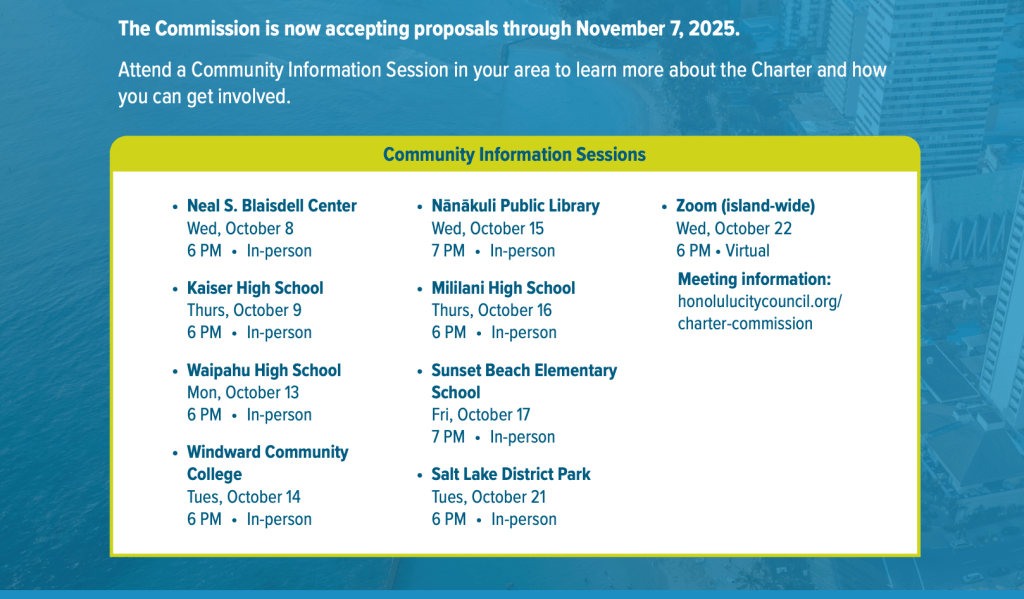
The commission has been hosting a series of public discussions this month all over Oʻahu to get people engaged in proposing changes to the Honolulu Charter. The roadshow ends with an island-wide video forum on Wednesday from 6 p.m. to 8 p.m. Details here, where you can also check out proposals that are already being submitted. Deadline is Nov. 7 for people to get their ideas in.
People are encouraged to suggest tweaks, modest improvements and even substantial fixes to the city’s foundational governing document. These are changes that can only be put in place by voters, either through the 10-year charter review process or if the City Council musters enough political momentum to put something on the general election ballot in non-charter commission years.
Still, only the voters can ultimately approve this level of change. And that is especially important in Hawaiʻi, where there is no statewide citizens initiative process and county-level initiatives are rare. This, citizens, is basically your shot at righting the wrongs you so eloquently call out in comments on news articles, in testimony at public forums and in social media rants.

We’ll be covering this civic extravaganza through to the end, with deeper dive stories and commentary on specific ideas. But I thought this might be a good time to bring us all up to speed on what the last charter commission did, what other charter changes have been passed since the 2016 vote and what might be different this time around.
2016 Was So 10 Years Ago
In 2016, no one had ever heard of Covid-19. “Spotlight” won the Academy Award for Best Picture. The Chicago Cubs won the World Series for the first time since 1908. Donald Trump won the presidential election but Tulsi Gabbard voted for Hillary Clinton.
In Hawaiʻi, we worried about the Zika virus and dengue fever. David Ige was governor, Josh Green was a state senator and the Legislature made the national history books by making Hawaiʻi the first state to raise the legal smoking age to 21. The giant Florida power company NextEra tried to buy Hawaiian Electric Co. President Barack Obama expanded protections for Papahānaumokuākea Marine National Monument and they named a fish after him. Congressman Mark Takai died.
On Oʻahu, the Honolulu rail project was pegged to cost $6.6 billion and Hitachi unveiled the new rail car. The Navy insisted it couldn’t talk about leaking Red Hill fuel tanks for security reasons. Lawmakers rejected another proposal to replace the crumbling Oʻahu Community Correctional Center. And Louis Kealoha was still the Honolulu police chief but was finally put on leave a step ahead of conspiracy and corruption convictions.
On the ballot, Kirk Caldwell beat out Charles Djou to win a second term as mayor. And voters passed 16 of 20 ballot propositions put before them by the 2015-16 Honolulu Charter Commission.

The ballot measures were whittled down from 154 proposals submitted by residents, civic activists, neighborhood boards and city and county officials. Members of the charter commission themselves drafted quite a few proposals.
The 120-page final report of the charter commission details the broad aspects of local government that had captured people’s thinking, everything from expanding the size of the City Council to ending or revising the Honolulu Authority for Rapid Transportation to limiting political contributions to city candidates.
Several proposals dealt with salaries, several more urged better oversight of the city budget, the procurement process and a shakeup in city agencies. Election reform and better access to public records. Environmental protection and creating a sustainable future. Police reform. Ethics reform. Beef up affordable housing programs and the housing fund. Increase the minimum wage.
The 13 commissioners started out with a framework that they came up with after discussing it among themselves. The report summarizes it this way:
• Department and agency organization; Do any need to be split or combined? Why? To whom is each department accountable?
• Should any parts of Public Safety be combined: Fire Department, Police Department and Water Safety?
• Is the Ethics Commission needed, or could the State Ethics Commission be used?
• Which Boards and Commissions are still needed?
• What structural changes are needed at the Honolulu Authority for Rapid Transportation (HART) which will move into Operations phase within five years, long before the next Charter Commission is formed.
• Department of Information Technology (DIT) seems to do a considerable amount of work for other governmental levels with little or no compensation. Examples are: State Judiciary, Department of Transportation, Elections (voter registration lists); and other counties, Motor Vehicle registration and licensing. The Commission could not find authority for DIT to provide services to State and counties. One option considered was to stipulate that all services provided to other entities must be compensated or receive fair payment for service rendered.
• How do the two semi-autonomous agencies work in relation to the rest of the City (Board of Water Supply, HART)? To whom are they responsible?
• Climate Change is a looming issue not addressed in the duties of any department.
• Does the issue of contract hires in Section 6-1103, RCH, (Personal Service Contracts) need to be addressed?
• Long-range planning is needed for: parks, land management, low-income housing, affordable housing, and climate change. Some of these were functions eliminated in previous Charter reorganization, either purposely or inadvertently.
• Should there be planning functions included in the duties of each department?
In the end, and after 35 public hearings, the commission combined its own ideas and the public’s and decided to put 20 questions out to the voters. The 16 that passed included:
• giving more authority to the police commission to suspend or fire the chief
• allowing the affordable housing fund to be used to develop rental housing
• requiring departments to prepare long-term plans for infrastructure needs
• creating an Office of Climate Change, Sustainability and Resiliency
• creating a Department of Land Management
• reviewing boards and commissions periodically to see if they should continue as is
• expanding the fire commission from five to seven members
The four measures that the public rejected included a question about the powers of the mayor and the City Council as well as whether the mayor should be able to delegate who signs documents on behalf of the city. Voters also rejected a requirement that no more than five members of the City Council Reapportionment Commission be from the same party. And voters refused to allow the mayor and council members to serve more than two consecutive four-year terms.
The charter commission’s final report includes a section of recommendations to its future self — the 2025-26 commission. Most of the recommendations discuss lessons learned that the 2015-16 commission thought the next group of commissioners might want to be aware of. An entire section is devoted to the process itself — like its first meeting should be no later than December 2024 (this 2025 commission didn’t get rolling until March) and make sure it leaves itself enough time to handle a large number of proposals that may come in and figure out a better way to submit proposals. Don’t let the city attorneys muck things up, they advised.
But the 2015-16 commission also had several substantive issues it thought the next commission should address. First of all, commissioners said, the entire charter needs to be reviewed, not just piecemeal agency-by-agency concerns. They wanted the next commission to review the four ballot measures that didn’t pass, in particular the proposal to clarify mayor and council powers regarding the annual budget and funding authority.
The commission also recommended that the feasibility of ranked choice voting be studied with a plan to implement it in Honolulu. Commissioners said they believed a proposal for ranked choice voting or an “instant runoff” procedure could produce a system that more accurately reflected the will of the voters. The 2015-16 commission tabled it, however, because commissioners felt they needed more time to work out the logistics.
Read through the 2015-16 final report, especially Appendix C, the list of proposals. It will get you fired up:
More Charter Tweaks — Or Not — Since 2016
Once the charter commission is over, it’s up to the City Council to send charter amendments to the ballot for voter consideration. That’s happened every election year since 2016 with mixed results.
In 2018, the council agreed to put forward a measure similar to one sought by HART during the charter commission process. The proposition would have made it easier for the rail board to take action on certain items, such as change orders, in light of the difficulties they were having getting a quorum for meetings. Voters overwhelmingly defeated that one.
In 2020, voters imposed term limits on the Honolulu prosecuting attorney, bringing that office in line with the mayor and City Council members at two consecutive four-year terms. They established a Honolulu Youth Commission and gave the Honolulu Ethics Commission more control over its budget and staffing.
In 2022, voters passed three of four proposed amendments but narrowly said no to increasing the amount of property tax revenue that could go into the city’s affordable housing fund.
Voters were more charitable when it came to expanding use of property tax money for the clean waters and natural lands fund, which passed overwhelmingly. They also supported requiring the city planning commission members to have specific backgrounds including in Native Hawaiian issues, in land use planning and environmental expertise, among other things. And voters also approved making the Office of Council Services permanent.
That same year, with turmoil at the Honolulu Police Department still swirling after Kealoha’s departure and because his replacement, Susan Ballard, didn’t work out as the police chief, public safety advocates pushed the City Council to put a major reform of the Honolulu Police Commission, which oversees the chief, on the ballot.
But council member Andria Tupola, chair of the Public Safety Committee at the time, refused to send the four proposals forward. They died in her committee and are the basis for some proposals expected to be submitted to this year’s charter commission.
Last year, in the 2024 elections, voters approved all four ballot propositions. Those capped salary increases for City Council members, codified job requirements for the Department of Emergency Management’s director, created a climate resiliency fund and established an ocean safety advisory commission.
10 Years Later
The 2025-26 charter commission has been meeting at least once a month since March. Various subcommittees have also been at work drafting procedures and policies that the commission will abide by in reviewing proposals and crafting measures to submit for the ballot. Staffers and some commissioners are holding public meetings all over the island this month.

The deadline for the public to submit its suggestions is Nov. 7 and the commission’s timeline envisions it reviewing ideas and holding public hearings from December through April. Ballot proposals would be finalized by July. The commission would then turn its efforts to educating voters about the ballot measures leading up to the November election.
Commissioner Cedric Duarte, who’s chairing the communications and community relations subcommittee, says this year’s commission paid particular attention to its predecessor’s advice about seeking strong public participation.
Overall, the commission is trying to make it easier for people to submit suggestions and ideas through a new website and by allowing a simpler format. People can email ideas or send via snail mail too.
“You can just give us an idea and we can figure out the language later,” Duarte says.
Duarte notes that this is the first charter commission to use virtual meeting technology, something that has taken root since the Covid pandemic forced government entities to work online to a much greater extent.
As for other recommendations from the 2015-16 commissioners, Duarte says it’s still too early to say what will come of those. Clearly this commission is not going to tackle a review of the entire city charter and for the same reason — a lack of time. He says at least one person brought that idea up at a recent community meeting.
But so far there’s no decision on whether the commission will take up a new voting system, for instance, or the authority that the mayor and council have to fiddle with the budget and funding.
“It’s very possible that some of those proposals that didn’t make it in 2015 and 2016 will be revisited by those authors again,” he says.
He agrees that there is value to starting the whole process earlier, especially because of the requirements that the Sunshine Law imposes on how public meetings are conducted.
So far more than two dozen ideas, including some fully formed proposals, are posted on the commission’s website. A number of city departments also have notified the commission they plan to submit proposals. Even Mayor Rick Blangiardi has said he plans to submit at least one proposal — to switch the hiring of the police chief to the mayor and away from the police commission.
If this year is anything like 10 years ago, expect a flood of proposals right before the deadline. But in the meantime, send your thoughts to the commission and tune in to the public sessions. It’s really an amazing opportunity to participate in the future of Honolulu.
 Sign up for our FREE morning newsletter and face each day more informed.
Read this next:

Local reporting when you need it most
Support timely, accurate, independent journalism.
Honolulu Civil Beat is a nonprofit organization, and your donation helps us produce local reporting that serves all of Hawaii.
ContributeAbout the Author