The Oldest Group Of Influential Hawaiʻi Citizens You've Never Heard Of
The Social Science Association is still going strong after 143 years. But its once high-profile community presence has faded from public view.
November 30, 2025 · 12 min read

About the Author
In 1882, King Kalākaua was still on the throne when 10 of the most prominent men in Honolulu gathered at the Rev. Dr. C.M. Hyde’s house at 122 Beretania St. That night, they formed the Honolulu Social Science Association, a civic discussion group made up of dozens of highly influential community members that has continued to meet regularly for more than 140 years.
The 10 who had been “hand picked as leaders of opinion,” as a history of the organization puts it, got together with the aim of “promoting each other’s advancement intellectually and socially,” as well as “the higher interests of the Community generally.” The constitution they adopted that night remains the foundational document that still guides the Social Science Association today.
With the exception of two years during World War II, the group has met once a month every year from October through June — “the season,” as they’ve called it since the beginning — to learn about and debate the most important events of the day. Members have included governors, mayors, elected officials, businessmen and merchants, doctors, lawyers, judges, clergymen, academics and newspaper publishers. Most of them are names we all recognize as shaping the history of these islands.

The Social Science Association seemed to me to be a fitting kickoff for our new occasional series, “Bright Spots,” which aims to shine a light on government programs and institutions in Hawaiʻi that are actually doing pretty well along with people who are quietly going about the public’s business, some inside, some on the outside of government. Their end game, as is the Social Science Association’s, is to make a Hawaiʻi a better place.
The people, programs and organizations we’ll feature aren’t necessarily perfect. And the Social Science Association certainly has its issues. Some of its earliest members, like Sanford Dole and Lorrin Thurston, helped overthrow the monarchy. Nearly a hundred years later, one of its more active members, the Australian psychologist and University of Hawaiʻi professor Stanley Porteus, was discredited as a racist for his support of eugenics and his name removed from a campus building.
Still, hundreds of Hawaiʻi’s leading luminaries have, over the decades, contributed their energy to what a Honolulu Star-Bulletin writer in 1913 called “an organization which is perhaps the most unusual social group in the islands.” They rarely take any kind of official action and, as one member told me, “We really don’t do anything except talk and listen.”
But there’s an argument to be made, including by today’s members, that having people in positions of influence who understand the state’s most important issues, events and controversies will play a role in shaping outcomes on more subtle levels, whether through their own work or other opportunities.
Are they having an impact? It’s hard to say and none of the members I spoke with could point to any recent significant result that has come out of their meetings. But, they say, the larger purpose and value is to make sure civic issues are being broadly aired.
“It’s important in that it’s a Third Place, a place in our society that allows this kind of intercourse and exchange of ideas outside of government,” says Tim Johns, the current president of the Social Science Association and a member since 2007. He’s the president and CEO of Zephyr Insurance Co., besides serving on other community boards.
“It’s not driven by a profit motive,” he says. “It’s not driven by a ‘I want to get reelected’ motive. It really is driven by the mission of improving and truly understanding the place you call home. To me, that idea is strong enough to have carried it through the years and the group feels that that’s still relevant, otherwise it would have fallen away, like a lot of other organizations.”
The most recent membership roster:
It’s remarkable, really, that the concept launched in 1882 has had such staying power. The basic format is virtually unchanged although what started as 10 white men has grown into a diverse collection of 50 established professionals. In 1988, they finally allowed a woman to join — then-Honolulu Star-Bulletin publisher Catherine Shen was the first, the announcement buried in a society page piece that devoted most of its column inches to a gushing account of Dolly Parton coming to town.
As it has always been, members take turns hosting the meetings. Another member presents an essay on a topic of their choosing. The essay must be in writing — they are long — and over the decades hundreds of these well-researched papers have been sent to the Hawaiʻi State Archives and the University of Hawaiʻi library where they are still available to anyone who cares to go dig them up.
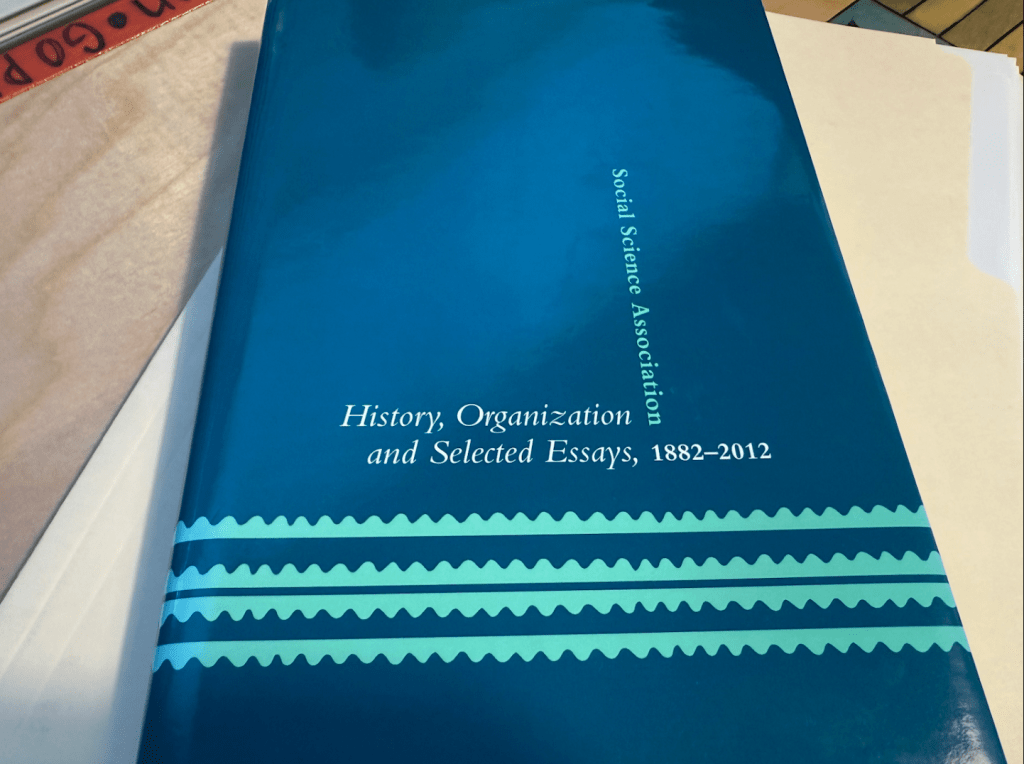
In 2012, the association published a collection of eight essays in a book titled “Social Science Association: History, Organization and Selected Essays, 1882-2012.” An appendix lists all the rest — more than 600 at the time — by year and title. The introductory chapter, by Stanley Porteus, traces the group’s first 100 years that is as much a social and political journey through the history of Hawaiʻi as it is the evolution of the association.
Each meeting features an invited guest speaker who talks to the group about a current event. In the last year or so that has included Honolulu Board of Water Supply Chief Engineer Ernie Lau giving an update on the Red Hill water situation, Maui Mayor Richard Bissen talking about the year after the deadly wildfire and John Komeiji explaining what is happening with the Maunakea Stewardship and Oversight Authority, which he leads.
Until about the 1960s the host and the essay writer were required to wear tuxedos to the meeting, everyone else just a coat and tie. And the constitution still requires strict attendance. If you miss three meetings in a year you go on probation. Members who can’t or won’t keep up the pace are transferred from active to honorary status where they can still attend occasionally but their spot is then open for a new member. The pandemic ushered in a Zoom capability for the association as it did for a lot of organizations and agencies.
I first learned a little about the association in 2019 when a spot opened up for a media member and Johns reached out with an invitation to join. I declined. It just felt like too much of a conflict of interest for me, a journalist, to listen to the state’s most prominent people talk about interesting stuff and not be able to report on it. What happens in Vegas stays in Vegas, Johns told me more recently in explaining the group’s operating rules.
But I’ve always been fascinated that this gathering of 50 people could be so involved and yet so … underground. I’ve asked many people here if they’ve ever heard of the Social Science Association and only one, who had once been an invited guest, knew what I was talking about. By far the most intriguing thing I learned in researching this column is that it’s not always been that way.
A Robust Public History
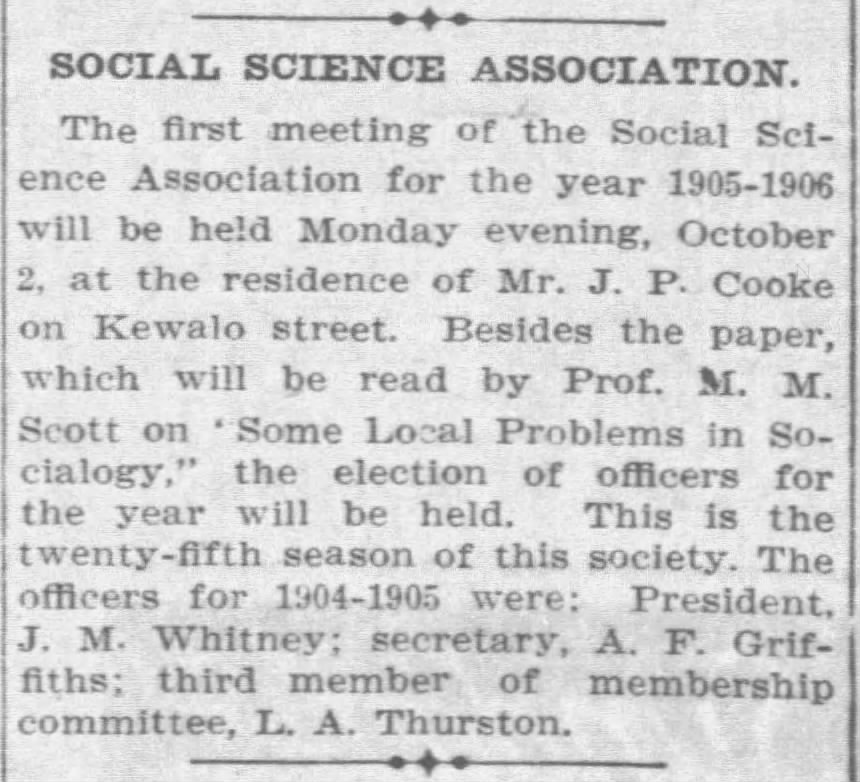
For a hundred years the Social Science Association was constantly in the local papers, their meetings written up and their essays often reprinted over full pages of the papers. A newspapers.com review turns up nearly 700 references.
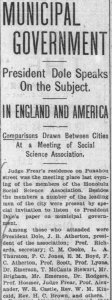
But in the late 1980s mentions of the association pretty much vanished from the news. An essay in 2002 by former Department of Health Director Bruce Anderson entitled “Is Hawaii Prepared for Bioterrorism?” is the last substantive piece I could find. Any mention of the group now is generally in a member’s obituary.
Yet for much of the organization’s history what the members of the Social Science Association had to say helped guide public affairs in Hawaiʻi. They may not have taken direct action as a group — in 1911 in what appears to be a rare move they formally endorsed Prohibition and federal enforcement of liquor laws — but their words helped propel the development of the islands from the overthrow of the monarchy through two world wars, the birth of a new state and beyond.
In 1888, the Hawaiian Gazette devoted a full page to an essay by the Rev. W.B. Oleson that touted “The Educational Value of Manual Training.” It sparked a move to establish vocational and technical training programs in the islands.
In 1889, in what can most charitably now be read as an attempt to continue finding ways for all residents to achieve better lives, the Rev. S.E. Bishop asked the group “Why Are Hawaiians Dying Out?” in an essay that blamed sex, alcohol, disease and “wifeless chase.”
In 1893, the year a group of armed men forced Queen Liliʻuokalani to give up the throne, only one essay appears to have made the newspapers. It was called “Some People Whom I Have Met” by the Hon. J.L. Stevens (who was described as “another Social Science man”) although the list of essays delivered that year includes three others. By the next year, the Social Science Association appeared to be back on pace with at least half a dozen published pieces.
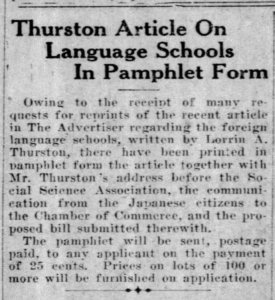
Over the decades, the association continued to play an important role in leading the discussion on current events even if it was not so well received. In 1900, the Pacific Commercial Advertiser chastised the group for meddling in municipal affairs as a debate raged over a city charter for Honolulu. “It is time they were brought up with a stiff club,” the newspaper scribe wrote.
But the community was taking the organization seriously, too. An essay by Lorrin Thurston on foreign language schools in the Honolulu Advertiser had so many requests for copies that the newspaper reprinted it in pamphlet form and charged people 25 cents per copy.
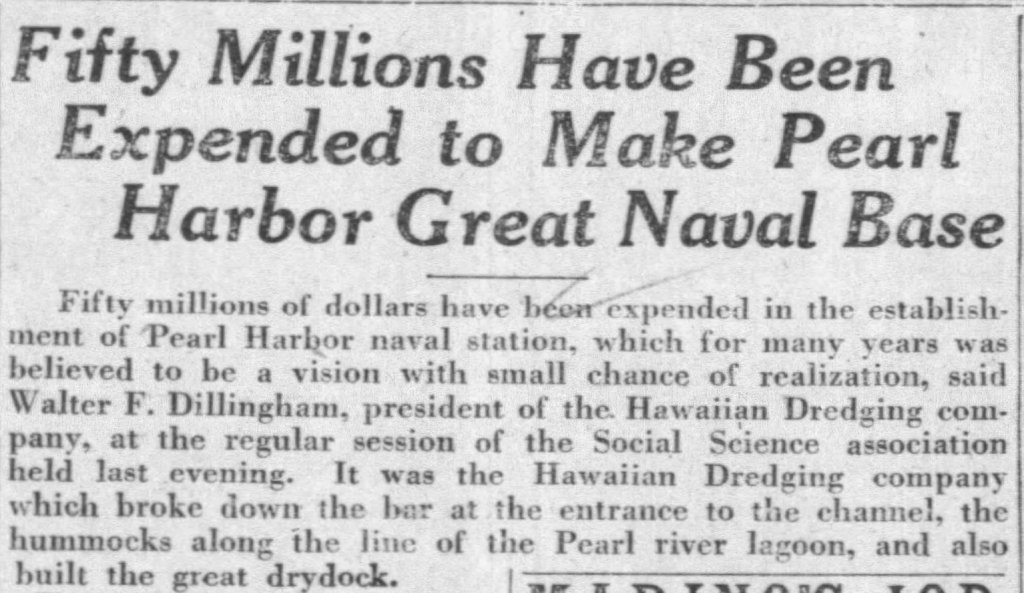
In 1928, with unrest in Europe post-World War I raising concerns about another military conflict, the association gathered at La Pietra, the home of Walter Dillingham, to listen to the prominent Honolulu developer pitch a major expansion of Pearl Harbor. His Hawaiian Dredging Co. was already at work on building out a base that would be capable of holding “most if not all of the Pacific Fleet.”
War did take its toll on the Social Science Organization directly. The group met on Dec. 7, 1941, then not again until October 1943. A newspaper article reported on that meeting, in which Frank Atherton, a veteran member, was elected president. It had held monthly meetings for more than 50 years, even through World War I, but the attack on Pearl Harbor with resulting blackouts and driving restrictions prevented the gatherings at members’ homes.
The Social Science Association was such a public entity that in 1932, on its 50th anniversary, the Honolulu Star-Bulletin blasted a story on the birthday bash across the front page. The 35 members and their wives dined at the Pacific Club in celebration of “Hawaii’s oldest discussion club.”
Fifty years later, as the organization turned 100, the Star-Bulletin again featured a story about the group and its long history.
Local journalists had become members and one in particular, A.A. “Bud” Smyser, a longtime columnist and editor of the Star-Bulletin, was a regular attendee. He wrote numerous pieces about the discussions and essays being delivered at the meetings.
In 1982, Advertiser columnist Bob Krauss penned a tribute to the association’s long-time secretary, Col. Harold Kent, the retired president of Kamehameha Schools, who had been keeping meticulous minutes of every meeting since 1957. Kent would boil down the lengthy essays into 500-word summaries and share them with the members.
The Social Science Association was so prestigious, Krauss wrote, “that when members fell asleep in the meeting room downstairs of the Pacific Club that the club’s designer, renowned architect Val Ossipoff, was called in. He went to the board and had AC installed.”
Ossipoff was also a member of the Social Science Association.
But by 1982, the organization was already losing its place in the news pages and the public’s attention. Krauss referred to it as “one of the most prestigious if among the least known organizations in the state.”

Why it lost its public profile is a mystery. I spoke to a number of members for this column and none could explain what changed or point to an event that sent the group into the shadows.
Now it remains there by choice. Johns, the president, began our first conversation on the Social Science Association by telling me that the members preferred I not write about them.
“The membership doesn’t want a story,” he said a few months ago. “They think the mission of the group isn’t furthered by publicity. They’re not trying to drive public policy.”
More recently, we talked again about about how the Social Science Association had for decades been very openly at the heart of community debate. He and other members I spoke with had no idea that the venerable civic group had been so public for so long.
Maybe it should be that way again, with regular reporting on the essays and the guest speakers. It could and should be a real bright spot for community conversation and understanding.
Johns seemed at least intrigued by that possibility. “I do know it would be vigorously debated by the membership,” he says.
He says he may do his next essay on the idea.
Tell us about a government program or service you think is working well. We’re also interested in people, especially public employees, who deserve to be celebrated for their service or their contributions to making Hawaiʻi a better place. Send to sunshine@civilbeat.org and include Bright Spots in the subject line please!
 Sign up for our FREE morning newsletter and face each day more informed.
Read this next:

Local reporting when you need it most
Support timely, accurate, independent journalism.
Honolulu Civil Beat is a nonprofit organization, and your donation helps us produce local reporting that serves all of Hawaii.
ContributeAbout the Author