Denby Fawcett: County Mayors Want More Money For Honolulu Rail System
The four mayors agreed last week to seek a tax extension from the Legislature not only to pay for the rail but neighbor island transportation needs as well.
December 16, 2025 · 8 min read

About the Author

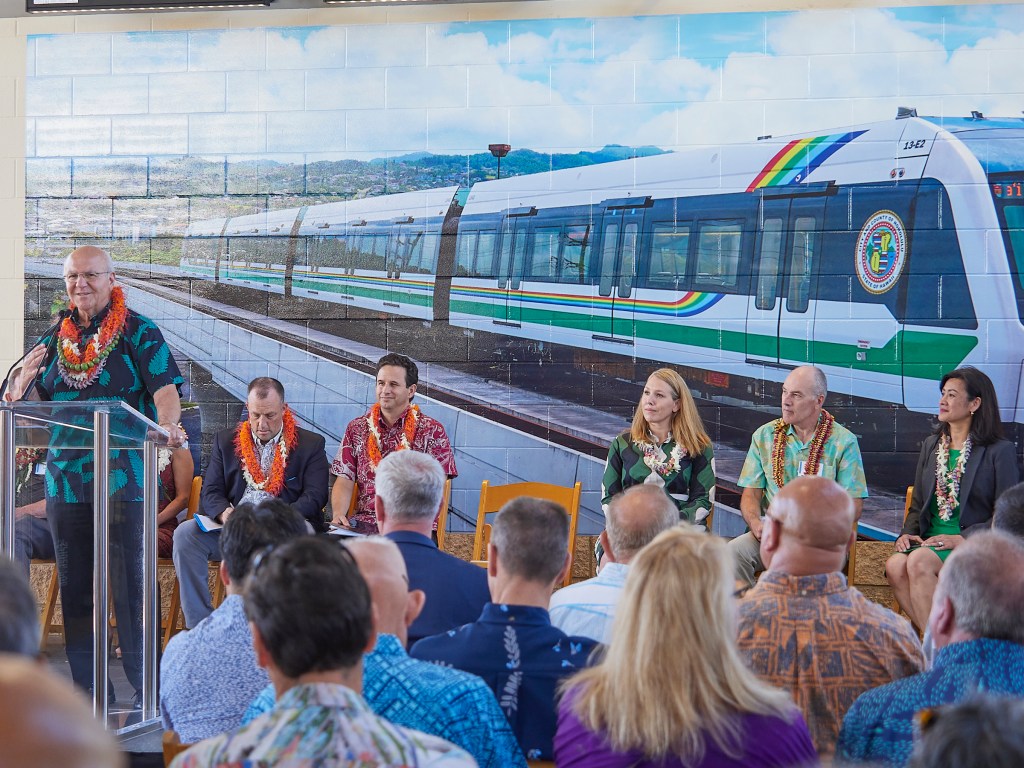
Honolulu Mayor Rick Blangiardi says he and the other county mayors will ask the Legislature to extend the 0.5% excise tax surcharge to 2055 to pay for Oʻahu’s rail system.
I found this out in a phone conversation with the mayor on Friday to talk about the larger issues facing the Skyline system, such as where the city will find the additional $1.6 billion needed to build the system as planned to Ala Moana Center.
As an East Oʻahu resident, I have never felt much support for rail in the past because it does not directly benefit my area. But lately I enjoyed trips to experience the train with friends or sometimes by myself — once heading out alone at night on Skyline to Waipahu to visit a Honduran restaurant I heard was good.
It turns out the place was out of business and after wandering around on the darkened streets of the old sugar mill town for about an hour, I got back on the train and returned to Middle Street where my car was parked at the station. The rail trip was very efficient and easy except for getting lost in Waipahu.
Like most riders, I enjoyed the sweeping views from its elevated tracks of the waterways of Pearl Harbor, the planes lined up at the airport and multi-colored clouds topping the Koʻolau mountains. Train rides offer a tree top perspective of Oʻahu most of us have never experienced.

Ideas showcases stories, opinion and analysis about Hawaiʻi, from the state’s sharpest thinkers, to stretch our collective thinking about a problem or an issue. Email news@civilbeat.org to submit an idea or an essay.
The state started imposing the rail tax surcharge in January 2007. It was supposed to be a temporary tax with an original expiration date of 2022 but it’s been extended twice, to Dec. 31, 2030.
State lawmakers granted the counties the authority to impose an up to 0.5% excise tax surcharge in 2005 but Kauaʻi and Hawaiʻi island did not adopt the surcharge until 2019, and Maui did it only last year.
And Blangiardi said Friday that the mayors had agreed at a Zoom meeting earlier that same day to ask the Legislature to extend the 0.5% tax surcharge to 2055, both for Oʻahu rail and to help the county mayors alleviate their own pressing traffic problems.
The bill will be submitted to state lawmakers in January as part of the Hawaii Council of Mayors joint package.
Senate President Ron Kouchi said Monday he had not seen the mayors’ proposal yet. But, he says, “It will be a big deal. Everything to do with rail is big deal because of cost and policy issues.”
Kouchi says the proposal to extend the rail tax to 2055 will be considered as a part of the Legislature’s overall economic package along with lots of other things such as potential federal budget cuts and tax revenue losses in todayʻs weaker economy.
The Blangiardi administration needs additional tax collections to get the Skyline rail system to its final eastward stop near Ala Moana Center and to push farther west with a new West Kapolei station.
Now, the city has enough money to add six more stops by 2030 including Chinatown and downtown Honolulu with an end stop at the Civic Center at South and Halekauwila streets in Kakaʻako. But that’s it.
Another $1.6 billon is needed to get Skyline to Ala Moana and even more money will be necessary if it is to extend the system past East Kapolei to West Kapolei.
Ala Moana is an important stop for the success of the system because it is a key public transportation hub with bus connections for rail riders to use to travel all over Oʻahu.
The mayor says he hopes to amass the money for the extension to Ala Moana both by extending the excise tax surcharge through 2055 and by persuading the Federal Transit Administration to kick in additional federal grant money above the $1.55 billion it has already allocated in a federal grant to the project.
$1.2 Million Public Relations Campaign About To Kick Off
Part of generating support for that money will be to convince a weary public that the rail system is worth it.
In early January, Blangiardi plans to launch a major $1.2 million public relations campaign with funding already in the budget to counter what he calls two decades of negativity about the rail.
Residents have been upset for years about the project’s soaring cost, which has doubled from the original expected construction cost of $5.1 billion to more than $10 billion, its delays and the sense it goes from nowhere to nowhere.
But that has changed with the opening of the second segment in October with four new stops including at the Daniel K. Inouye International Airport and Joint Base Pearl Harbor-Hickam — places riders actually want to go, economic hubs where thousands of people work.
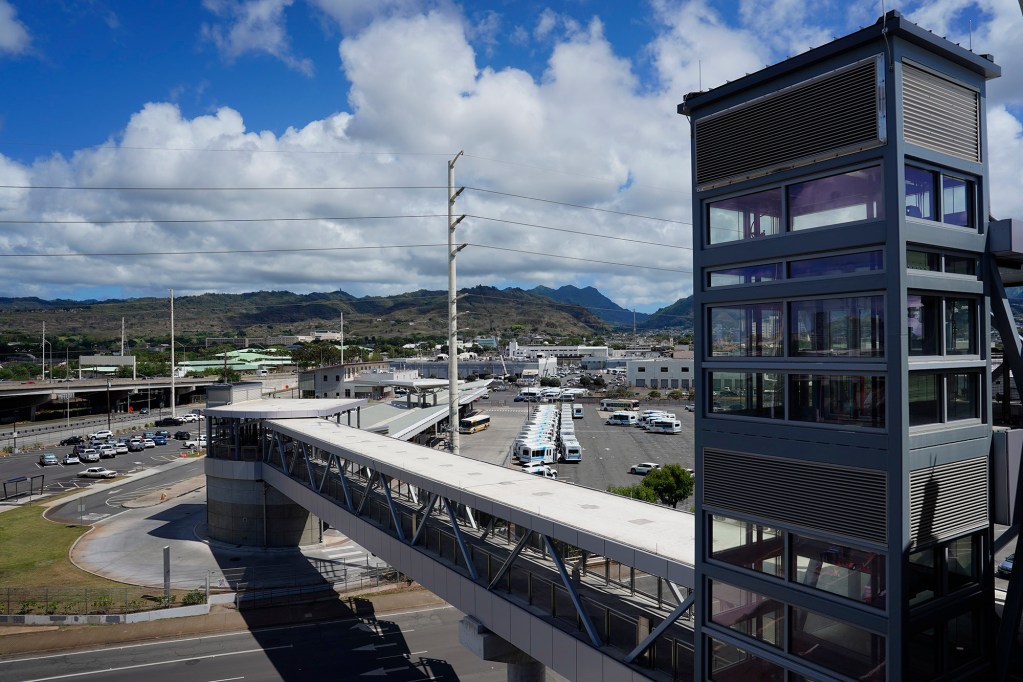
The mayor hopes to increase boardings in a year to 25,000 each weekday with the new media campaign. Currently, boardings on the new second segment are running about 10,000 to 11,000 a day. That compares to only about 3,000 riders a day on the first segment, which opened June 2023 from East Kapolei to Aloha Stadium.
That still is far short of the Honolulu Authority for Rapid Transportation’s latest projection of rail ridership at 84,000 riders each weekday when the line makes it to Kakaʻako.
“Now we can show the train doing what it was supposed to do, getting passengers to where they want to be, efficiently and safely and predictably with never more than a 10-minute wait for a train, usually much less than that,” the mayor said.
The media campaign will be done with an in-house creative team including Blangiardi and his communications director Scott Humber, who will work with Hawaii News Now’s marketing team and other outside vendors to create television commercials, digital ads and social media postings.
Humber says they are in early discussions with the University of Hawai‘i about a potential partnership to place Skyline advertising at select UH sporting events, while also promoting UH athletics on Skyline and TheBus.
Until now there has been no extensive media outreach to boost ridership. “I blame myself for having no game plan to educate the riders,” Blangiardi said.
He said the focus in the past was on the ongoing rail construction and on operating the system rather than convincing the public on how riding it could enhance their lives.
Getting Citizen Buy-In
Of course, a new media campaign alone is not be enough to rebuild residents’ trust in the rail project. Other factors will include making sure the line gets to Kakaʻako on schedule with no construction delays or surprise cost increases. And finding the additional $1.6 billion to advance the line to the Ala Moana will be a major initiative.
Also, that the city must continue to build high-frequency bus networks to connect seamlessly with rail stations.
And it needs to exercise rigorous oversight over the zoning for Transit-Oriented Development — the high-density housing and economic opportunities projected to flourish around the rail stations.
There is a final factor not as tangible: counting on the experiences of individual rail-riders over the years as a quiet source of support for the project.
My own epiphany has been how enjoyable it is to ride the rail to places I would not normally fight the traffic to visit in my car. And to get off to explore some places not familiar to me even though I grew up on Oʻahu.
Such a trip was a recent rail ride with my friends, Nora Meijide Gentry and her daughter Corin Gentry, to the end of the line in East Kapolei and then back to town, disembarking at the Pearlridge station to eat a lunch of cheeseburgers and strawberry pie at Anna Miller’s Restaurant and after, walking up the hill to the Pearlridge Mauka mall to check out the Christmas decorations before heading back to ride the train to our car at the Middle Street station.
It was a relaxing and inexpensive way to experience the holiday season without the traffic and parking stress of driving to a shopping center in town.
When my friend Alia Pan and I rode the train to East Kapolei early this rainy Sunday morning we chatted with a woman named Mercy Stevens in the Honolulu Kitchen restaurant in Waipahu where we were waiting for our dim sum and manapua order.
Stevens described her own epiphanies. She said she was constantly surprised by things she learned about her Waipahu community when she rode the train, such as looking out to see a large homeless encampment in the neighborhood she didn’t know existed and finding out she could experience the holiday without going into town — from a rail car.
“I don’t need to go into Honolulu to see the Christmas lights. I can see them right from the train,” she said.
There is no going back. Rail is here to stay. Now the challenge will be if we can learn to like it.
 Sign up for our FREE morning newsletter and face each day more informed.
Read this next:

Local reporting when you need it most
Support timely, accurate, independent journalism.
Honolulu Civil Beat is a nonprofit organization, and your donation helps us produce local reporting that serves all of Hawaii.
ContributeAbout the Author