Makana Eyre: Hawaiʻi-Style Canoe Paddling Has Spread Worldwide
About 20% of the members of this New York canoe club have Hawaiʻi roots.
February 2, 2026 · 5 min read

About the Author

Of all the places I thought I’d paddle a waʻa, the Hudson River, the large body of water running along the west side of Manhattan, was not one of them.
On a bright, cool November morning last year, I took the subway from Brooklyn to Pier 96, which sits about a third of the way up the island, west of Columbus Circle and the southern edge of Central Park.
As many reporters do, I arrived early, hoping to get the lay of the land and some color before my interviews. I took a moment to look out at the slate colored river. A chilly wind blew white caps over the water. Just a hundred yards east stood the great skyline of New York City, all steel and glass and concrete. As a place for water sports, it seemed a bit hostile.

Ideas showcases stories, opinion and analysis about Hawaiʻi, from the state’s sharpest thinkers, to stretch our collective thinking about a problem or an issue. Email news@civilbeat.org to submit an idea or an essay.
My reservations vanished, though, once I got inside the boathouse and met the crew at New York Outrigger, one of the area’s major canoe clubs. They were a jovial bunch, eager to share their love for paddling.
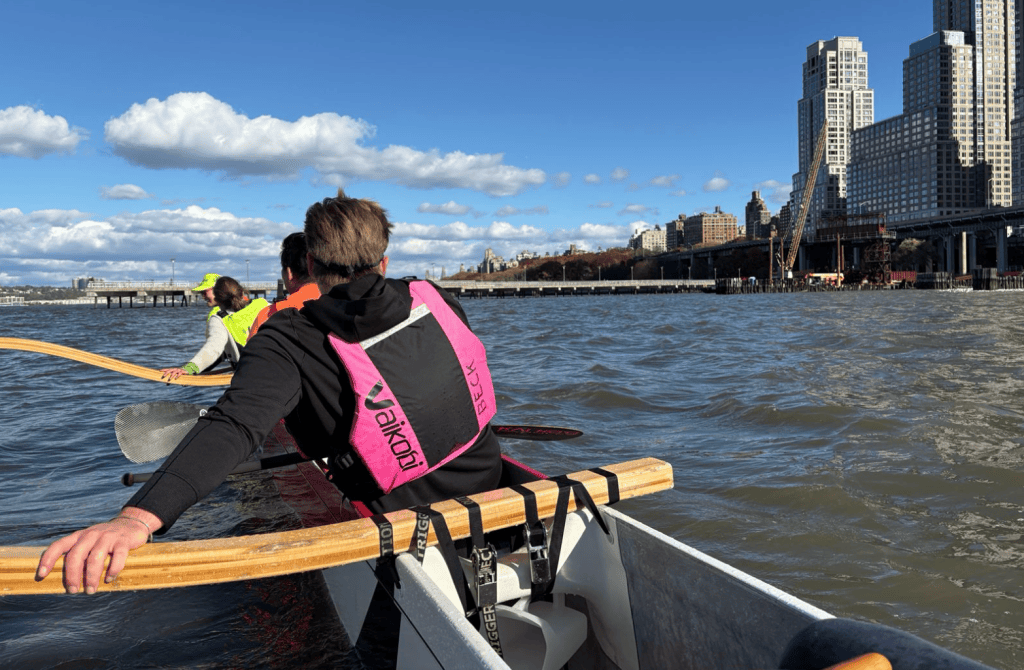
Soon we were hauling a red-and-white six-man down the dock and onto the water. Sitting seat five, a few feet from two Hawaii-raised paddlers, Jason Ng, our steersman, and Brent Beck, in seat four, we took our first strokes and set off on the water.
Paddling of the Hawaiian style, where an ama is rigged to a hull with two ʻiako, is now global — and has been for some time. While surfing might be Hawaii’s most famous export, paddling has quietly spread wide, creating thousands of passionate watermen and women scattered around the world.
In Europe, there are clubs in Portugal, Spain, the United Kingdom, France and Germany, among other countries. Paddlers in Hong Kong race off Tai Wan To Beach. In Singapore, they launch canoes from Sentosa island. In Japan, they train off Zushi’s shores. Rio de Janeiro and Brasilia are home to clubs, as are the Australian cities of Sydney, Melbourne and Brisbane. Even in the humblest bodies of water, like an old reservoir in the landlocked Canadian city of Calgary, people hoist themselves into canoes and paddle.
In my own far-flung family, paddling has a way of turning up in unlikely places. When my older sister moved to Sweden in the mid 2000s, she steered a crew that trained in the clear, cold waters of the Stockholm archipelago. They rigged the amas low. To huli carried real risk.
Last year, my dad bought an ARES one-man. His dealer, a Frenchman named Olivier Marie who lives near Biarritz, sells a half dozen different sorts of canoes to clients across the continent. Marie delivered the boat in person to my dad’s Swedish village on his way to the Baltic Sea Festival, a race in Eckernförde, Germany and a qualifier for the Va’a World Sprints, a major global regatta.
When I visited New York Outrigger, its then-president, Julie Rwan, told me about the club, which was founded three decades ago in 1996. Today, about 60 enthusiastic people — one-fifth with roots in Hawaii — show up regularly to paddle the club’s seven boats. They try, as far as it’s possible at such a distance, to keep a link to Hawaiian culture.

Enthusiasm is not optional, at least late in the fall months when I visit. At dawn, the Hudson is often calm. By mid-morning, when we hit the water, boats chugging up and down the river have created a frenzied energy making the water churn in every direction, thrusting our boat about like a garment in the washing machine. Jet skis and cruise ships create even more violent wakes.
Sitting in a canoe on the Hudson bears little resemblance to the places where I grew up paddling on Oahu. It’s far deeper and wider than the Ala Wai Canal. It’s colder and rougher than Keʻehi Lagoon. The surroundings are urban in a way that even Magic Island, off which the Interscholastic League of Honolulu held regattas when I was a teenager, just can’t rival.
Yet for the paddlers of New York Outrigger, cold spray off a paddle’s blade or numb toes don’t extinguish the zeal.
I appreciate their passion. From the water, they get a rare view of New York City. Sometimes, they sight fish, sea lions, harbor seals. People from the quays stare and waive at the curious crafts gliding up and down the waterway. It also beats the fetid gyms of New York City.
For the Hawaii folks, I sensed that the club is a place of belonging, of celebrating their culture from afar. It’s also a means of cultural transmission, a way to share one thing that makes our islands great, minus the plastic lei, tiki bars, and kitschy poke.
Only one puzzling question remains. With such international interest, why isn’t paddling an Olympic sport? Kayaking is. An odd spectacle called canoe slalom, where kayakers navigate artificial white water courses, is also in the lineup.
If you know someone on the committee, please send them my column.
 Sign up for our FREE morning newsletter and face each day more informed.
Read this next:

Local reporting when you need it most
Support timely, accurate, independent journalism.
Honolulu Civil Beat is a nonprofit organization, and your donation helps us produce local reporting that serves all of Hawaii.
ContributeAbout the Author