That Dark Cloud Over The Legislature? This Bill Would Make It Even Darker
The University of Hawaiʻi is one of the most important institutions in the state. The public needs to know more, not less, about who’s running it.
March 22, 2026 · 10 min read


About the Authors


It’s been more than a decade since Hawaiʻi lawmakers put in place one of the strongest accountability measures in state history — the requirement that top government leaders reveal their financial interests so the public can see what conflicts they have when it comes to doing the state’s business.
The Legislature was unanimous in its passage of the financial disclosure bill that brought the members of 15 high-profile boards and commissions in line with disclosure rules that also govern all 76 lawmakers, the governor, lieutenant governor and a slew of other top state officials. Since at least 2015, dozens of people have filed annual reports with the Hawaiʻi State Ethics Commission, which posts them in an easily searchable database on its website.
Of course, as generally happens with things that aim to make government more open, that particular step forward wasn’t easy. Although lawmakers were united in their enthusiasm for the bill, then-Gov. Neil Abercrombie was less so and came close to vetoing it, bizarrely arguing that it would hurt women because board members would have to disclose their spouses’ information.
Two members of the University of Hawaiʻi Board of Regents raised a huge stink and quit rather then file the paperwork. Two others quit more quietly later.

Since then there have been a couple of attempts including by UH regents to water down the financial disclosure law. More than 100 smaller boards are allowed to file their reports confidentially and a couple of times others have asked to join that list but they’ve been rebuffed.
But no major board or commission has been removed from the public financial requirement since the 2014 law was enacted.
Now here we go again. And again the charge is being led by UH regents who complain that good people don’t want to be on the board because they don’t want their investments and other financial business made public.
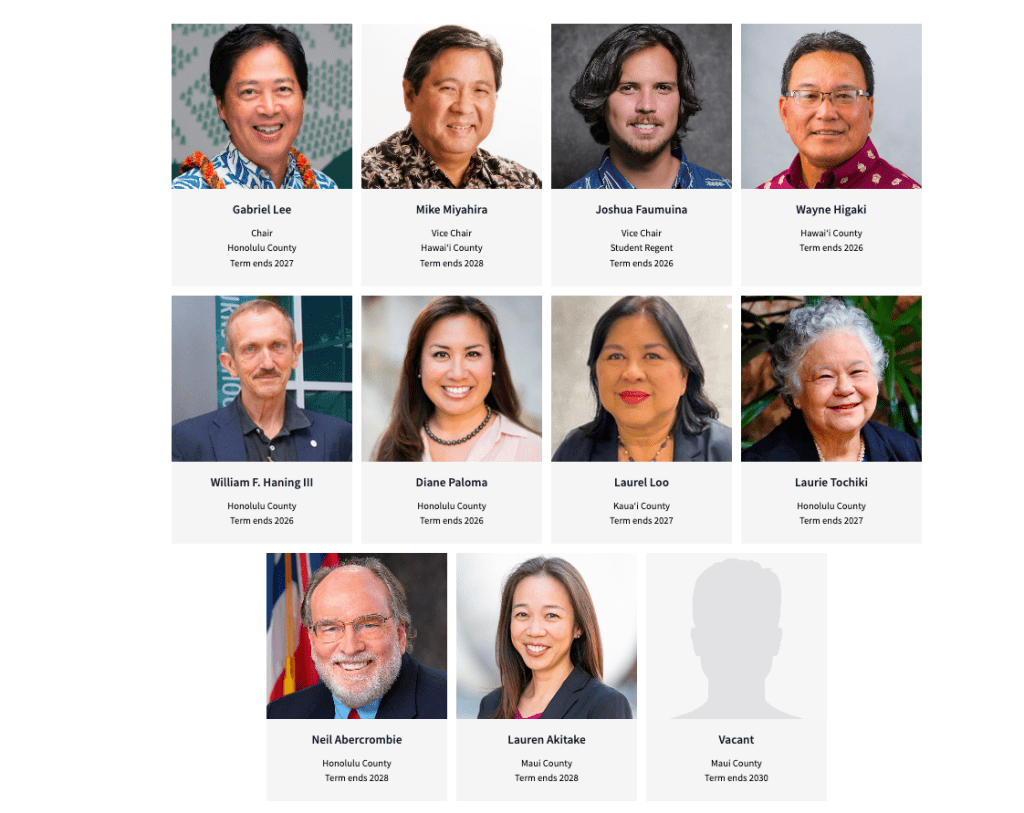
Perhaps not coincidentally one outspoken member of the Board of Regents is now Neil Abercrombie.
House Bill 1873 is a misguided effort on the part of six House members to exempt the regents from having to make disclosures public. They’d still file reports to the Ethics Commission, but the commission would not be allowed to share those with the public.
The bill doesn’t seek such special treatment for any other board or government official, only the regents.
And in fact, this year the Ethics Commission is urging lawmakers to expand the list of people who must file public financial disclosures to include five new high-profile boards that have been created since 2014 as well as chief executive officers of all the boards that must report.
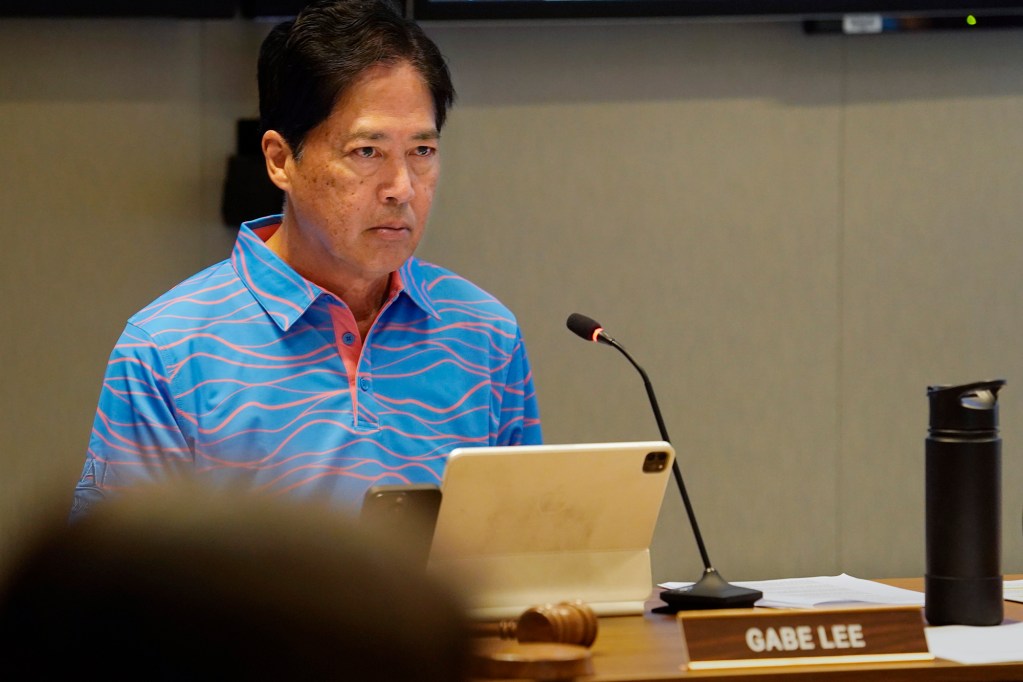
Last week, supporters of SB 1873, including Gabe Lee, the chair of the regents, told the Senate Education Committee it’s been difficult to attract good candidates to serve because they don’t want financial information like the names of employers, income ranges, creditors, properties, investments and directorships to be made public. He believes that an exemption would widen the pool of qualified applicants, attracting in particular those with expertise in large scale organizational, management, financial, accounting and budgeting enterprises.
But it’s hard to see any merit in that argument considering the UH Board of Regents hasn’t seemed to have much trouble filling its openings.
There is currently one vacancy on the 11-member board — one of the two Maui County seats.
And UH News announced Thursday the names of five finalists to fill two upcoming vacancies for the Honolulu County seats.
The applicants are well known and illustrate that serving as a regent is a privileged post: attorney Benjamin Kudo, attorney and business executive Keith Amemiya, UH College of Education administrator Ryan Mandado, former Department of Human Services director Marie Laderta and former school superintendent Kathryn Matayoshi.
A better argument for why people might be hesitant to serve on the board is the fear of getting raked over the coals by certain lawmakers. One needs to look no further than the hearing two years ago when Sen. Donna Kim, chair of the Senate Education Committee, publicly humiliated Alapaki Nahale-a, the Big Island regent who wanted to serve four more years on the board of regents.
Nahale-a, who was chair at the time and CEO of the Global Resiliency Hub in Kohala on Hawaiʻi island (he previously worked for Kamehameha Schools and served as president and executive director of the Hawaii Public Charter Schools Network), was then narrowly rejected by the Senate.
Ironically, Kim at the time said she was worried that the board of regents during Nahale-a’s tenure had not been transparent and accountable to the public. Lee replaced Nahale-a as board chair.
Robert Harris, executive director of the Ethics Commission, has been working hard to convince legislators to reject SB 1873. He wrote a letter to lawmakers trying to dispel some of the misinformation being spread about why the regents should be let off the hook. And he wrote an essay for Civil Beat last month arguing that the regents are asking to fix a problem that doesn’t exist.

“If disclosures are hidden from the public, potential conflicts are more likely to surface only after the fact, when the commission may be asked to investigate decisions after any harm to the public trust has already occurred,” he testified last week at the Senate hearing.
Limiting the transparency, Harris told the education committee Wednesday, “runs counter both to national standards and other similar institutions such as the University of California, which does also have public disclosure requirements.”
He also took issue with the notion that UH is having difficulty attracting applicants to serve as regents. Since the public disclosure requirement for regents and 14 high-profile boards and commissions took effect in 2014, the quality of applicants and appointees serving on the board “has remained high,” he said.
Harris emphasized that the Legislature made the decision to include “high-profile policymaking boards with substantial fiduciary responsibilities” in the public disclosure. UH Board of Regents is just one.
The list of those required to make their finances public, as identified in Hawaiʻi Revised Statutes Section 84-17, include:
- Agribusiness Development Corporation
- Board of Agriculture and Biosecurity
- Ethics Commission
- Hawaiʻi Community Development Authority
- Hawaiian Homes Commission
- Hawaiʻi Housing Finance and Development Corporation
- Board of Land and Natural Resources
- Land Use Commission
- Legacy Land Conservation Commission
- Natural Area Reserves System Commission
- Natural Energy Laboratory of Hawaii
- Hawaiʻi Public Housing Authority
- Public Utilities Commission
- Commission on Water Resource Management
- Stadium Authority
The same statute also applies to the governor, lieutenant governor, members of the Legislature, trustees of the Office of Hawaiian Affairs, state department directors and their deputies, UH presidents, vice presidents, chancellors and provosts; the Board of Education, superintendent, deputy superintendent, state librarian and deputy state librarian of the DOE; the administrative director and deputy director of the courts; and the OHA administrator and assistant administrator.
Now two other bills proposed by the Ethics Commission that would expand the list of boards and their members required to report are advancing at the Legislature at the same time HB 1873 is seeking to exempt the regents.
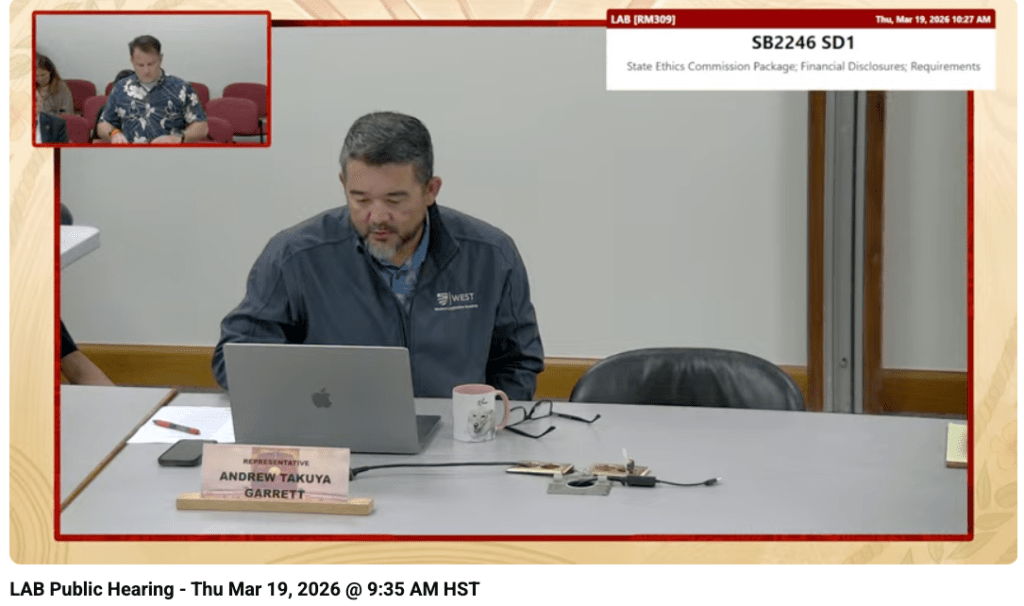
Senate Bill 2246 and its House companion would add the Employees’ Retirement System, the Hawaii Employer-Union Health Benefits Trust Fund, the Hawaiʻi Green Infrastructure Authority, the Hawaiʻi Technology Development Corp. and the School Facilities Authority. It also calls for including both members and chief executive officers of influential boards and commissions.
The bill itself offers this perfectly good rationale as to why these five organizations should be added: “Several boards and commissions that manage large sums of public funds, exercise significant financial discretion, or make decisions with substantial economic impact are not currently included in the statute’s public disclosure requirements.”
Even Rep. Andrew Takuya Garrett, author of the bill seeking to exempt the regents, on Thursday voted for the greater disclosure, although with resevations.
Regents Also Want To Meet Privately
SB 1873 also takes a swing at the Sunshine Law by allowing the regents to meet in private in what the bill describes as a strategic planning retreat. Kim, in passing the measure out of her education committee last week, didn’t mention the financial disclosure dust-up but did amend it to limit the retreat to one six-hour session per year.
And while other senators also remained mum about the disclosure requirements, several expressed concern about walling the public off from such a gathering.
“You folks oversee billions of dollars, and so to exempt you from Sunshine Law, to have those meaningful discussions and one-on-one conversations, really does not signal to the public that transparency is important — not to mention the financial disclosures,” Sen. Samantha DeCorte told Lee.
Groups opposing both the open-meetings and financial disclosure exemptions include the Public First Law Center and the League of Women Voters of Hawaii. The Hawaiʻi chapter of the Society of Professional Journalists also opposes the retreat exemption.
“No one has specified why a retreat needs to be done in secret,” testified SPJ president Stirling Morita. “Exemptions from the opening meeting requirements of the Sunshine Law should be extremely rare, particularly when the direction and policy of the state’s university are at play, and we feel this business should be done in public.”
SB 1873 is now headed to a joint hearing of the Senate Judiciary and Ways and Means committees.
By any measure, the University of Hawaiʻi — the state’s only public institution of higher learning — is a major player in education, finance, government and politics.
The University of Hawaiʻi system has 10 campuses and seven educational centers on every major island. UH is recognized internationally for research in oceanography, linguistics, astronomy, education, tropical agriculture, cancer, genetics and the Pacific Islands and Asian area studies. And it employs around 10,000 people, enrolls more than 51,000 students and has a budget of $1.3 billion.
UH is by design an economic engine essentially owned and operated by the people. It’s important, then, for the people to know as much as possible about the 11 members of the UH Board of Regents who hire its president and how they go about approving appointments, budgets, policies and programs.
Allowing these top state officials to operate in the shadows whether it’s filing their financial disclosure reports secretly or meeting behind closed doors for an all-important strategic planning session is very much a step backward from the hard-fought accountability achievements in place without any problem for 12 years.
It seems unbelievable that lawmakers would even consider such a back pedal at a time when investigations into legislative corruption continue and a number of bills to address money in politics and official misconduct are at center stage.
 Sign up for our FREE morning newsletter and face each day more informed.
Read this next:

Local reporting when you need it most
Support timely, accurate, independent journalism.
Honolulu Civil Beat is a nonprofit organization, and your donation helps us produce local reporting that serves all of Hawaii.
ContributeAbout the Authors