Will Hawaiʻi Voters Once Again See Long Lines On Election Day?
Voters may be forced to wait in line this election season after the death of legislation that would have funded more county voter service centers.
April 12, 2026 · 11 min read

About the Author

Ever since Hawaiʻi first implemented its statewide mail-in voting system in 2020 there have been complaints that there aren’t enough places to vote in person on Election Day.
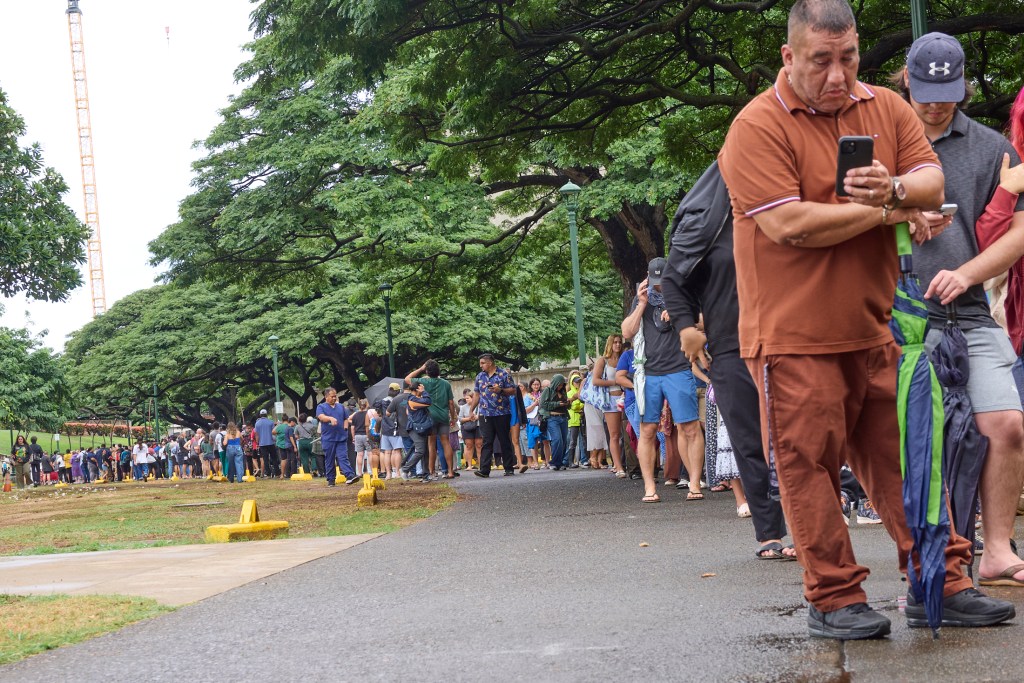
On two occasions, most recently during the 2024 general election, long lines formed at several polling sites. The lines were most prominent on population-heavy Oʻahu, where voters could only cast their ballots in person on Nov. 5 at Honolulu Hale and Kapolei Hale.
Many voters stood in line for hours, delaying the reporting of results until well after midnight. Although the polls technically close at 7 p.m. on Election Day, by law they cannot close as long as someone is still waiting to perform their civic duty. At Kapolei Hale, the last voter cast a ballot well after 11 p.m. There were also lines in Wailuku on Maui and in Kona on the Big Island.

One solution, according to many lawmakers and government reform advocates, is to add more voter service centers to all four counties. The centers handle in-person voting, same-day voter registration and collection of voted ballots.
But that won’t happen in time for the Aug. 8 primary election or the Nov. 3 general election this year for one reason: the county clerks don’t want them, even in an election that promises to have longer-than-usual ballots.
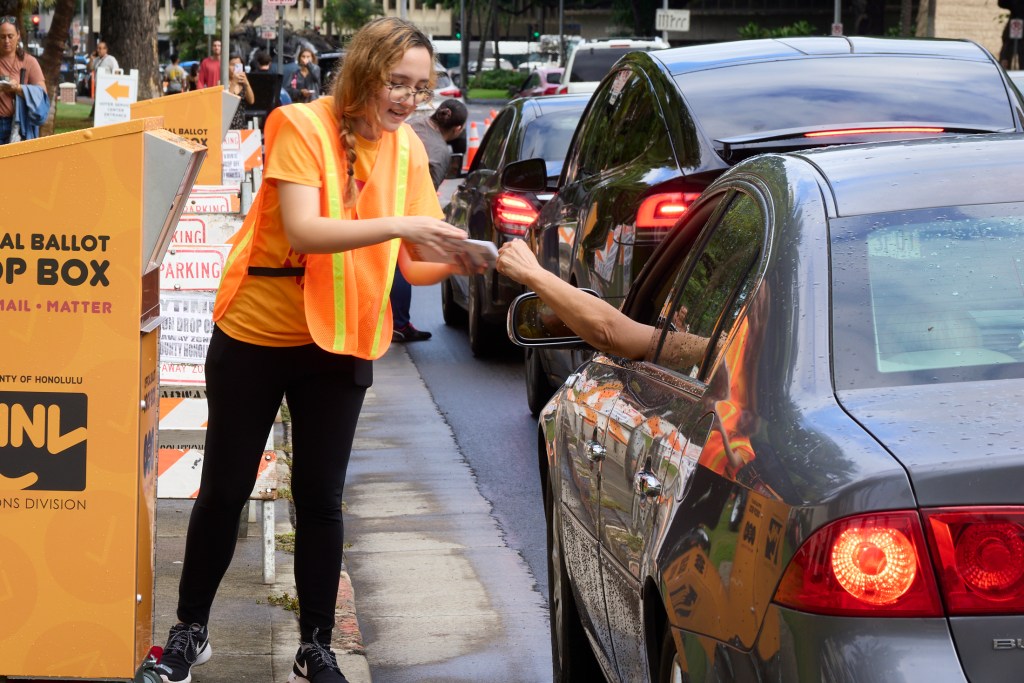
While the state Office of Elections is responsible for candidate filing, printing and counting of ballots, as well as voter education, the counties directly handle registration and voting.
Three of the four chief clerks — representing Maui and Hawaiʻi counties and the City and County of Honolulu— managed to convince House and Senate committees this session that it would be a waste of resources to fund more centers, it would be difficult to staff them and it would likely not make it easier to vote. Kauaʻi County stayed neutral, although it did offer comments on the bill.
The current election system, which includes early voting locations and ballot drop boxes, works just fine, the clerks say. They point to turnout numbers that show that mail is the preferred way to vote. In 2024, for example, nearly 61% of registered voters (522,236 people) voted by mail. Only 39,000 voted in person.
What would really help, the clerks argue, is for residents to actually vote before the election rather than wait until the last day.
The dustup over voter service centers is more than just a philosophical dispute over those who prefer to vote in traditional ways versus those who want convenience. It comes as the Trump administration and other conservative groups are working furiously to change voting laws nationally in time for the 2026 elections. They say they are protecting the integrity of voting to prevent fraud, but opponents argue the GOP is actually trying to keep voters more aligned with Democrats away from the polls.
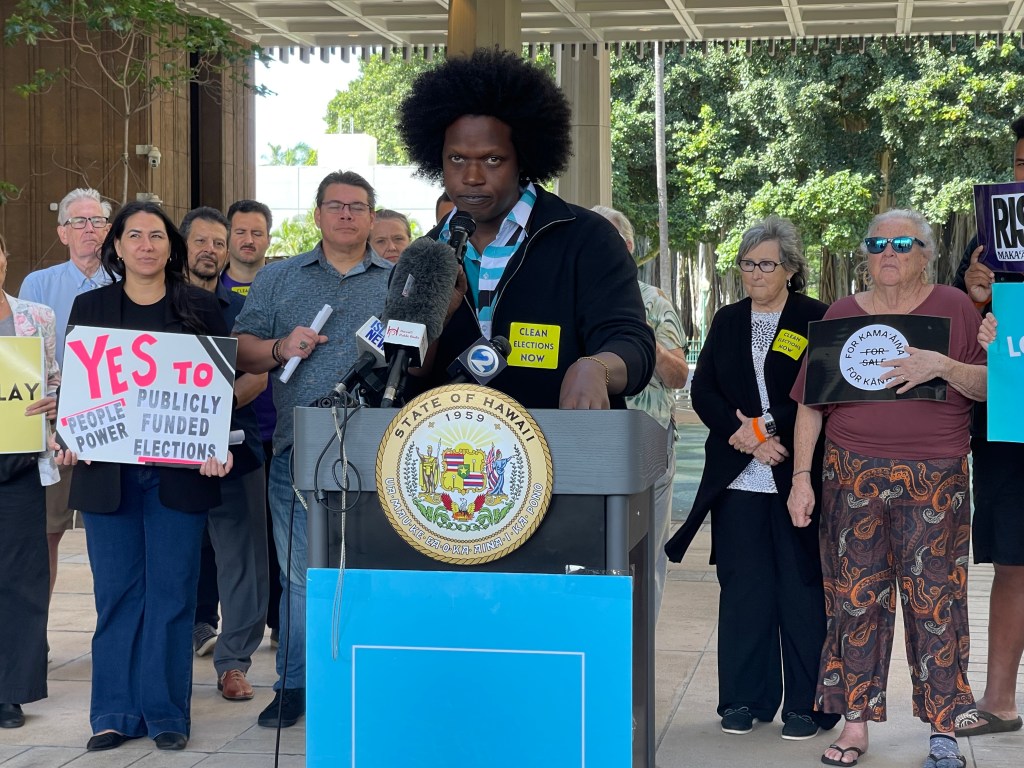
Here at home, Camron Hurt, state director for Common Cause Hawaiʻi, is not pleased with the counties’ resistance to voter service centers. Giving voters more access was a priority for Hurt’s good-government group before the 2026 session began, and now it’s not going to happen, barring a last-minute funding intervention from the Legislature.
“I think that it is a failure of county government if they cannot accommodate day-of voting for their population,” he said.
In Hurt’s view, the lack of more centers amounts to disenfranchisement that may lead to lawsuits over civil rights violations. He gave the example of the burden for someone on Oʻahu’s North Shore driving over an hour to vote in Kapolei, having to wait in line and then driving home.
“What you are guaranteed is the right to the ballot on Election Day,” Hurt said. “I have the right to vote on Election Day. You should make it accessible to me.”
That’s a point that Rep. Diamond Garcia made during a hearing on one of the voter service center measures in February, House Bill 1525. When Honolulu City Clerk Glen Takahashi told lawmakers that his office had encouraged voters to not wait until the last day to vote, Garcia responded forcefully.
“Regardless, that is their right to vote on Election Day,” he told Takahashi. “I get it. It might be your preference to have them go vote early or vote by mail, but the preferences are besides the point. They have a right to go walk in in person on Election Day, and our resources, paid for by taxpayer dollars, should give ample time and resources to allow them to cast that vote in person.”
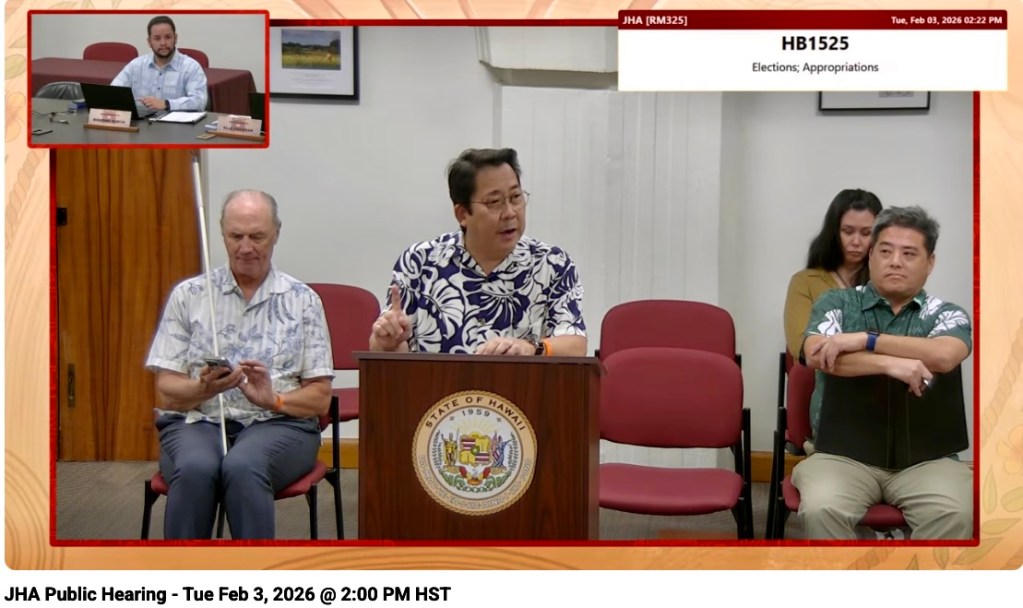
Takahashi did not take issue with Garcia, explaining that his office will do what it can to accommodate all voters.
“We let every person who stood in our line cast that vote,” he replied. “We will stay up until 3 in the morning, if that’s what it takes.”
Takahashi’s point, however, was that voting in person any other day besides Election Day typically averages only 10 minutes.
“Even with funding, I can’t promise a 10-minute wait, especially if 400 or 500 people show up at 6 p.m.,” he said. “There’s no way that that’s going to occur in 10 minutes. I’ve just got to be very real and candid.”
‘Election Integrity’
The 2020 presidential election gave rise to accusations of voter fraud, led by Donald Trump, who lost to Joe Biden. Those accusations — which have proven to be false — continue and have been heard in Hawaiʻi.
The Hawaiʻi Elections Commission, where allegations of voting irregularities have been voiced for years, has unsuccessfully pushed to have the state and counties audit the 2024 general election and to abandon all mail-in voting except for cases like absentee voters or those in need of assistance.
It’s a very different situation at the national level, however, where voting is being challenged on several fronts.
That includes a case before the U.S. Supreme Court on whether to count ballots received after Election Day, the still-pending SAVE America Act that would require American citizens to show identification documents such as a passport or birth certificate to register to vote, the Department of Justice demanding copies of states’ voter registration lists and Trump’s recent executive order attempting to curtail mail-in voting.
It’s unclear how Hawaiʻi might be impacted by any of these efforts. It has refused to turn over voter lists, for example, and it does not count ballots received after Election Day. The states are also charged with conducting elections. And despite the continued clamoring of Trump and his allies — the argument essentially boils down to ensuring that voting is safe via “election integrity,” as it is deemed — voter fraud is rare.
Allegations of voter fraud, in the meantime, are seen by Democrats as the GOP’s efforts to hold onto power by making it harder to vote.

What many Democratic and Republican legislators in Hawaiʻi agree on, though, is that voters should be allowed to vote on Election Day. Garcia and three other Republicans co-sponsored House Bill 1525 to add more voter service centers. The bill, authored by Democrat Rep. David Tarnas, was one of 13 introduced this session, all of which died after failing to meet a Friday deadline.
HB 1525, which advanced the farthest, would have given state money to the four counties to set up the centers. While a total cost was not estimated, the Kauaʻi County clerk said it would need $310,000 to set up two more centers.
The state Elections Office would also have received $178,000 to support a public outreach program and $2 million to print and mail the existing digital voter information guide.
But HB 1525 ended up confronting state lawmakers with the unusual scenario of county officials turning down the offer of money.
Takahashi along with Moana Lutey and Jon Henricks, the clerks for Maui and Hawaiʻi counties, respectively, expressed worry in testimony that it would be difficult to hire and train enough workers needed to properly staff the centers. Takahashi said that paying them $20 an hour for seasonal work, the current rate, was not an attractive job opportunity.
The clerks made clear that they appreciated the Legislature’s offer but did not want the money, so their pushback came as a surprise. Sen. Karl Rhoads, the author of the Senate companion to HB 1525, immediately killed his bill after hearing the clerks. Tarnas did pass his own bill as did the House Finance Committee, but it was not heard in the Senate.
“It’s unfortunate it’s dead, because that was a good bill, even if it couldn’t have been everything,” Tarnas told Civil Beat. “It could have been at least something.”
Voter Options
Janet Mason of the League of Women Voters was also disappointed there will be no additional voter service centers this election. But she found the clerks’ rationale compelling and plausible, in particular the concerns about staffing hurdles.
“It’s very hard to find entry-level workers, particularly if it’s just a temporary job,” she said. “So I think their explanation is completely true.”
Mason is concerned, though, that voters who choose to vote in person, whether before or on Election Day, will likely face a much longer ballot than two years ago. That is because some of the counties including Oʻahu will likely have detailed charter amendment questions to consider. It is possible as well that there may be several constitutional amendments for voters statewide.

“Particularly for our general election this year, when the ballot is going to be very long, it does make a lot more sense to vote from home,” she said. “If you haven’t prepared yourself to answer those ballot questions before you get to a voter service centers, you’re going to be delayed, and you can hold up the line.”
When it comes to voting opportunities, then, the 2026 election is likely to be a lot like the 2024 but with a more time-consuming ballot. There will be some differences that might make things run more smoothly, and the clerks encourage voters to do their homework before voting.
On Oʻahu, for example, the “pop-up” voter service centers that operated in Kāneʻohe and Wahiawā will be opened again for early voting, but this election they will operate simultaneously Monday through Saturday, in the 12 days prior to the primary and general Election Days. In 2024, they were staggered.
Oʻahu will also again have 16 drop boxes, most of them in city parks but also one each at the park-and-ride bus stops in Mililani and Hawaiʻi Kai. Check the city’s elections office website for the latest voter information.
For the Maui County elections office, which includes Molokaʻi and Lānaʻi, Lutey said more signage is being placed at voter service centers. There are 16 total drop boxes on all three islands.
Lutey’s office is also using social media to help get the word out, and extra outreach will again be made to remote Hāna and Lahaina. The primary voting center is again in Wailuku.
For the Big Island, the voting places are again in Hilo and Kona, but there are no pop-ups. The county also has 16 drop boxes. Henricks, the county clerk, said his office also plans on running ads in print and on radio.
On Kauaʻi there will be 10 drop boxes. The only place to vote in person is again in Līhuʻe.
Ultimately, the responsibility to vote is up to the voter. Mason’s advice from the League of Women Voters is this: “Just go for it. Go out and register and, more than that, start taking a more active role in Hawaiʻi civic life. Otherwise, our future is even more uncertain.”
 Sign up for our FREE morning newsletter and face each day more informed.
Read this next:

Local reporting when you need it most
Support timely, accurate, independent journalism.
Honolulu Civil Beat is a nonprofit organization, and your donation helps us produce local reporting that serves all of Hawaii.
ContributeAbout the Author