

$100K Tab For Failed Hawaiʻi Island Charter School May Fall To Taxpayers
The case raises questions about whether the state could be on the hook for millions of dollars if other charter schools close.
Eight years after Hawaiʻi closed a Big Island charter school for financial mismanagement and faulty record keeping, taxpayers are on the hook for thousands of dollars worth of rent and property damage the school’s partners failed to pay.
Lawmakers are close to approving a $100,000 payment to the charter school’s former landlord, South Point Investment Group. The school, Kaʻu Learning Academy, occupied a former golf clubhouse in Nāʻālehu owned by the investment group from 2015 to 2018. But it closed after the school was accused of using its budget to cover staff’s personal expenses and possibly inflating test scores.
Charter schools, which receive state funding and do not charge tuition, are responsible for finding and paying for their own facilities. But the case of Kaʻu Learning Academy is raising questions about who is left holding the bag when a charter school fails.

In most cases, charters rely on outside nonprofits to enter into lease agreements or take out loans to purchase or renovate campus facilities. As state agencies, charter schools themselves can’t take on debt. The responsibility typically falls on nonprofits – not the schools or the state – to repay the loans or make rent payments.
But that wasn’t the case for Kaʻu Learning Academy. As the academy struggled financially, the state stepped in to help negotiate the lease renewal. And the Hawaiʻi State Public Charter School Commission, which is responsible for overseeing and closing charters, pledged to pay off Kaʻu Learning Academy’s financial obligations, according to a lawsuit South Point Investment brought against the state in 2020.
Civil Beat was unable to determine why the state inserted itself in the matter. Ed Noh, executive director of the commission, said he can’t comment on ongoing litigation.
But because the state got involved, an agreement that was supposed to remain between the nonprofit and landlord put financial responsibility on the state. Taxpayers are now paying the price years later.
Jim Griffin, a co-founder of Momentum Strategy and Research, which researches and evaluates charter school facilities, said the state’s involvement was out of the ordinary.
“You are hands off, and you take extra steps to keep yourself out of these transactions and away from any liability,” he said of the government’s usual stance.
South Point’s lawyer, David Louie, declined to comment for this story. Toni Schwartz, public information officer for the Department of the Attorney General, said in an emailed statement the proposed settlement isn’t an admission of liability or wrongdoing by the state.
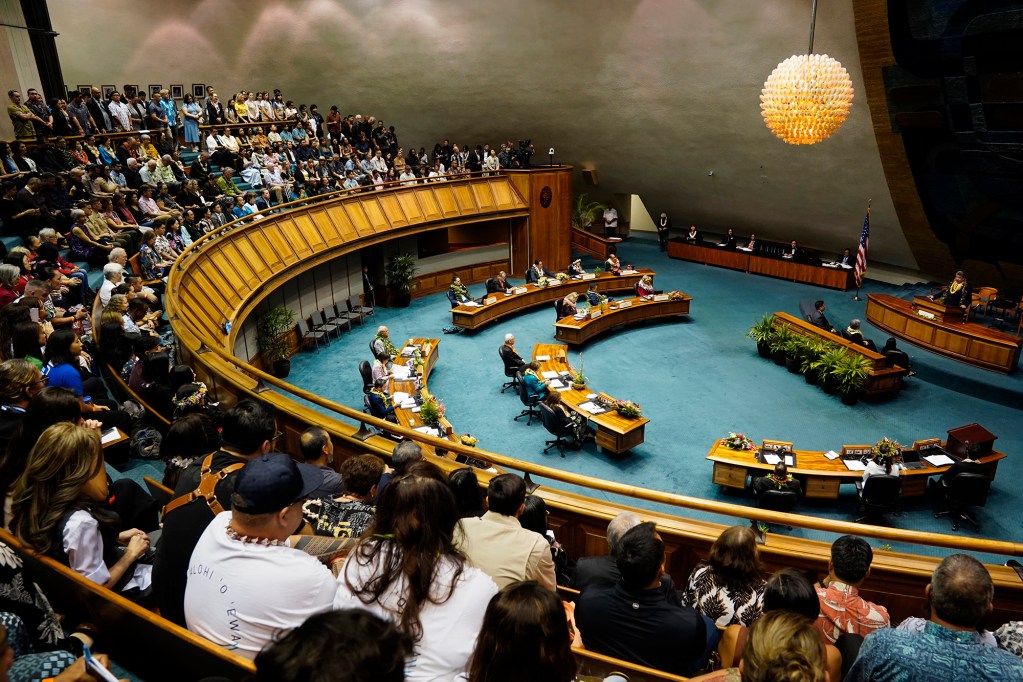
The $100,000 settlement for South Point is part of a larger appropriation bill settling 36 claims against multiple state agencies. The bill passed through the House and is awaiting its final reading in the Senate.
The state has since taken more precautions to avoid liability for the millions of dollars some nonprofits take out in loans to finance charter school facilities. But the first real test of whether it has done enough will be in the handling of another charter closure. Before Kamalani Academy in Wahiawā closed last year, its nonprofit took out roughly $2.3 million in loans to renovate school facilities, and it remains unclear who will pay the remaining debt.
Lawmakers are also grappling with the decades-old question of how to better fund charter facilities to make it easier for school leaders to secure affordable learning spaces for their students and meet families’ growing demand.
Some advocates are hopeful this legislative session could be the year for change, with one bill providing more opportunities for charter schools and the state to partner with private developers to build campuses in high-need areas.
“It’s not going to change the whole state overnight,” said David Sun-Miyashiro, executive director of the advocacy group HawaiʻiKidsCAN. “But I think it’s just kind of how we provide a new model, and a new case study for what’s possible.”
Kaʻu Learning Academy’s founder, Kathryn Tydlacka, could not be reached for comment.
What Happened?
Kaʻu Learning Academy opened in 2015, pledging to set students up for college and career success and offer families more educational options in a remote part of the Big Island with few public schools.
The school enrolled roughly 100 students in grades three to seven.
The school had both a nonprofit and limited liability company entering into lease agreements on its behalf, according to South Point’s lawsuit. The 2015 agreement between South Point and the two organizations associated with the school – Kaʻu Learning Academy LLC and the Fournier Center for Empowerment – allowed the charter to hold classes in a former clubhouse on a Nāʻālehu golf course.
The charter school commission was optimistic about Kaʻu Learning Academy’s prospects at the time.
“KLA’s facilities plan is exemplary as they have already secured a facility for two years, which is a significant accomplishment for a not-yet-approved charter school applicant,” the commission wrote in a 2014 decision to approve the school’s opening.
But Kaʻu Learning Academy’s nonprofit and LLC failed to uphold their end of the rental agreement within the first year of the school’s opening, according to the lawsuit. Problems persisted in the second year of Kaʻu Learning Academy’s operations, around the same time an independent audit raised concerns about financial mismanagement, including a lack of oversight and missing documentation for payments from the school.

By late 2017, the charter commission was considering closing the school and withheld state funding from Kaʻu Learning Academy, according to the lawsuit. But even as the academy faced the threat of closure, the state intervened in lease negotiations between South Point and the school’s partners. The lawsuit does not specify which state officials were involved in the negotiations.
In a draft of the lease agreement, the state said it would guarantee the school’s financial obligations and acknowledged payments to South Point were dependent on the availability of state funding, according to the lawsuit. The Charter Commission later affirmed that the state would cover debts to South Point after Kaʻu Learning Academy closed.
Catherine Payne, who was chair of the charter school commission at the time, said she doesn’t remember why the state would involve itself in lease agreements that didn’t directly involve a charter school. The commission would have needed to review the Kaʻu Learning Academy’s plans for securing facilities, she said, but it wasn’t responsible for overseeing any agreements between the school’s nonprofit and a private landlord.
The lease agreement was never executed because the commission shut down Kaʻu Learning Academy in summer 2018. Even still, lawyers for South Point pointed to the draft agreement as evidence that the state would take responsibility for unpaid debt associated with the school.
Around the same time, the school’s nonprofit and LLC were terminated, according to state records.
While the state offered an unspecified amount of money to South Point in 2019 to pay off the debt and cover some facility damage, the proposed settlement was insufficient, according to the lawsuit.
South Point took the state to court just months later.
The State Draws The Line
Nearly a decade after Kaʻu Learning Academy’s closure, the charter commission is making it clear that the state isn’t responsible for handling the debts that a school’s nonprofit takes on.
Starting in 2021, the Charter Commission’s operating agreements with charter schools specify it is not responsible for any liabilities schools take on while they’re operating. Each charter has its own deputy attorney general responsible for overseeing its contracts and agreements, Noh said, but the state isn’t responsible for the decisions of schools’ associated nonprofits.
The state also should not be on the hook for the loans nonprofits take out, Griffin said.
“When the school closes, that’s gone, the debt is with the nonprofit,” Griffin said.
The state has only closed one charter school since Kaʻu Learning Academy shut down, and taxpayers have yet to see how other disputes may play out. Last June, the commission closed Kamalani Academy, a Wahiawā charter school, as it struggled financially and faced significant turnover with its leadership.

As of July, the school was able to cover its outstanding payments, including staff salaries, according to minutes from a summer charter commission meeting. But the school’s nonprofit, Kamalani Academy Foundation, is still responsible for a $2.3 million loan it took out to repair and improve the school’s facilities.
The foundation has previously argued that Kamalani Academy is responsible for the nonprofit’s debt since the two entities are closely related – but school leaders strongly disputed that in a series of emails in fall 2024 published on the school’s website.
“Both Kamalani Academy Foundation and Kamalani Academy are separate and autonomous entities that are not responsible for the other’s debt, nor should their debt depend on the other entity’s financial or operational data and decisions,” Aumoana Kanakaole, the school’s governing board chair, wrote in an Oct. 2024 email to the foundation.
The foundation did not respond to requests for comment on how it plans to pay off its loan.

Lawmakers are now considering legislation that aims to reduce the costs of building schools and streamline the process of helping charters find facilities. Senate Bill 2024 instructs the School Facilities Authority to work with private developers to build school campuses, which could then be leased to charter schools at affordable rates.
The bill passed through the Senate and recently received its final reading in the House.
The partnership could help address charters’ facility needs, particularly in areas of the state that are seeing rapid growth and interest in charter schools, said Sun-Miyashiro of HawaiʻiKidsCAN. While the bill wouldn’t solve charter schools’ facilities problems completely, he said, it offers a starting point to ensure that schools have secure, quality places to teach their students.
“If the school is functioning well, kids are learning, kids are safe, it’s being managed as well as possible, then hopefully you’re not never having to deal with this kind of emergency situation,” Sun-Miyashiro said, “which definitely seems like the worst case scenario.”
Civil Beat’s education reporting is supported by a grant from Chamberlin Family Philanthropy.

