Do Trump Budget Cuts Signal A New Challenge For Native Hawaiians?
While Congress is likely to restore funding for Native Hawaiian programs, the administration’s rhetoric signals a major escalation that seems destined for the courts.
May 3, 2026 · 8 min read


About the Author

It’s the Washington equivalent of cat and mouse.
Each year President Donald Trump zeroes out funding for key Native Hawaiian programs and each year Congress, led by Hawaiʻi’s four member delegation, reallocates the money.
But this year is different, and not because the money won’t come through. The real change is in the rhetoric coming out of the White House.

When Trump released his fiscal year 2027 budget in April he proposed eliminating a Native Hawaiian block grant program that annually sends tens of millions of dollars to the Department of Hawaiian Home Lands to help build housing and lease homesteads to those who have spent decades on its waitlist.
His justification: “Native Hawaiians are not a tribal nation but a racial group.”
To U.S. Sen. Brian Schatz, a key Democratic member of the Senate Appropriations Committee, that declaration marks a significant escalation in the long-running fight over Native Hawaiian programs, one that turns annual skirmishes over line-items in the president’s budget into an existential legal fight over the future of Native Hawaiians in general.
Trump is relying on long-standing conservative reasoning, pushed by groups like the Heritage Foundation and others, that argues that Native Hawaiians are a race rather than a distinct Indigenous people with special political status in the eyes of the U.S. government.
That same argument is already being used by outside activists who have recently mounted legal challenges to Native Hawaiian programs and institutions, including to Kamehameha Schools, and recently has been bolstered by a new legal opinion from Trump’s own Justice Department, which declared certain Native Hawaiian programs unconstitutional.
“He’s not a monarch; he can’t wave a wand and eliminate funding,” Schatz said of Trump’s most recent cuts. “But I think it is fair to understand this as a more comprehensive, more organized, more well-funded, more frontal assault on Native Hawaiians.”
Bucking The President
Native Hawaiians have long been viewed in Washington as an Indigenous people with a special trust relationship with the U.S. government, similar to that of Native American tribes. But the Trump administration is now trying to undercut that narrative as part of a broader agenda targeting diversity, equity and inclusion in government and slashing federal programs it argues are based on unconstitutional racial preferences.
Schatz said he’s confident Congress will continue to fund Native Hawaiian health care, education and housing programs despite Trump’s wishes, just as it did last year and throughout his first term.
Already, the legislative branch is bucking the president. For instance, after Trump’s budget proposed slashing $28 million from a Native lending program that’s part of a larger fund that he said “advanced immigration, gender, and climate radicalism,” the GOP-led House Appropriations Committee passed its own spending measure that restored funding for the Native program to an even higher level than before – $35 million.
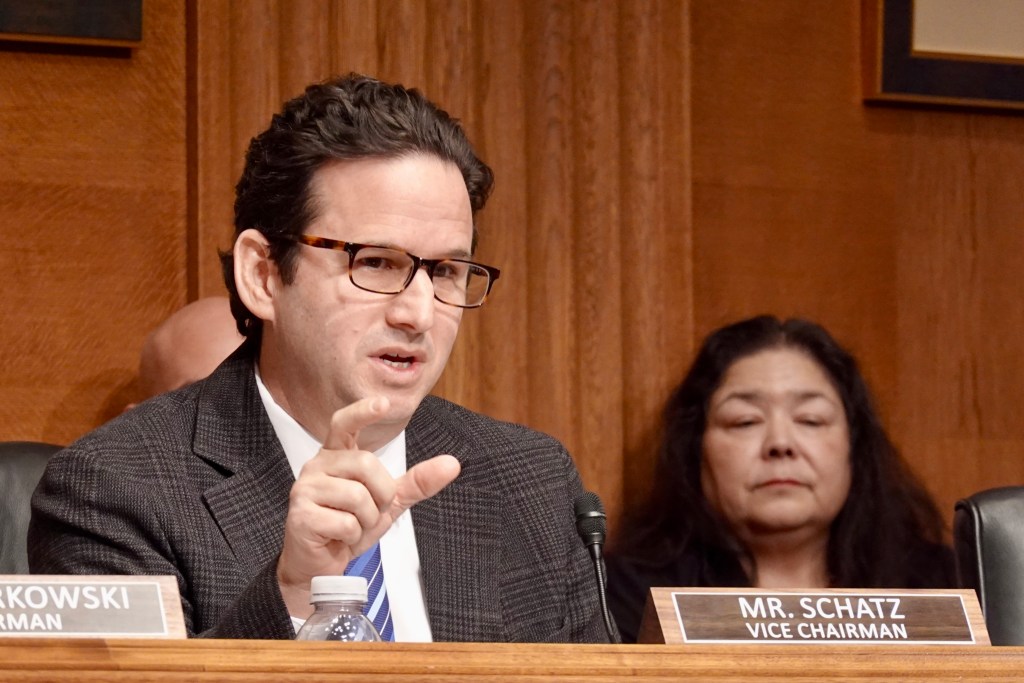
But Schatz still worries about the groundwork being laid.
Trump’s budget proposal follows a December legal memorandum from the U.S. Justice Department that used language similar to that found in his budget to argue that certain Native Hawaiian education programs were race-based and therefore unconstitutional. That memo highlighted the fact that Native Hawaiians, unlike many Native American tribes and Alaska Natives, do not have formal federal recognition and are not represented by a political entity that’s forged a government-to-government relationship with the U.S.
Schatz said that memo is just an opinion and has yet to be tested, but it aligns with the arguments being pushed by other outside conservative groups who have challenged Native Hawaiian programs and institutions. These include Students for Fair Admissions, which has targeted Kamehameha Schools over its admissions policy, and Do No Harm, which is trying to open up a Native Hawaiian health scholarship program to non-Hawaiians.
“This is an assault that underpins these programs,” Schatz said. “For some of this I can be useful, but a lot of this is going to be litigated.”
U.S. Rep. Ed Case, who sits on the House Appropriations Committee and is a lawyer, shares a similar view. Case said the DOJ memo looks like it was “written with a result in mind” and is “highly tailored” to the legal arguments already being advanced by conservative groups, such as Do No Harm, that are currently suing to halt Native Hawaiian programs.
While he’s hopeful Congress will continue to approve funding for Native Hawaiians, he said he’s worried about what might happen should the administration argue the underlying programs are illegal.
“I’m definitely having to spend a lot more of my political capital to maintain these programs over time,” Case said. “In some sense, we’re trying to play for time until we get to a friendly place again.”
He said he has concerns that the administration is already slow-walking previously allocated funds for Native Hawaiian programs and taking longer to process grant applications. If providers need to sue to release future funds it will only add to the delays and further starve them of funds they need to serve their community.
The budgetary and legal threats, he said, have already had a chilling effect in the islands with certain organizations scaling back services or delaying investments because they worry funding might not materialize.
Case warned that the Trump administration’s posture is part of a “divide and conquer” strategy aimed at all Indigenous programs. Native Hawaiians just happened to be first because their lack of formal federal recognition makes them the “weakest link.”
“This is a coordinated effort,” Case said. “This is an attack on all the Indigenous peoples of the country, not just Native Hawaiians.”

Schatz, the highest ranking Democrat on the Senate Indian Affairs Committee, echoed that concern.
“We should not assume that they’re merely trying to pick off one Native group or the other, but that they consider the whole enterprise to be something they want to overturn, and that includes our relationship with more than 200 tribal nations, Alaska Natives and Native Hawaiians,” Schatz said. “They think the whole thing is rotten. And so if there’s a tribal member or tribal leader who thinks that they’re not vulnerable at the moment, I would just say, take a beat and understand the need for solidarity.”
The White House directed questions about Trump’s budget and cuts to Native Hawaiian programs to the Office of Management and Budget, which did not respond to a Civil Beat request for comment.
Robin Danner, a senior advisor to the Sovereign Council of Hawaiian Homestead Associations, is among the Native Hawaiians keeping a close eye on the Trump administration and says it’s critical to remain vigilant.
She said Native Hawaiians are “beyond race” and points to the many laws that have been enacted over the past century, including the Hawaiian Homes Commission Act of 1920, that recognize the special trust relationship Native Hawaiians have with the U.S. government.
That history, she said, provides her at least some solace as Trump and his allies target her people through budgetary maneuvers. While she expects Congress will continue to allocate funding for Native Hawaiian programs, she predicts that the real fight will take place in the courts.
“I am not naive,” Danner said. “The bluster from President Trump about defunding our Indigenous programs can and will likely lead to a serious legal challenge that will be settled eventually. Until then, I don’t intend to wring my hands about it.”
In the meantime, she said it’s important for Native Hawaiians and those who serve and support them, including the state of Hawaiʻi and the aliʻi trusts, including Kamehameha Schools, to prepare for the coming battle. She said she’d even like to see them pool their resources and contribute to a litigation fund that can be tapped when defending Native Hawaiian programs.
“We must prepare to fight and the tool of choice is not a fist in the air or a demonstration,” Danner said. “It is kālā. It is the colonial master of money and resources that can be used to put together a legal defense in our third branch of government.”
 Sign up for our FREE morning newsletter and face each day more informed.

Local reporting when you need it most
Support timely, accurate, independent journalism.
Honolulu Civil Beat is a nonprofit organization, and your donation helps us produce local reporting that serves all of Hawaii.
ContributeAbout the Author