

Kamehameha Schools Sued Over Native Hawaiian Admissions Policy
Students for Fair Admissions founder Ed Blum said he has received death threats over his attempt to strike down the policy.
Weeks after launching a website seeking plaintiffs, an anti-affirmative action group sued Kamehameha Schools Monday over its admissions policy that gives a preference to Native Hawaiians.
Students for Fair Admissions, which has led cases striking down affirmative action in the college admissions process on the mainland, said it represents two families — referred to as “Family A” and “Family B” —who want their non-Hawaiian children to go to Kamehameha.
In a written statement, the school’s trustees and CEO Jack Wong said they would vigorously defend the policy.
“The facts and the law are on our side, and we are confident that we will prevail,” Wong and the trustees said.
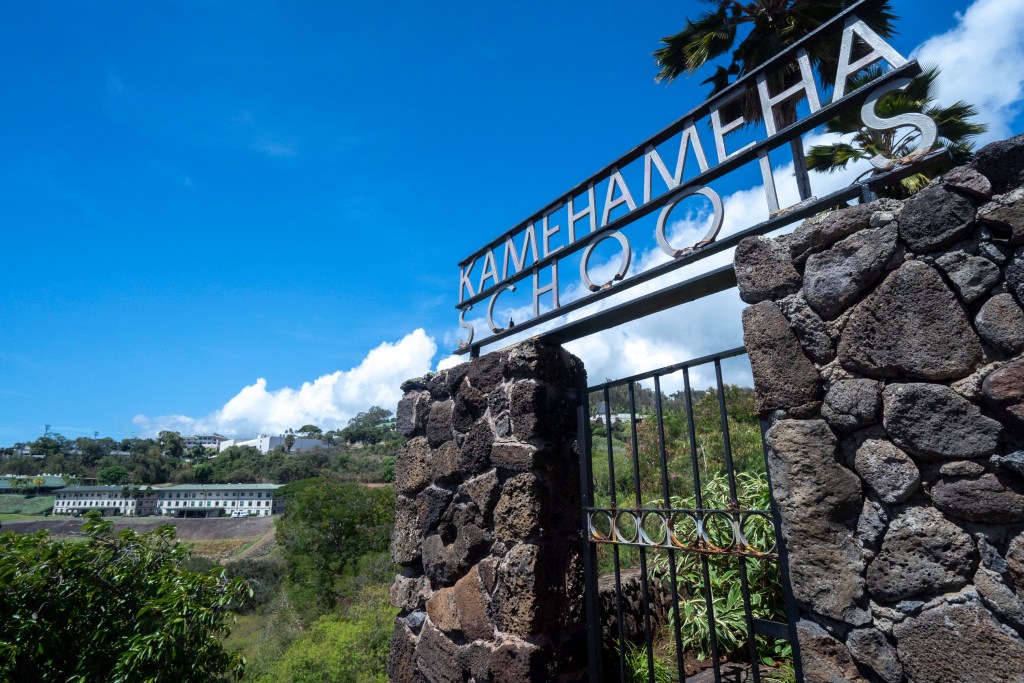
Students for Fair Admissions set up a website early last month seeking plaintiffs for the lawsuit that was filed Monday in Federal District Court in Honolulu. It was met with a swift rebuke on social media from parents and students of Kamehameha across the state as well as Hawaiʻi Democrats and Republicans.
State Senate Republican Minority Leader Brenton Awa even traveled to Virginia to try to speak with the group’s founder, Ed Blum. Awa said Blum never returned calls from him and fellow lawmakers.
“We were just hoping our contacts up there would find someone, someway to drop it,” he told Civil Beat.
Awa said he and his colleagues met with the head of the school before the lawsuit was filed. Wong told them that fighting the lawsuit could be a long legal process.
Kamehameha is planning a rally to support the school at ʻIolani Palace Tuesday morning.
The suit alleges that the current admission policy violates the rights of any non-Hawaiian applicant to the school, that the policy is not a valid way to address educational disparities between Native Hawaiian children and those of other races, and that Kamehameha should not be granted any constitutional carve-out that would uphold its admission policy.
The lawsuit also includes about 10 pages worth of excerpts of threats Blum said he has received since announcing that his group was seeking plaintiffs for this lawsuit. The profanity-laden messages tell Blum to kill himself or threaten to beat him. Others make antisemitic remarks about Blum, who was born into a Jewish family.
The lawsuit says those threats are reasons why the identities of Family A and Family B need to stay out of the public eye. The families aren’t listed as plaintiffs but as members of Students for Fair Admissions.
Family A is described as a mother who homeschools her 10th grade daughter, who is white. The mother believes that Kamehameha has programs that “would create networking and career opportunities that would benefit the daughter for the rest of her life.”
However, she never had her daughter apply to Kamehameha to avoid “the humiliation of going through that futile process.”
Family B lives near the Kapālama campus on Oʻahu and includes a father, a stepmother and a second grade daughter who is half-white and half-Asian, according to the lawsuit. The family “cares deeply about native Hawaiian culture and is drawn to Kamehameha’s unique number of high-quality programs, especially in the arts and music,” the lawsuit says.

The legal challenge by Students for Fair Admissions is the latest attempt to strike down the nearly 140-year-old policy of accepting qualified Hawaiian children to the private school, which was established in the late 19th century through the estate of Princess Bernice Pauahi Bishop to educate Hawaiians.
The institution successfully defended its admission policy in a series of lawsuits in the early 2000s. The trustees and Wong promised to do so again.
The lawsuit makes similar arguments to the legal case filed in the early 2000s.
In that case, Kamehameha settled with the plaintiffs before the case was taken up by the U.S. Supreme Court. Before that, Kamehameha just narrowly won a favorable decision from a panel of Ninth Circuit Court of Appeals judges who found that the policy was enacted to remedy educational disparities between Native Hawaiians and students of other races.
While learning outcomes for Hawaiians have improved, those disparities have persisted.
Last year, 35% of Native Hawaiian students tested proficient in reading, compared to more than half of all public school students. In math, only a quarter of Native Hawaiian students scored proficient on the state standardized test, compared to 41% of all students.
Native Hawaiian students attending public schools also reported the second-highest rates of chronic absenteeism, with 35% of kids missing 18 or more days of class.
While more than half of the class of 2024 attended college last fall, just over a third of Native Hawaiian students enrolled in higher education.
Families have also recently argued that students lack opportunities to learn about the Hawaiian language and culture in local public schools. Lawsuits filed against the Hawaiʻi Department of Education this summer claim the state is falling short of its constitutional duty to provide families with access to Hawaiian immersion schools, which are open to all students regardless of their ancestry.
Students for Fair Admissions is based in Virginia and has a cadre of lawyers from firms in Tennessee and Virginia asking the federal court to admit them for this case. The attorney who submitted the complaint, Jesse Franklin-Murdock, is an associate at the San Francisco-based Dhillon Law Group.
He worked for local law firm Kobayashi Sugita & Goda before clerking for U.S. District Judge Jill Otake in 2020, according to his bio. Franklin-Murdock did not return a voicemail to discuss the case.
Read the lawsuit below:
Civil Beat’s education reporting is supported by a grant from Chamberlin Family Philanthropy.


