Data For Dummies: Hawaiʻi Facts For Those Of Us Who Can't Read Spreadsheets
A local consulting firm has created a very user-friendly dashboard that gives people the high points about life in the islands.
August 28, 2026 · 7 min read

About the Author

Now that another primary election has come and gone, I’ve been wondering: Is Hawaiʻi still the worst in the nation when it comes to voter turnout?
Fortunately, the folks who built Hawaiʻi Dashboard, a cool new database of key Hawaiʻi facts, figures and trends, were reading my mind.
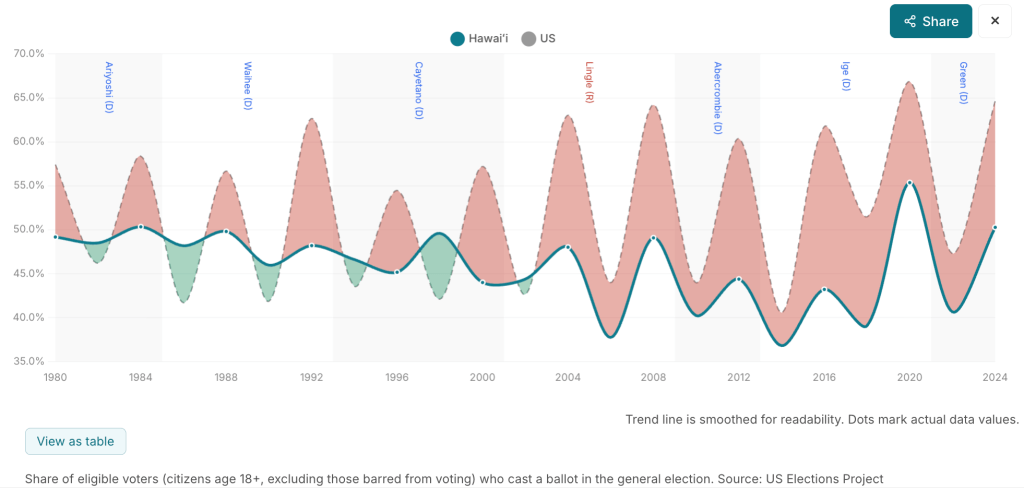
Yes, unfortunately we are dead last in the U.S. when it comes to voter participation. The data through 2024 shows only 50.3% of eligible voters (eligible, not registered) voted in the 2024 elections, a presidential year.
Dig deeper. Click over to the “Rank” section of the dashboard and you’ll see that puts Hawaiʻi at the bottom of all states for voting in that election. And if you click on “Rank history” you’ll see we have been at or near the bottom for four decades. That doesn’t seem likely to change once the 2026 data is factored in later this year, given our regrettably low primary turnout (based on registered voters as reported by the state.)
Hawaiʻi Dashboard is a great new tool for people who want to know basic things about Hawaiʻi but get easily frustrated when confronted with too many datasets and spreadsheets and graphics that can quickly become mindboggling.

“How is life in Hawaiʻi? And I want to know in 15 minutes,” says Iqbal Ashraf of Guild Consulting, a Honolulu firm whose staff developed the dashboard as a kind of civic side hustle.
The company does a lot of work with government agencies as well as businesses and nonprofits that work with government agencies, so it was well-positioned to mine the federal and state data they use every day and pull it together into something much more user friendly.
And they’re making it available to the public for free, no strings attached, they say.
“I think this is a community contribution that we’re doing,” says Ray Tsuchiyama, another Guild Consulting principal, longtime Hawaiʻi business executive and educator who writes frequently for local publications, including Civil Beat.
A three-minute video tour that summarizes what users can expect to find tops the site, an easy-to-grasp walk-through of what data is available and how to find it.
But first you can answer a simple question of the day, like “Unemployment has gone down in Hawaiʻi in the past five years. True or false?” The answer includes a simple explainer complete with data and a history lesson.
The site covers 27 measures organized under five topic areas that make sense for people who want to know just the toplines about Hawaiʻi. Safety and health. Affordability. Economy and workforce. Education. Infrastructure and trust.
“How affordable is life here? How safe is it?” says Ashraf.
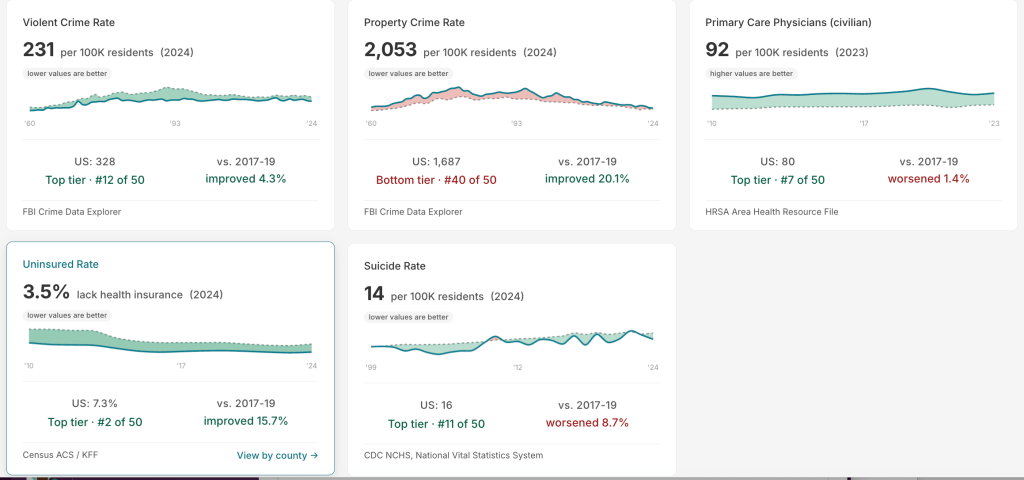
He uses the crime rate as an example. There are two simple charts on the dashboard — violent crime and property crime — based on federal crime data.
People can see how those issues are shaking out in Hawaiʻi overall. Or they can view them county by county. And they can easily compare that to the rest of the U.S. or even a particular state.
“We have very low violent crime rates,” Ashraf says, “but we have high homelessness, and that’s kind of unique in the country, because in many places the violent crime rate goes up with homelessness. They are kind of correlated.”
The graphics are accompanied by simple explainers and brief analysis. Or you data nerds can download the numbers, including in an Excel file, and build your own charts.
You can also look at the trends over time, some measures going back decades. The dashboard lets you overlay which governor was in office at the time, not to say that a certain governor or administration was responsible, Ashraf says, but to think about it in terms of the highest level of accountability in state government. The crime rate, for instance, went up when George Aryoshi was governor, the dashboard shows.
My favorite section is called “Off The Charts” and Guild’s eloquent analysts use the data to write short stories where the numbers tell the tale. The latest, called “Easy to vote. Less to vote for,” links the troubling reality that while Hawaiʻi is the fourth-easiest state in which to cast a ballot, it ranks at the bottom in turnout. Moreover, while voting has gotten easier, fewer candidates than ever are running and some races have no opposition. So there are simply fewer choices for voters on the ballot.
Other posts provide revealing looks at reading scores, the price of rent, homelessness and housing, rising energy prices and, frankly, how unaffordable Hawaiʻi has become especially compared to elsewhere.
“We have a specialized kind of AI agent, or multiple agents, whose job is to find patterns like this and surface to us, and then we decide what to write on,” Ashraf says. “It’s very short form, so we don’t spend hours because we have a day job as well.”
Interestingly, there are areas where the data shows Hawaiʻi is improving — broadband service, for instance — but still lags behind the U.S. overall and other states are improving much faster.
Iqbal is quick to point out that theirs is not an advocacy organization, and the dashboard reveals just the facts that the data shows, not the consultants’ opinions.
Tsuchiyama and Ashraf say the dashboard is something the company has been thinking about doing for a long time and it took the staff many months to build it. They launched it in March with little public fanfare but have been meeting with local organizations to show what’s available and how it can be useful.
“We have tried to stay away from, like, fancy stuff on this thing, because people get lost,” Ashraf says.
Tsuchiyama says the dashboard seeks to address some of the most intractable, incurable issues in the state. He hopes policymakers and the public will use the information to help think through solutions, some of which will take many years. “And that’s what’s so challenging,” he says, “but we’re focused on outcomes.”
Their hope is that government, businesses and community groups can use the dashboard to get aligned and really start to tackle some of the problems Hawaiʻi has faced for so long.
“Who is it for? Who can use it?” Tsuchiyama asks. “There’s a whole range of people. Journalists, of course. There’s students, there’s policymakers, neighborhood-born people, grant writers, high schools like Farrington. Hawaii Business Roundtable, the Chamber.
“There’s a whole swath of people, but they don’t talk to each other because there’s no common ground or basis to copy. So this becomes a foundation for really getting … people to talk about these issues and to create, I hope, more vibrant solutions, programs, initiatives.”
Tell us about a government program or service you think is working well. We’re also interested in people, especially public employees, who deserve to be celebrated for their service or their contributions to making Hawaiʻi a better place. Send to sunshine@civilbeat.org and include Bright Spots in the subject line please!
 Sign up for our FREE morning newsletter and face each day more informed.

Local reporting when you need it most
Support timely, accurate, independent journalism.
Honolulu Civil Beat is a nonprofit organization, and your donation helps us produce local reporting that serves all of Hawaii.
ContributeAbout the Author