Hawaiʻi GOP Aims To Win More Seats And Fire Up Debate
With an extra House seat, Republicans could force the majority party into painful floor votes on hot topics and hard-to-fix problems Democrats might rather avoid.
September 20, 2026 · 13 min read

About the Authors


The arcane rules of the Hawaiʻi Legislature can quietly resolve a controversy, or blow up an issue into an embarrassing public vote. This year, the Republicans in the state House have reached a pivot point that may allow them to turn one of those obscure rules to their political advantage.
Republicans currently hold just 10 out of 51 seats in the state House, and it appears the Nov. 3 election won’t dramatically change that balance of power. But if the Republicans can secure just one additional House seat, the House rules will allow them to force roll call votes on the House floor.
Hawaiʻi’s Democratic majority would sometimes prefer to avoid public votes on controversial topics. But with an extra House seat, Republicans could force some very public discussions about Hawaiʻi’s pressing problems such as the painfully high cost of living and housing. That would give GOP lawmakers a way to put more Democrats on record on hot-button issues or proposals that otherwise might not be addressed on the House floor.
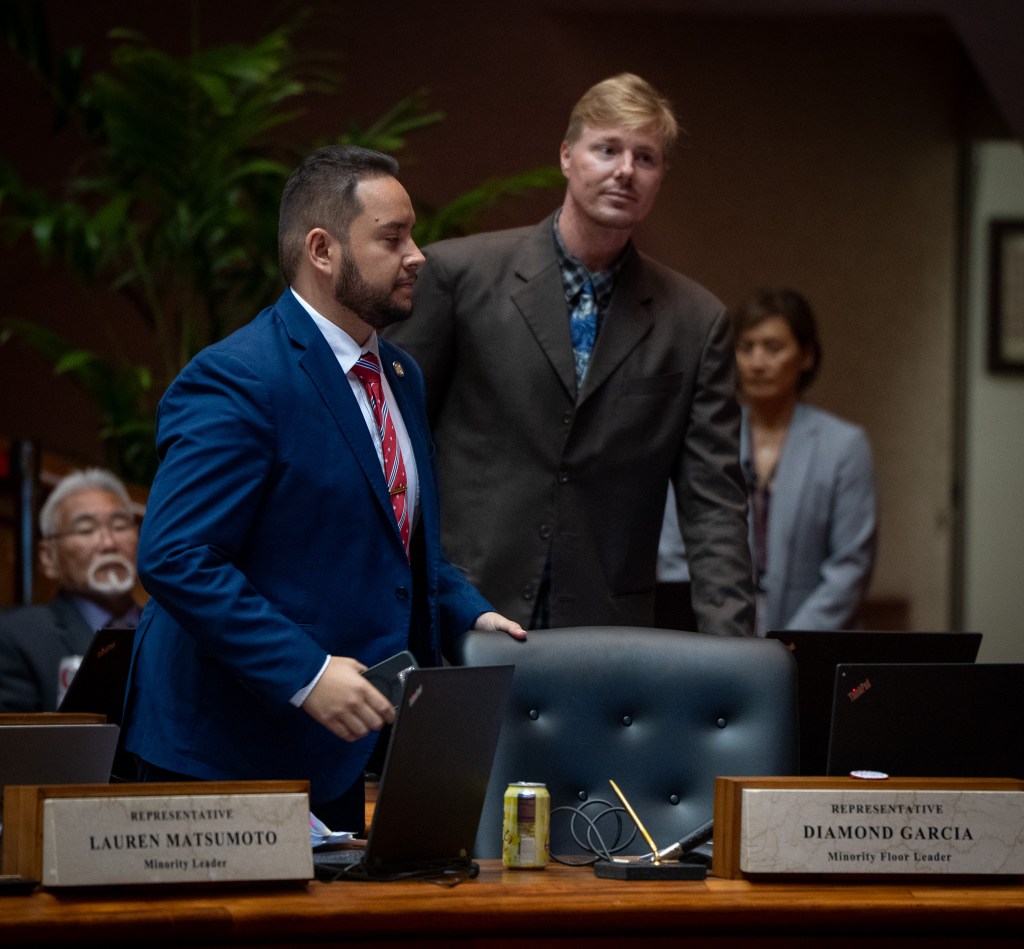
“Anything to increase debate is a good thing,” said House Republican Floor Leader Diamond Garcia. “If we increase the numbers — and we’re praying to God we do — we’re definitely going to make use of our ability to force debate on more topics, and have more conversations openly and publicly.”
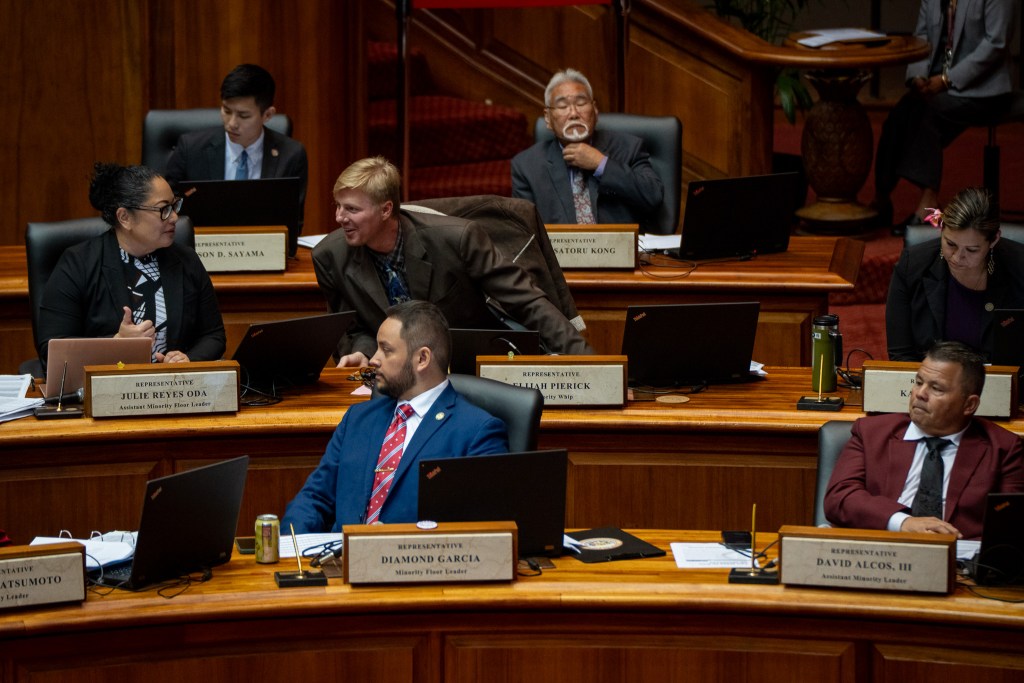
The Democrats dominate at the state Capitol, but the Republicans have slowly been rebuilding their numbers in both the House and the Senate. West Oʻahu neighborhoods including Waiʻanae, ʻEwa Beach and Kapolei are tilting more Republican, allowing the GOP in the past decade to double the number of House seats it holds from 5 to 10. Three of the 25 Senate seats are now held by Republicans, an improvement from zero a decade ago.
Robert Perkinson, professor of American Studies at the University of Hawaiʻi Mānoa, said Republicans here have been slowly gaining ground because of voter discontent with Hawaiʻi’s establishment Democrats, largely because of economic issues.
In Hawaiʻi and on the mainland, “more than half of the population is just barely making it,” Perkinson said. “It does provide an opportunity for opposition in Hawaiʻi to kind of harness that discontent, and I think politicians in Hawaiʻi have some time to wake up to that before bad things happen here, but they’d better wake up to it soon.”
Hawaiʻi Republicans may also benefit politically this year from the plight of prominent local Democrats who were indicted in July in a campaign spending and bribery scandal. They include Lt. Gov. Sylvia Luke, former Department of Human Services Director Ryan Yamane, and former Public Utilities Commission Chair Leo Asunción Jr.
Those cases are still pending and no one has been convicted yet, but “it’s a really serious scandal that makes people upset,” Perkinson said. It isn’t clear what impact that will have on local elections because Republican President Donald Trump is so unpopular at the moment, Perkinson said. Unhappiness with Trump may make voters here reluctant to support local Republicans.
Forcing Floor Votes
Hawaiʻi Republicans have previously used House floor maneuvers to put political pressure on the Democrats, but it has been years since they had the numbers they need to aggressively use those tactics.
Blake Oshiro, a former House majority floor leader, recalls when Linda Lingle led the Republican Party 25 years ago and the GOP controlled 19 House seats. That gave the Republicans enough leverage to yank controversial bills out of committee and force the Democrats to vote on them on the floor, triggering long hours of debate.
The Republicans knew they would rarely win those floor votes, but even the losing votes created a clear record of lawmakers’ positions on uncomfortable issues. Today bills often die in committee without ever being put to a vote of the full House, and historically some Democrats have been reluctant to take clear public positions on controversial proposals. One example was the heated 2017 public debate over medical aid in dying.
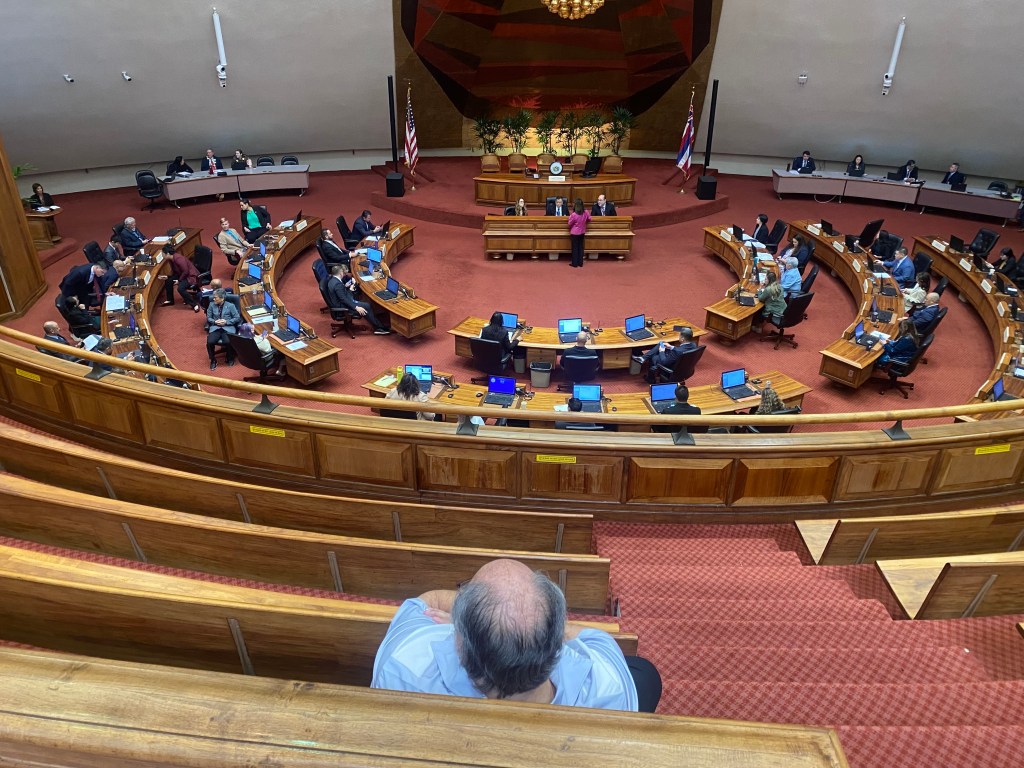
The opening that may be available to Republicans this year is a House rule that allows for one-fifth of the members to demand a roll call floor vote. That works out to 11 votes in the 51 member House assuming every lawmaker is present, or less if some are absent.
If the Republicans have that tool, “now you can ask for roll call, and so people can be held to a little bit more of a higher standard,” Oshiro said, “and they’re accountable for their vote.”
It would provide an opportunity for the Republicans to “hold the majority’s feet to the fire on high-profile, controversial issues that sometimes, especially vulnerable or new members, would prefer not to be ‘quote unquote’ on record,” Oshiro said. “So it does create that sort of additional complication for leadership.”
GOP Maneuvering “Performative,” Democrat says
This year, Republicans participated in a move to force a roll call vote on one controversy, but they needed help from a pair of Democrats to make it happen. The issue was a petition signed by more than 900 people calling on lawmakers to investigate alleged public corruption by an unnamed state lawmaker who reportedly accepted $35,000 in a paper bag.
House Speaker Nadine Nakamura announced on April 22 she was filing the petition away without any further action because the state Attorney General was investigating the case, but Democratic Rep. Della Au Belatti wanted to appeal that decision.
Democratic Reps. Belatti and Kim Coco Iwamoto then voted with the Republicans to demand a roll call vote on the issue. In the end the House voted 39-11 to reject Belatti’s appeal and file the petition, but the floor maneuver created a voting record on the handling of the petition that otherwise would not have existed.
House Democratic Majority Leader Sean Quinlan criticizes some of the Republicans’ maneuvering on the House floor as “performative.” He said the current Democratic leadership is willing to allow bills to die on the floor in public votes, which is a change from how things were done in the past.
“Our votes are public already, and so I don’t understand what the roll call accomplishes when our votes are already public,” Quinlan said. “It’s not achieving a goal. It’s just putting on a show for whoever’s watching.”
But Minority Floor Leader Garcia said there has been a “culture” in the Capitol for many years that limits debate on all but a few dozen bills each session. “The vast majority of the members will just sit there and say nothing,” he said.
When important bills fail to pass, “the public deserves to understand why it’s being killed,” he said. “They deserve to hear from the elected voices of their districts, the elected voices of their communities as to why the bill is not going to pass.”
Which House Seats Are Promising?
To force more roll call votes and create that kind of voting record, Republicans must win at least one additional House seat without losing any of the seats the GOP already holds. That may prove to be a difficult task.
Garcia said Republicans for years have been eyeing the North Shore House district held by House Majority Leader Quinlan as a likely prospect, in part because that area has elected Republicans in the past and is now represented by state Sen. Brenton Awa, a Republican.
Quinlan, who was first elected to the House in 2016, will face social media influencer Mark Talaei in the general election. Talaei ran unsuccessfully against Quinlan in 2022.
The House Republicans also see Maui’s District 11, which includes Kīhei, Wailea and Mākena, as a good prospect, Garcia said. That seat is now held by Democratic Rep. Terez Amato who won by large margins in both the 2022 and 2024 general elections, but Garcia noted Kīhei has been represented by a Republican in the House as recently as 2012.
On the other side of the ledger, the Democrats appear to have a shot at winning at least three seats now held by Republicans.
One is the West Maui district including Lahaina that is now represented by Rep. Elle Cochran, who won election to the House as a Democrat in 2022 and 2024, but switched to the Republican Party this year. Cochran, a former Maui County Council member, also drew some unfavorable attention for missing 51 of 60 House floor sessions last year.
Cochran will face Democrat Sne Patel and Green Party candidate Pa‘ele Kiakona in the general election, but Garcia predicted Cochran will win in part because she will benefit from the dynamics of a three-way race. Three-way contests often help incumbents by dividing up their opposition.
Another race where the Republicans could lose a seat is the East Honolulu district represented by Rep. Joe Gedeon. He is a freshman Republican who was appointed by Gov. Josh Green after the well-liked, longtime Rep. Gene Ward died in the spring of 2025.
Gedeon is not nearly as well known as Ward was, and is opposed by Democrat Jamie Wataru, a former president of the United Public Workers union.
Yet another seat that could switch from Republican to Democrat is House District 39, which includes parts of Waipahu, Royal Kunia and Village Park. That district is open because Republican Rep. Elijah Pierick is running for the state Senate this year.
Democrat Corey Rosenlee, a former president of the Hawaiʻi State Teachers Association, has run for the District 39 seat twice before, and lost by just 11 votes to Pierick in 2024. He will face Republican Danny de Gracia, a political scientist and an ordained minister. De Gracia is also a former columnist for Honolulu Civil Beat.
New Faces For GOP, But Can They Gain Senate Seats?
Just like in the House, the Senate allows one-fifth of its members present to allow for a roll-call vote. Currently, there are only three Republicans in the 25-member state Senate, and two of them are not on the ballot this year.
One of those senators, Brenton Awa, is running for Congress against Democrat Jill Tokuda. But even if he loses he will keep his seat, as he is in the middle of a four-year term.
If Awa wins, that will trigger a process in which the local GOP picks a replacement. But Tokuda is heavily favored to keep her 2nd Congressional District seat.
The GOP senator who was up for reelection this year, Kurt Fevella, lost to challenger Bob McDermott in the Aug. 8 GOP primary. The election ended in a tie but McDermott won the Aug. 15 tiebreaker drawing to be the party’s nominee.

McDermott has a strong chance to win District 20 (’Ewa Beach, Ocean Pointe, ’Ewa by Gentry, Iroquois Point, portion of ‘Ewa Villages), as it is located in the same part of Oʻahu where he was elected multiple times to the House. It leans conservative with a significant military population, and McDermott served in the U.S. Marine Corps.
His opponent is Democrat Markus Owens, a first-time candidate. He is a former University of Hawaiʻi Rainbow baseball player and San Francisco Giants minor leaguer.
Owens currently works for Coldwell Banker Realty. His backers include the powerful Hawaii Regional Council of Carpenters, which is known to canvass heavily for its preferred candidates.
The Hawaiʻi Republican Party hopes to pick up four other Senate seats as well. Their best bet may be District 18 (Mililani Town, Waipio Gentry, Crestview, Waikele, portion of Waipahu, Village Park, Royal Kunia), where longtime Senate veteran and powerhouse Michelle Kidani retired in June.
Because Kidani stepped down after a filing deadline, the seat could not be openly contested in the primary. The Democratic Party of Hawaiʻi recommended three candidates to fill Kidani’s term until Nov. 3 — general election day — and Gov. Josh Green picked one of them, Danielle Bass, for the temporary gig.
But the selection of Bass, the sustainability coordinator for the state Office of Planning and Sustainable Development, is viewed by some party members as well as some Republicans as a backroom deal that left District 18 voters with little choice whom to vote for.
The GOP thinks it has a strong candidate in Kelly Kitashima, a telegenic tourism executive who previously ran unsuccessfully for another state Senate seat in 2020 following the death of Democrat Sen. Breene Harimoto.
Other Hopeful Seats For Republicans
In District 19, meantime, Democratic Sen. Rachele Lamosao is trying to hold onto the seat that represents Pearl City, Waipahu, West Loch Estates, Honouliuli and Ho’opili. Similar to Bass’s seat, Lamosao was appointed in December to replace Henry Aquino, who resigned midterm to become a lobbyist.
Lamosao was selected by area Democrats and the governor to serve until November, but there are still two more years left on the term. That prompted Rep. Elijah Pierick, a former officer in the Air Force Reserves, according to his website, and a pastor with the Foursquare churches, to jump in the race. Pierick often cites the Bible during House floor sessions, sometimes to the consternation of majority Democrats.
The Republicans’ other Senate hopeful is Wallyn Kanoelani Christian, an area neighborhood board member. She faces Tricia Kwai Lin Nakamatsu, the Democratic nominee for District 13 (Dowsett Highlands, Pu’unui, Nu’uanu, Pacific Heights, Pauoa, Punchbowl, Pālama, Liliha, Iwilei, Chinatown and Downtown).
Nakamatsu defeated four other Democrats in the primary, hoping to succeed Karl Rhoads, who is retiring.
Democratic Sen. Stanley Chang is defending his District 19 seat (Hawai’i Kai, Kuli’ou’ou, Niu, ’Āina Haina, Wai’alae-Kāhala, Diamond Head, Kaimukī, Kapahulu). Although it was previously held by the late Sam Slom, a Libertarian-leaning Republican, GOP challenger David Crosswell is not well known.
 Sign up for our FREE morning newsletter and face each day more informed.
Read this next:

Local reporting when you need it most
Support timely, accurate, independent journalism.
Honolulu Civil Beat is a nonprofit organization, and your donation helps us produce local reporting that serves all of Hawaii.
ContributeAbout the Authors