

Rematch May Be Coming For House Seat Decided By Tiebreaker
The Hawaiʻi Supreme Court will decide Friday whether a special election is needed for the tight race between two Oʻahu Republicans.
The state’s highest court appears to favor ordering another election to decide who should represent a disputed House district in a case that could affect future close electoral contests.
Associate Justice Sabrina McKenna said Wednesday that the Hawaiʻi Supreme Court will announce its decision Friday in the matter of Souza v. Nago in House District 43.
The contested case, heard by the court at Aliʻiōlani Hale in downtown Honolulu, was filed by Rep. Kanani Souza. The Republican lawmaker is challenging a decision by the Hawaiʻi Office of Elections to settle the outcome of the Aug. 8 primary that resulted in a tie with challenger Sheila Medeiros.
Several of the justices, including McKenna — who was serving as acting chief justice in the absence of Vladimir Devens — indicated they were concerned over how the voting was conducted. They also expressed uneasiness with the lack of clear guidelines in state law and administrative rules regarding exactly how the elections office handles races that require tiebreakers.
While Souza had 841 votes to 840 for Medeiros in the GOP primary to represent Kapolei and Makakilo in the Legislature, the narrow margin triggered an automatic recount.
Souza still held her lead following the recount Aug. 12. But the elections office, after later “curing” 30 ballots — a process that allows voters to correct signature issues and other problems with their ballots — concluded the race was tied at 842 votes each.
That led to a tiebreaker Aug. 15, in which the elections office engaged in a drawing of lots to break the tie, with Medeiros the lucky winner.
But while the justices were questioning Scott Nago, the chief election officer, Chadd Kadota, the acting clerk for the City and County of Honolulu, and Rex Quidilla, the city’s elections administrator, it was revealed that two of the ballots counted for the District 43 race should not have been included in the final count.
That’s because the two voters who voted in person at Kapolei Hale on Aug. 8 requested ballots for House District 40 Precinct 3 — or 40-3, in election office lingo.
Instead, they were mistakenly given ballots for District 43 Precinct 3 — that is, 43-3. While the city reported the mistaken vote to the state that same day, the elections office was not aware of the error until after the tiebreaker was held.
Nago insisted that the voting overage would not have changed the outcome of the Souza-Medeiros race. But Associate Justices Todd Eddins and Lisa Ginoza were troubled that Nago didn’t know about the ineligible ballots when he was deciding how to hold a tiebreaker.
Another concern was that the two ineligible ballots might also have affected the Senate GOP primary between incumbent Kurt Fevella and challenger Bob McDermott, which is in the same general area in West Oʻahu.
That race, to represent Senate District 20 (‘Ewa Beach, Ocean Pointe, ‘Ewa by Gentry, Iroquois Point and portion of ‘Ewa Villages), also ended in a tie and was ultimately won by McDermott in a tiebreaker Aug. 15. The justices wondered whether it was possible that the same two voters who asked for ballots for the House District 40 contest might also have voted in the Senate District 21 race.
The outcome of the Senate GOP primary, however, has not been challenged and the deadline for that has passed. Instead, the justices are focused on a possible remedy for the House race.
While Hawaiʻi law calls for the chief election officer to determine how best to decide a tie, the justices indicated their disappointment that the names of Souza and Medeiros were each placed in plastic Easter eggs, with the winner announced after one of the eggs was pulled from a small lauhala basket. In her complaint, Souza argued that the process was not properly explained nor conducted in a secure fashion.
But Nago explained that that is the same process his office uses when it decides the order of political parties on the primary election ballot.
If the court orders a special election, the justices indicated, it would be held either on the same day as the Nov. 3 general election or in a special election not long after that date.
If the special election is held on Nov. 3, voters in House District 43 will receive general election ballots that also include the Souza-Medeiros race. The court has to act quickly because the state will begin printing ballots Sept. 12.
Either way, unlike the primary, the election will be open to all voters, not just Republicans.
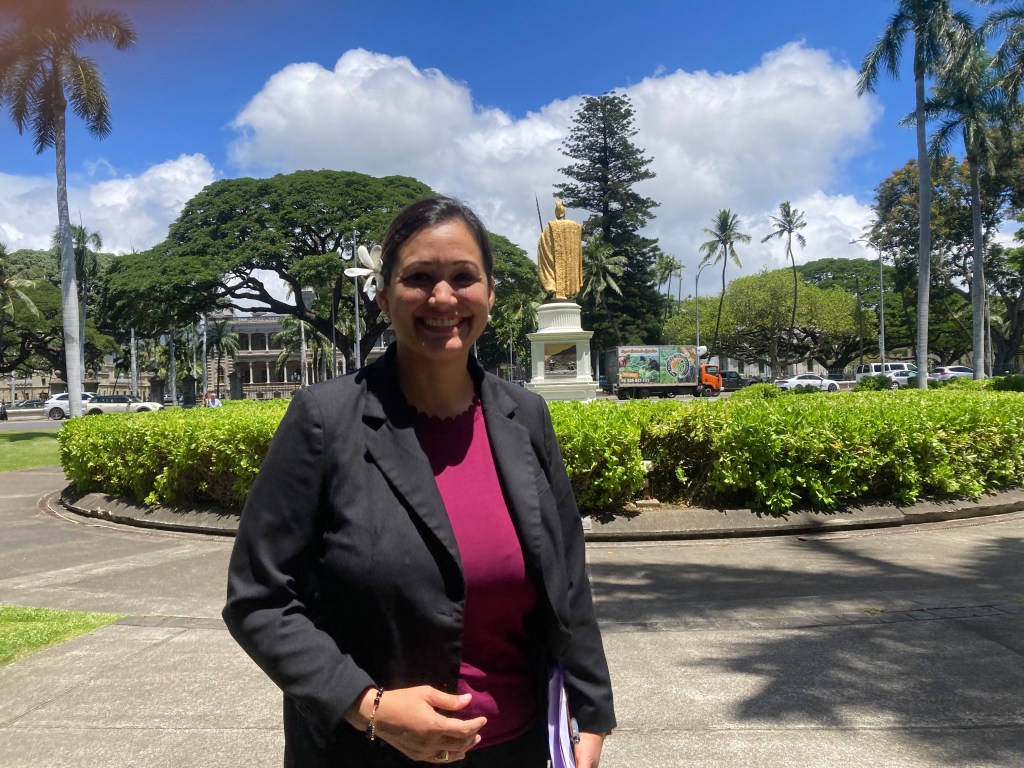
After the court hearing Wednesday, which lasted two and a half hours, Souza told reporters she was pleased that the voters of District 43 may get to select who should represent them rather than through a random drawing.
“Just the way the questioning went, I do think that it’s a very positive sign going forward to call for a new election in this case,” she said. “I’m very pleased today that truth came to light and transparency prevailed. That ultimately is what matters to me.”
Asked about how her constituents might feel about other parties being able to vote in what is a Republican race, Souza said, “I think that either way the people’s voice and democracy will prevail at the end of the day.”
Medeiros, who was named as a defendant in the lawsuit along with the state and city officials, told the court she hoped the results of the tiebreaker would remain in place.
The courtroom drew a large, interested audience that included Trevor Ozawa, the former Honolulu City Council member who lost a special election in 2019 to Tommy Waters under similar circumstances.
Last week, the same court rejected Waters’ argument that he should be allowed to run for a third term. Ozawa now faces Tara Malia Gregory on the Nov. 3 runoff for the District 4 seat that stretches from Hawaiʻi Kai to Waikīkī.
Also watching was Ralph Cushnie, a commissioner with the Hawaiʻi State Elections Commission, who alleges that there were major discrepancies in the 2024 general elections in Kauaʻi and Hawaiʻi counties. As with the District 43 race, Cushnie argues that Hawaiʻi’s election process is in need of a major overhaul when it comes to transparency and accountability.

