Jeta: What Micronesian Artists Reveal About Ties Across the Pacific
The “Ocean of Peace” exhibition features 11 artists who draw on ancestral wisdom and traditions to celebrate kinship that transcends lines on a map.
October 20, 2026 · 9 min read

About the Author
Editor’s note: This is the second of two Jeta columns on Micronesian art and culture in Hawai‘i. Read the first one here.
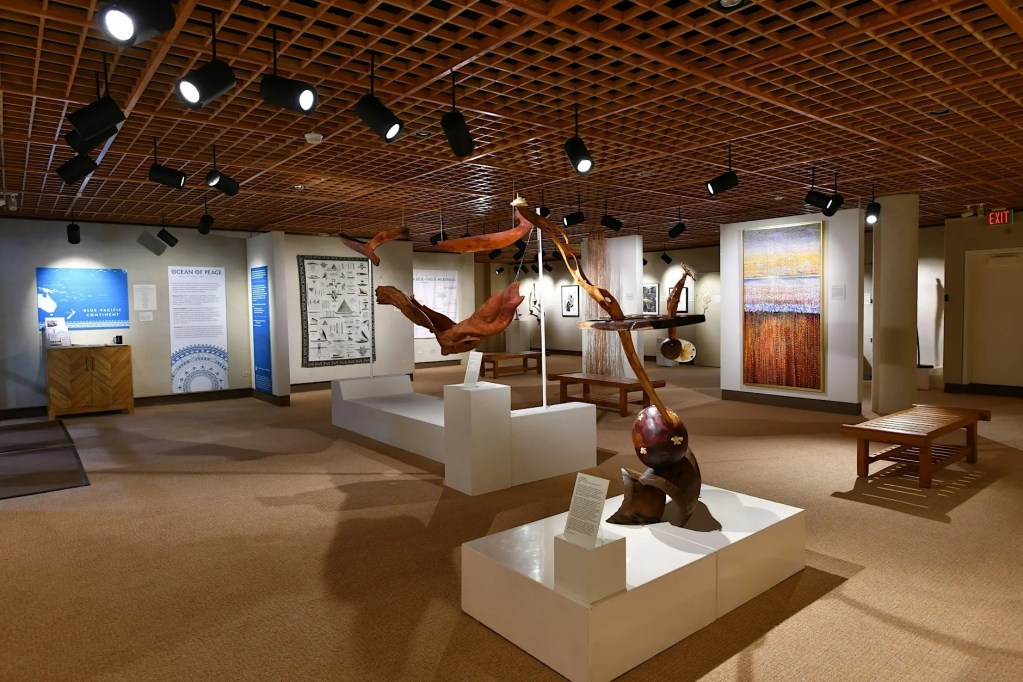
When I arrived at the East-West Center, vestiges of the installation were still strewn throughout the art gallery. The “Ocean of Peace” exhibition was in its final stages, with only a few pieces left to hang.
Ahead of its Sept. 20 opening, Mary Hattori invited me for a sneak preview of the traveling exhibition. After debuting at Maui’s Schaefer International Gallery with six artists last December, the show now features 11, handpicked by Hattori for its latest iteration at the EWC Gallery.
What hasn’t changed is its name, “Ocean of Peace,” inspired by Fijian Prime Minister Sitiveni Rabuka’s vision for the Pacific.
In 2024, Rabuka explained, “We are separated by the ocean’s size but bound together by a common 3,000-year-old maritime heritage. Our original ancestors were some of the greatest of all navigators. We inherited from them a sense of kinship spanning the endless waters.”
His vision calls for peace and unity against external forces threatening that solidarity.
Today, the Pacific is still described through imaginary lines drawn by European outsiders nearly two centuries ago. In 1832, French naval officer Jules Dumont d’Urville flattened the region’s diverse cultures into categories based partly on island size and skin color: Polynesia (“Many Islands”), Micronesia (“Small Islands”), and Melanesia (“Black Islands”).
Where Rabuka envisions a Pacific united by the ocean, “Ocean of Peace” harnesses another unifying force: art that exposes the cultural kinship among Pacific peoples.

Ideas showcases stories, opinion and analysis about Hawaiʻi, from the state’s sharpest thinkers, to stretch our collective thinking about a problem or an issue. Email news@civilbeat.org to submit an idea or an essay.
Ironically, though, the Western concept of fine art doesn’t quite capture how Indigenous peoples have traditionally understood creative expression.
“In many Native communities, not just Pacific, there is no word for art,” Hattori says. “In the Western world, art is often separate from everyday life. It might be upheld for its beauty, but it’s not functional.”
What we regard as “Indigenous art” often serves a practical purpose, with utility and beauty inseparable. The exhibition showcases canoes and everyday tools, such as axes and ladles, fashioned from natural materials.
That same philosophy informed Hattori’s curatorial approach. As the team finished installing the exhibition, she gave me a gallery tour and explained her “Pacific style” curation.
Ancestral Techniques, Contemporary Art
In conventional Western curation, works by disparate artists converge under a common theme. The curator arranges them to create connections. But Pacific cultures are deeply relational.
Hattori, who recently became executive director of the Hawaiʻi Council for the Humanities, prioritized artists with deep community ties and lived experiences in Micronesia and Hawaiʻi. These include multidisciplinary practitioners who incorporate ancestral techniques, such as pandanus weaving and wood carving, into contemporary art.
The Pacific connection isn’t imposed by a curatorial theme. It already exists within the artists and their communities.
Among them was Amber Khan, an artist who isn’t of Pacific ancestry. In her sculpture, wooden forms come together in an awkward, unnatural arrangement, with a long wooden shaft extending from a spherical base. The result feels uneasy, almost as though the pieces don’t belong together.
The sculpture embodies the alienation Khan felt among her own people before finding acceptance within a Pacific community. She supported previous exhibitions behind the scenes before being invited to participate as an artist. Her husband, Kainoa Gruspe, also has work in the show.
As Hattori puts it, “In Micronesian culture, presence is everything. Absence means something.”
For outsiders, the intricate webs of Pacific kinship can seem impenetrable. But Khan’s experience shows that belonging can be cultivated. Once welcomed into the circle, even outsiders can be embraced as one of their own.
In Hawaiʻi, our own Pacific neighbors are treated as outsiders.
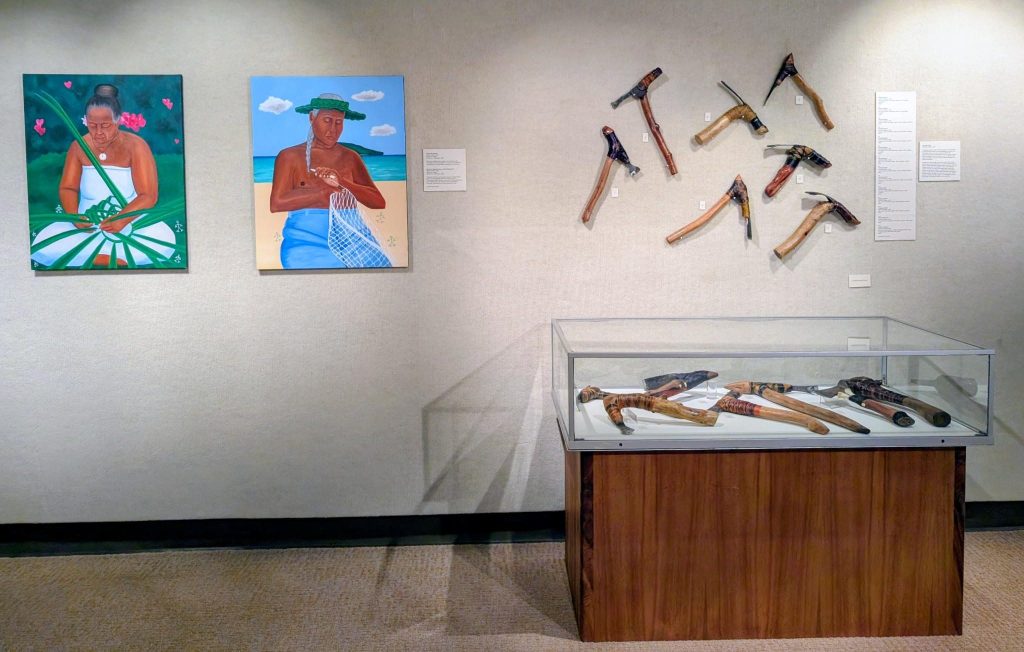
Yet the works of CHamoru master weaver James Cruz Bamba highlight just how interconnected Pacific cultures are.
Bamba honors his ma’ñaina (ancestors) in Guåhan while crediting Yap, Chuuk, Pohnpei, Belau, and even Hawaiʻi for the ancestral knowledge woven into his pieces, which he describes as a “synthesis” of traditions.
Acknowledging how changing needs have diminished weaving’s practical role, Bamba says, “We don’t need weaving anymore. But it shows who we are, where we come from, our resilience and capability to do these types of things.”
One of his pieces takes traditional weaving into the modern age: a fully woven QR code that links to his website.
The exhibition also features work in a new medium by Pulitzer Prize-winning photojournalist Manny Crisostomo, who has spent much of his career documenting CHamoru faces across the diaspora.
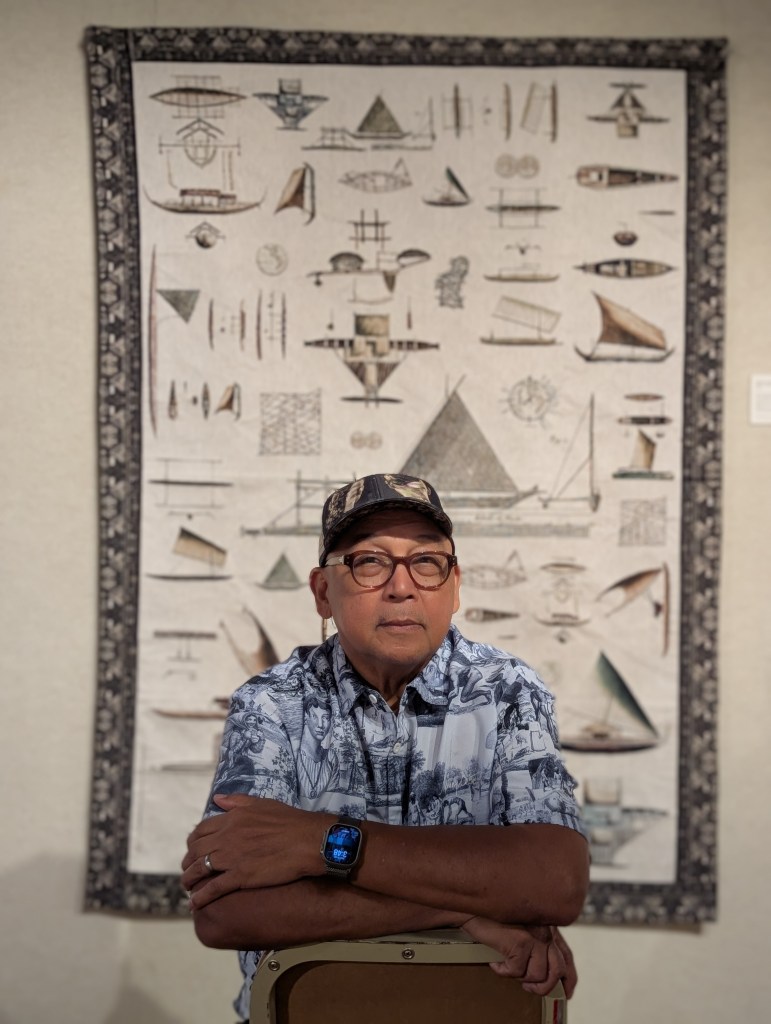
Crisostomo jokes, “I’m not gonna have some white guy document my people. I want the narrative to come from me.”
This year, he turned to tapestries, once used during the European Renaissance to depict significant events and people. His “Pacifica Lifelines Revisited” showcases traditional Pacific voyaging and wayfinding through what he calls “tapestry photo art.”
“There’s a Renaissance of the culture out here in the Pacific, and it’d be kind of neat to put it in that substrate,” he says. “It’s just a different way to get the story of the CHamoru people out.”
In the age of “AI slop,” Crisostomo prefers the imperfections of the loom. The visible threads and uneven textures create a physical presence that a digital image can’t replicate.
For Pohnpeian scholar and poet Carol Ann Carl, storytelling takes the form of verse. Her poetry reflects the cadence of spoken Pohnpeian, where words are chosen with purpose.
Carl describes her poetry as “planting seeds into the minds of those who would listen.” Those seeds grow into trees, eventually carved into canoes to navigate life’s challenges.
In the aftermath of Iremamber Sykap’s killing by Honolulu police in 2021, Carl encountered a vile Instagram comment about the unarmed 16-year-old Micronesian teenager: “One less cockroach. Prove me wrong.”
She wrote the spoken-word poem “I Remember” to do exactly that, honoring Sykap as a “descendant of a navigating society” and reclaiming his dignity in death.
The poem was later featured in “Why It Matters,” a civic engagement docuseries for the Hawaiʻi Council for the Humanities.
Her exhibited poem explores environmental stewardship.
“Planting seeds into the minds of those who would listen.”
Carol Ann Carl, describing her poetry
While she writes for a broader audience, Carl likes to slip little “Easter eggs” into her poems, references only those familiar with her culture would recognize. If you know, you know.
Samoa falls within Polynesia, but that carries little weight in “Ocean of Peace.”
Two paintings by Samoan artist Saumolia Puapuaga explore his cultural identity as a first-generation American struggling to connect with his heritage.
“Because there’s this diaspora of being away from your homeland, I don’t speak the language,” he says. “But it doesn’t mean I’m less Samoan. I’m exactly who I’m supposed to be.”

In “O Le Aso Lenei,” he “weave painted” the intricate patterns of ʻie tōga (Samoan fine mat) onto canvas to honor his grandmother, a master weaver who taught the craft to women in her village.
His large-scale painting “Teine Sāmoa,” inspired by Sandro Botticelli’s “The Birth of Venus,” celebrates Samoan women and female strength through imagery such as malu (traditional Samoan women’s tattooing).
Painted nearly a decade ago in Oklahoma, the painting followed him to Hawaiʻi. In 2019, he reluctantly parted with it for a Bishop Museum fundraiser, where it was purchased by none other than Hattori.
It hung in her office for years before being selected for the exhibition. Unbeknownst to Puapuaga, his participation would reunite him with “Te Neʻi Sāmoa,” a fitting symbol of his journey to reconnect with his Samoan heritage.
Inventing Tools To Tell Timeless Stories
Ancestral craftsmanship finds its way into the exhibition through reclaimed wood sculptures by Belauan sculptor and toolmaker Anthony Watson.
Growing up in Belau, Watson had to learn toolmaking before elders would teach him canoe carving. Today, he still carves with handmade tools he considers cultural keepsakes, preserving traditions that survived generations of colonialism.
His canoes on display symbolize familial lineage and kinship.
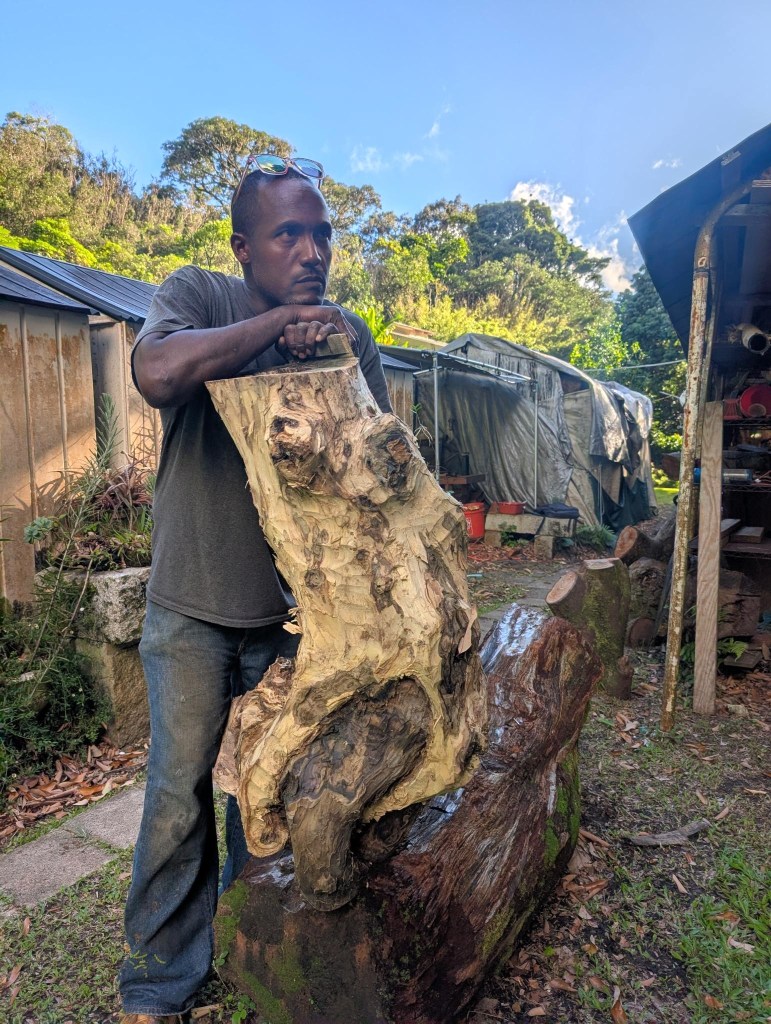
“Some of the tools that I ended up making, I thought I just invented,” he says. “And I realized that deep in Belauan history, somebody already built that. It’s like this continuum of history where you’re never so disconnected from the past.”
Other artists include digital artists Kalany Omengkar (Belau/Northern Mariana Islands) and Gillian Dueñas (Guåhan), charcoal and oil painter Lissette Yamase (Chuuk), and Hawaiian fiber artist Marques Hanalei Marzan.
“Ocean of Peace,” now extended through March 14, 2027, has brought greater visibility to Micronesian art in Hawaiʻi, and led to new acquisitions for the state’s public art collection.
According to Hattori, since its founding in 1967, the Hawaiʻi State Foundation on Culture and the Arts had acquired only one work by a Micronesian artist, later removed from the collection. Following the exhibition’s Maui debut, the foundation approved the purchase of five works by James Cruz Bamba, Lissette Yamase and Anthony Watson.
Beyond institutional recognition, Watson, who is also of African American descent, reflects on how Micronesians are perceived.
“We’re not Polynesians, we’re Micronesians,” he says. “We’re dwarven versions of Austronesian. People think we’re small people. From what I’ve seen of Micronesian culture and history, they’re not small. They’re quite brilliant.”
That brilliance isn’t always apparent to those who inherit it.
“When you’ve been teased and bullied about your culture so much that you don’t even want to be thought of as your own identity, that breaks your will. And that’s the worst,” Watson says.
“But your will is broken because you’re unaware of your history of brilliance.”
 Sign up for our FREE morning newsletter and face each day more informed.
Read this next:

Local reporting when you need it most
Support timely, accurate, independent journalism.
Honolulu Civil Beat is a nonprofit organization, and your donation helps us produce local reporting that serves all of Hawaii.
ContributeAbout the Author