The Sunshine Blog: Lines Being Drawn On Citizens United Might Surprise You
Hawaiʻi’s new campaign restrictions are sparking legal fire from liberals and conservatives alike.
October 4, 2026 · 13 min read

About the Author

Strange bedfellows: Hawaiʻi’s recently enacted effort to snuff the power of special interests and dark money in state elections is attracting more national organizations on both sides of the legal fight over what’s now known as Act 11. And The Sunshine Blog is interested to see that some of the positions — and the people involved — are not lining up the way the usual suspects usually do.
To recap: The Legislature hurriedly passed Senate Bill 2471, Hawaiʻi’s answer to Citizens United, this past session. It emerged at literally the last minute from conference committee with the understanding that lawmakers would take it up again in 2027 and fix problems that they simply ran out of time to address. In fact, it doesn’t take effect until July 1, 2027.
The law is the first of its kind in the nation and seeks to prohibit corporations, unions, nonprofits and other organizations that need in essence state permission to operate here from participating in elections, either directly or indirectly. It’s basically aimed at political action committees including super PACs and you’d think the folks at the most super of super PACs, Pacific Resource Partnership, would be the first to cry foul. Surprisingly (or perhaps not when you think for a minute that this is all supposed to go back to the Legislature next year), we have heard not a peep from PRP or the Carpenters Union, which have refused to talk about it.
Instead, the first legal salvo was fired by Grassroot Institute of Hawaiʻi, a libertarian/conservative-leaning think tank, that teamed up with the Washington, D.C.-based Institute for Free Speech to challenge the law in federal court. Grassroot has become more and more of a political player in the last few years and was planning to expand its political activism soon but contends Act 11 will prevent it from doing that.
Grassroot recently got some help from an unlikely ally — the American Civil Liberties Union. The ACLU calls itself a “resolutely nonpartisan organization” but likewise fears that Act 11 will put a big damper on its ability to advocate for the issues and people it cares about.

And not only will the ACLU be harmed but “The Act directly prohibits and indirectly chills a great deal of political advocacy engaged in every day by nonprofit and charitable organizations across the ideological spectrum,” the ACLU says in its amicus brief.
The Blog looked back through nearly 300 pages of testimony on SB 2471 and didn’t find the ACLU fighting the bill as it went through numerous committee hearings. Interestingly, the ACLU of Hawaiʻi’s policy director, Josh Frost, submitted testimony several times in support of the bill although he made it clear he was not speaking for his organization.
But that was then and this is now.
“Much of the ACLU’s advocacy in defense of civil rights and liberties around the country would be banned or chilled under restrictions like those in Act 11,” the ACLU says in the lawsuit. “First, the Act’s prohibition on ballot-issue advocacy by nonprofit corporations would apply to the ACLU’s (and ACLU Foundation’s) spending on ballot measures related to abortion access, LGBTQ rights, judicial independence, and voting rights. Second, the Act’s prohibition on speech that ‘indirectly’ supports or opposes a candidate would inevitably chill the ACLU’s public advocacy about candidates and officials.”

Then, on Sept. 24, the U.S. Chamber of Commerce filed the second lawsuit against the state challenging Act 11, arguing the law has broad effect on corporations nationwide, not just in Hawaiʻi. “Hawaiʻi cannot define away the First Amendment rights of non-Hawaiʻi corporations, much less silence them by threatening to revoke their authority to transact business within the State,” says the world’s largest business organization, noting it regularly participates in political speech including repeatedly endorsing Ed Case in Hawaiʻi’s 1st Congressional District.
This year, the Chamber says, the rise of the Democratic Socialists of America has prompted it to plan a major offensive against that political movement including a digital version of its anti-socialism “Free Enterprise Express” campaign to bring some voter education to Hawaiʻi.
“The Chamber believes that Hawaiʻi is an important forum for its message because debates concerning free enterprise, government control of economic outcomes, and the proper role of business in public life have become increasingly prominent in the State,” the lawsuit says. “In the course of discussing free-enterprise principles, the Chamber’s planned Hawaiʻi communications will identify specific candidates for Hawaiʻi state office by name and will support or oppose those candidates, directly or indirectly, by discussing with approval or disapproval their alignment with those principles and their positions on various other issues affecting the business community. In particular, the Chamber presently intends to disseminate communications in Hawaiʻi during the 2027–2028 election cycle referring favorably or unfavorably to specific candidates for Hawaiʻi state office by expressing approval or disapproval of their positions on free enterprise and alternative economic and political systems such as socialism.”
Oh boy. The Blog is really looking forward to the 2028 elections now.
Meanwhile, the state has attracted some amici of its own, with more friend-of-the-court filings by the Center for American Progress, which wrote the legal framework Act 11 is based on, and the Campaign Legal Center and the Citizens for Responsibility and Ethics in Washington.
The Blog is sure that Attorney General Anne Lopez welcomes the assist. Her office testified against SB 2471 and warned lawmakers several times that it was unconstitutional. Now that it’s a state law she has to defend it.
And in another twist, the Campaign Legal Center and CREW are being repped locally by Honolulu attorney Mateo Caballero, who was formerly the ACLU’s legal director here in Hawaiʻi.
Their court filing walks us through how the U.S. Supreme Court, in allowing corporations to spend freely as the “artificial persons” the high court deemed them to be, intended there to be safeguards to prevent secret donors and coordination with candidates as well as provide the ability to police abuses.
“Sixteen years later, the evidence is overwhelming that none of those safeguards has worked,” CLC and CREW argue. “Super PACs coordinate openly with the candidates they support, and the Federal Election Commission (FEC) has never voluntarily found a coordination violation. Dark money in federal elections — including in Hawai‘i — has grown from less than $5 million in 2006 to $1.9 billion in 2024. And direct spending from corporate treasuries has reached record levels.”
Act 11 is “a rational response” to the situation, the lawsuit says.
You can read the amicus briefs and other documents here on the Institute for Free Speech’s website, and the U.S. Chamber’s separate lawsuit below. The federal court is already considering a likely consolidation of the two cases.
Block that loophole: And speaking of things that keep coming back, look for another run this coming session by some lawmakers and good-government advocates to tighten the loophole that allows campaign donations from state and county contractors. The issue has come up for at least the last three years and, despite much news coverage and rallying by supporters, it manages to die year after year, often last minute and most times unexplained.
Once again, the Hawaiʻi State Ethics Commission will make the contractor loophole a focus for the 2027 legislative session. The challenge, executive director Robert Harris told commissioners at a meeting last month, is that senior executives of a contracting company are still allowed to make campaign contributions.
Previously, proposals put forward primarily by the state Campaign Spending Commission would have banned donations by company execs and their immediate family members as well as by nonprofit leaders and their family members who get state grants.
There are also versions of the bill that would limit the agencies involved — for example, only donations to candidates running for governor and lieutenant governor even though recent scandals have also included legislators and most contracts are funded by the Legislature, not the administration.
Harris said the commission would ask Senate President Ron Kouchi and House Speaker Nadine Nakamura “to prioritize this bill to make it a key piece of legislation they want to see passed next year.”
“The attempt here is just to prevent, hypothetically speaking, company X from sending 10 or 15 owners and senior officers to a campaign fundraiser and making contributions, and then putting a lot of pressure on that legislator to do something that may benefit their company,” Harris explained.
The Hawaiʻi Campaign Spending Commission will also be advocating — again — for legislation to close the loophole.
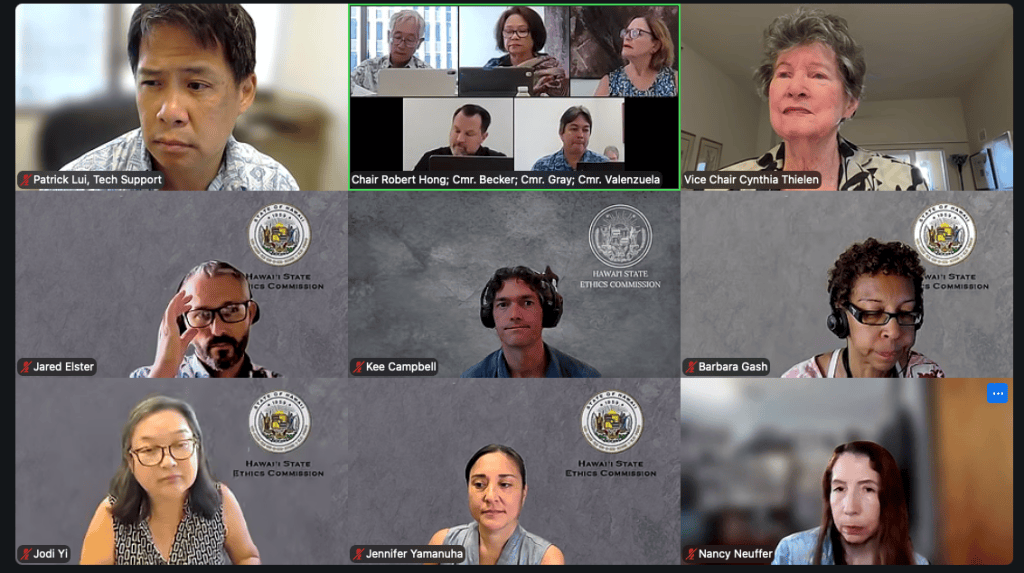
Executive decision: One reform that did pass earlier this year prohibits top state officials from participating in fundraisers and actively raising money for political candidates. It took effect in July and the Ethics Commission has put together a list of those who are affected and is contacting them to make sure they know and understand the new law.
The bill was the brainchild of Cynthia Thielen, a former longtime GOP state lawmaker who is now vice chair of the Ethics Commission (and still going strong at 93.) Thielen has said she was “utterly shocked” to read a Civil Beat/New York Times story about a top state official who regularly hosted campaign fundraisers where state contractors and others with business before the state would hand over cash and checks. She brought the issue to the commission which drafted a bill and shepherded it through the Legislature.
Now, Act 228, which became law July 10, applies to executive branch employees who are nominated or appointed by the governor to compensated positions requiring Senate confirmation. The letter being sent to them by the commission explains that once confirmed, “and until their employment in a covered position ends,” these employees may not:
- organize, attend, or host a political fundraiser for any candidate for elective office;
- solicit contributions for such a fundraiser; or
- directly or indirectly solicit campaign contributions from any individual or entity.
The new law does not prohibit covered employees from expressing their personal opinions, however, or making personal political donations or voting.
Check out who the law applies to (you can enlarge it by clicking the plus sign at the bottom of the box):
Geeking out: Hot off the presses, what would life for Blog fans be without the annual Hawaiʻi Data Book? The state Department of Business, Economic Development and Tourism released the 58th edition last week, having published it most every year since 1962.
The Blog is old enough to remember when it came as an oversized thin paperback. Reporters kept it on their desks for quick fact checks. Now, like a lot of stuff, it’s gone digital.
DBEDT calls it “the state’s most comprehensive statistical resource, featuring 24 sections and 832 data tables covering population, education, environment, economics, energy, real estate, construction, business enterprises, government, tourism and transportation.”
Some tidbits, culled from the state’s press release:
- Hawai‘i’s median age reached 42.1 years in 2025, up 1.5 years from the 2020 median of 40.6. By county, Hawai‘i County recorded the oldest median age at 44.9 years, while Honolulu County recorded the youngest at 40.9 years.
- As of December 31, 2025, there were 62,060 state and county employees in 15 collective bargaining units. Bargaining Unit 5 was the largest with 14,053 teachers and other personnel; Bargaining Unit 3 (white-collar non-supervisors) was the second largest with 12,278 members.
- CNBC’s 2026 “Top States for Business” ranked Hawai‘i 50th overall, down from 49th in 2025. While the state’s economy improved to 24th place, its cost of doing business and infrastructure both ranked last at 50th. Conversely, Hawai‘i’s quality of life remained a top strength, holding steady at 6th.
- Hawai‘i’s 2025 high school graduates continued to outperform national averages on the SAT, scoring 551 in math and achieving a record-high average of 574 in reading and writing. Both scores remained well above the respective U.S. national averages of 508 and 521.
- Camping permits issued by the City and County of Honolulu rose to 8,603 in 2025, marking a 7.2% increase from the previous year, but remaining below the recent peak of 10,818 permits issued in 2023.
- Kona’s 2025 Ironman World Championship registered 4,208 participants with a 92.1% finisher rate. Winning times were 7 hours, 51 minutes and 39 seconds for the men’s division, and 8 hours, 28 minutes and 27 seconds for the women’s division.
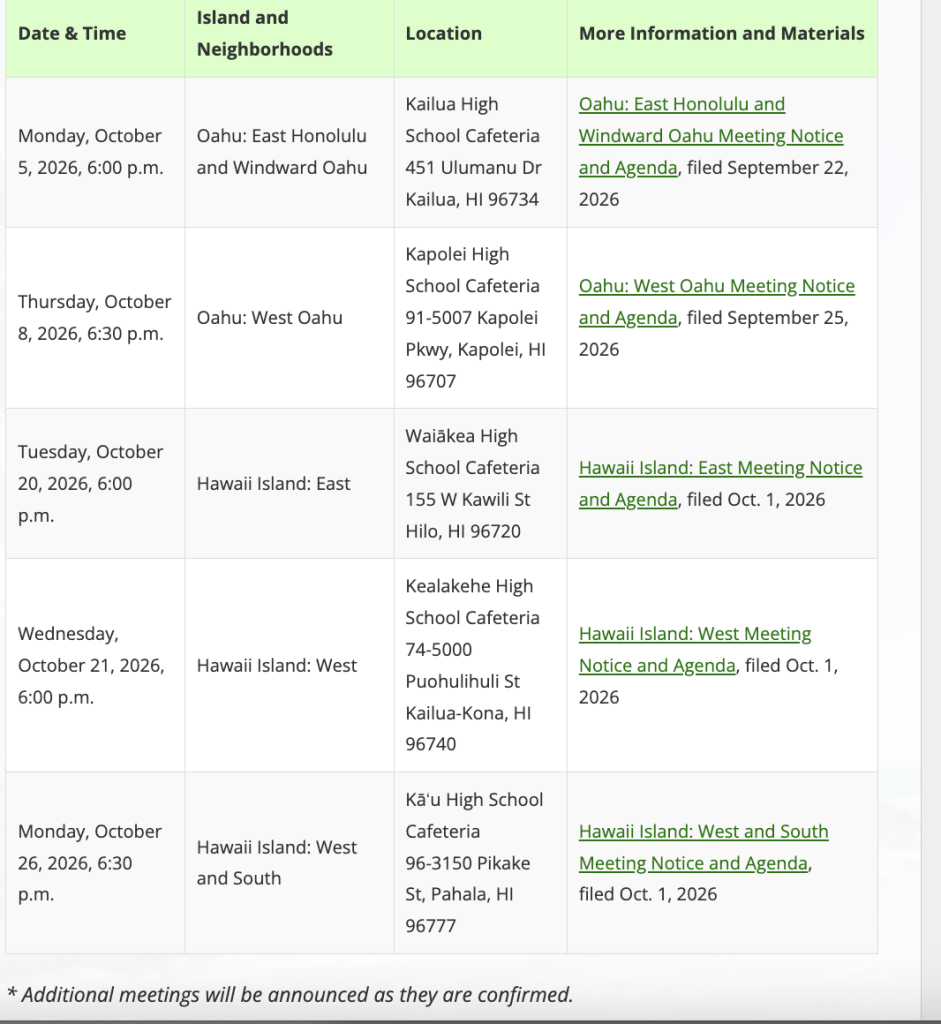
Electrifying conversations: And this just in, the Hawaiʻi Public Utilities Commission is holding public meetings to share information about Hawaiian Electric Co.’s recent storm-related service outages and impacts and hear residents’ concerns.
A preview of what might be to come was held last week in East Honolulu when HECO hosted a community gathering of residents concerned about why their power seems to go out all the time, stormy weather or not. People gave HECO execs an earful.
HECO is holding another meeting Sunday on Molokaʻi to explain more about its plans for a major upgrade of its electrical system there, extensive work that has some residents worried about being without power for long periods of time.
The Molokaʻi meeting is scheduled to be held at the Kilohana Elementary School Cafeteria, 7253 Kamehameha V Hwy in Kaunakakai from 4 p.m. to 5 p.m.
The PUC announced it was scheduling community sessions of its own beginning Monday. The meetings will include information from HECO and Consumer Advocate Michael Angelo as well as an opportunity for residents to download their thoughts. “Public input gathered at these meetings will help inform the commission’s ongoing review and future planning of Hawaiʻi’s energy system,” according to a press release.
You can also send written comments. Reference Docket No. 2021-0024 and include “Outage 2026” in the subject line. Written comments may be submitted online, by email, or by mail.
Online: hpuc.my.site.com/cdms/s/consumers/public-comments
Email: puc@hawaii.gov
Mail: Hawaiʻi Public Utilities Commission, 465 S. King St., #103, Honolulu, Hawaiʻi 96813
The commission plans to conduct additional meetings for communities in Central O‘ahu and Urban Honolulu, as well as on Maui, Moloka‘i and Lāna‘i, according to the press release. A virtual participation option will also be offered.
The commission plans to post a recording of each meeting on its YouTube channel. Watch for a list of meetings as it is updated on the commission’s website. Here’s the initial schedule:
 Sign up for our FREE morning newsletter and face each day more informed.
Read this next:

Local reporting when you need it most
Support timely, accurate, independent journalism.
Honolulu Civil Beat is a nonprofit organization, and your donation helps us produce local reporting that serves all of Hawaii.
ContributeAbout the Author