

Neal Milner: Honolulu Rail Is Laughable, But Not Funny
When it comes to the vexing issue of what to do about the rapid-transit debacle, the stand-up routines of the mayoral candidates could all use some work.
Honolulu’s rail project has become the subject of a lot of political humor. Unfortunately, it’s the top three mayoral candidates who are making the worst jokes.
They just don’t realize that their unreal solutions are laughable.
Mayor Kirk Caldwell brought his usual optimistic “it never rains in Honolulu” disposition into a recent meeting about rail, but once he got there, whoa Nellie.
One week after saying he was committed to building the entire 20-plus mile route, Caldwell about-faced from Pollyanna to the Angel of Death.
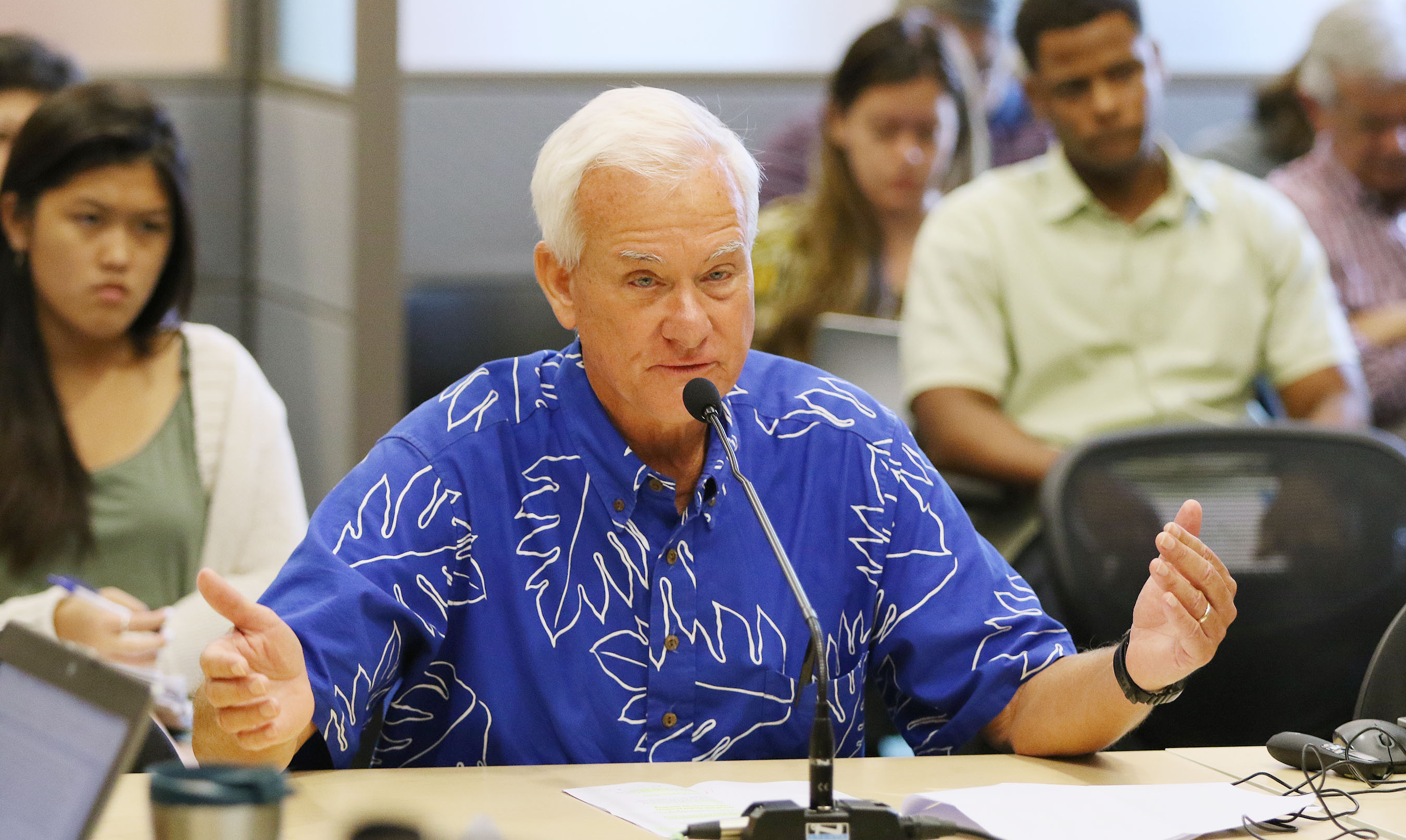
Humor is all about surprise, so his routine was a real knee-slapper.
Bad news, the mayor said, setting up the punch line. Somehow things have suddenly, suddenly changed. Poof, the money is gone.
Who knew?
Wait, there’s more. What makes his stand-up routine even funnier is the bit about buses.
The punch line, the zinger, is that buses are the answer! Da dum BOOM.
A plan that probably cuts rail ridership in half and makes those hapless, commute-exhausted West Oahu residents transfer at a dreary intersection far from their destination to buses for a slow, herky-jerky, ugly ride down the Nimitz or whatever.
“Rapid buses?” Only in the eyes of the beholders.
And one of the big bus beholders, along with some Democratic Party old-timers like Ben Cayetano and Walter Heen (part of the same powerful bipartisan anti-rail coalition that lost the last mayor’s race), is another mayoral candidate, Charles Djou.
He believes that busing from Middle Street is the only prudent answer.

What’s hilarious about Djou is this: He attacks the mayor for advocating the very same Middle Street bus plan that Djou himself advocates.
That’s because, as Djou put it, Caldwell has flip-flopped.
Flip-flop has been part of the GOP tool kit ever since George W. Bush magically made a virtue out of never changing his mind. Like, say, about Iraq.
For Republican audiences, “flip-flop” is like the Henny Youngman joke, “Take my wife — please.” No matter how many times a GOP pol says it, it gets a response.
The bus plan fits snugly into a Republican way of thinking because it is fiscally prudent. It works with these mantras: no tax increase, live within your means.
Conservatives say this to poor people all the time. The joke is often on the poor. With buses, the joke will be on all of us.
Speaking of not showing fear when your premise is not working and your material is going down the toilet, Peter Carlisle, our former mayor who is trying to win his seat back, says we can and should stay the course.
Don’t panic, he says. We can build the whole rail system from Kapolei to Ala Moana.
He does not really say where the extra money — a billion here, a billion there — will come from.

Carlisle’s shtick is like a joke that the comedian Robert Klein used to tell about Catskill comedians when he was a kid and the Catskills was a go-to place for Jewish vacationers.
The comic would set up the joke in English, and just when Klein, who spoke no Yiddish, was ready for the zinger, the guy would deliver the punch line in Yiddish.
Well, yeah, it’s a lot funnier when Klein tells it, but you get the drift. Just when we are ready to discover where the money would come from, the ex-mayor delivers the punch line in Yiddish.
In Carlisle’s eyes, if we walk in a storm, keep our head up high and don’t fear the dark, we can build Big Rail. He hopes that if he walks on with hope in his heart, he will never walk alone. Or at least enough voters will walk along with him to get him past the primary.
Quick question: How many of you can imagine putting “rail” and “hope in your heart” in the same sentence?
The comic’s act isn’t working. She’s dying out there. So try some new material, which in this case turns out to be public-private partnerships.
All of a sudden, politicians are saying that the private sector should pick up the slack and pay for part of rail. After all, the developers and other real estate people will benefit from development around the transit stations.
As Jerry Seinfeld would say, mentoring a young comic, that’s a good concept, but you really need to work it.
Here’s what is wrong with this idea. First, the city is close to nowhere on implementing plans for developing housing at transit stops.
Worse, though, is the timing. The city needs a commitment of money for rail right here and right now. Public-private partnerships take an enormous amount of time to set up. And in negotiations between, say, developers and city officials who would be operating under severe fiscal and political timelines, guess which side holds the bargaining chips?
The three candidates hope that their answers to rail are like a Henny Youngman one-liner. They never get stale. The trouble is rail is beyond stale. It’s dead.
There is no good solution, not even a mediocre one. It’s like the Waikiki Natatorium War Memorial disaster writ large. For at least a half-century politicians have promised to do something about the Natatorium. Instead it continues to crumble.
At least that blight is more or less hidden away. But there is no way to hide rail, not with miles of brightly visible elevated tracks that abruptly end in the middle of transportation nowhere.
Every day a reminder of failure. Middle Street becomes Muddle Street.
It is doomed. Politicians, unlike comedians, can’t be ironic about it. They have to be — or at least pretend to be — earnest and optimistic.
It’s no way to run a comedy club.

