

Health Beat: Why Pharmaceutical Price Gouging Costs All Of Us
If you don’t use an EpiPen, why should you care that it suddenly costs a lot more? Well, there’s your taxes, for one thing.
If you don’t use a particular prescription drug, why should you care what it costs?
Last year, Turing Pharmaceuticals increased the cost of Daraprim, an anti-parasite medication used to treat toxoplasmosis, 5,000 percent, from $1 a pill to $750 a pill, after purchasing the rights from another drug company. There was initially an outcry, resulting in company CEO Martin Shkreli being called to testify before Congress. He invoked his Fifth Amendment rights and said nothing, but his smirk became internet fodder for weeks.
The medication is commonly used in AIDS patients or those who have received transplants. Although the cost is lower now, $375 a pill, it’s still way above most patient’s ability to pay.
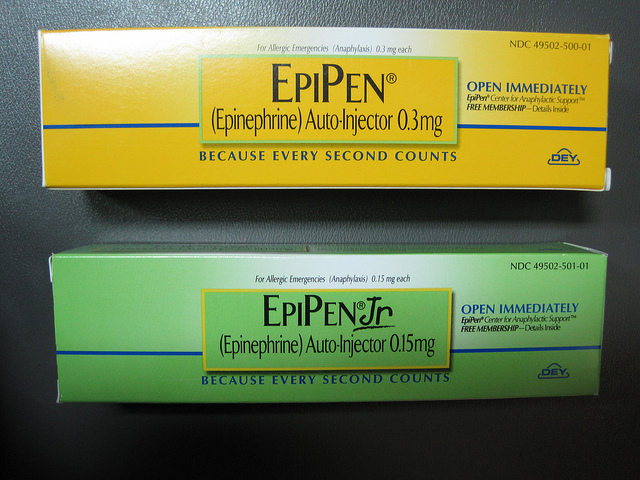
This past month, Mylan Pharmaceuticals, the makers of the EpiPen, ratcheted up the cost of their life-saving drug to $600 for a pack of two, (it can’t be prescribed for just a single dose) and once again, the failure of our government leaders to regulate the pharmaceutical industry in their endless pursuit of profits hurts those least able to defend themselves.
EpiPens are used for patients with severe allergies or life-threatening reactions to things like bee stings or peanuts. It’s only intended for a limited number of conditions and there are small numbers of patients who have the need to carry this medication, but those who need it could actually die if it’s not available.
This outrageous price-gouging of patients is legal, and there are no regulations currently in place to stop any other pharmaceutical company from doing the same thing with any drug that is still under its patent.
We need to change the laws now to make excessive increases in the cost of previously inexpensive treatments illegal, and hold the pharmaceutical industry accountable for their actions.
For those who don’t use this medicine, it might not seem like a big deal. That’s what happened last time, when no one bothered to fix the problem with Turing’s demand for more money for Daraprim. But this time, it’s even worse.
EpiPens save lives. Several states have laws that require schools to have the device available for use for students in case of emergency. The Hawaii Legislature has considered such a measure, HB 1163. Who funds the schools? Taxpayers. That’s us.
Currently, 40 percent children nationwide are covered under the Children’s Health Insurance Program, known as CHIP. This is jointly funded on the state and federal level. Who pays for this? All of us.
There’s an interesting exchange going on in the U.S. Senate right now. Mylan CEO Heather Bresch is the daughter of Sen. Joe Manchin of West Virginia. His colleague, Senator Amy Klobuchar of Minnesota, is demanding that the Senate Judiciary Committee investigate the price increase in the medicine her own daughter relies on for her severe allergies.
The response thus far, Mylan has offered discount cards to cut the price in half. That’s still $300 for a medicine that used to cost $100 just a few years ago. For those with insurance, the cost may be lower, but the end result is higher premiums for everyone to cover the high cost of drugs for a few.
Government-run insurance programs don’t allow discount coupons. These programs are also not allowed to negotiate prices for medications, so if it’s covered under Medicare or Medicaid, then taxpayers fund the full costs once again.
Now Mylan is trying to quell the controversy by taking the unusual step of offering a generic version of its own medicine that sells for $300 per two-pack.
Why should a medicine suddenly cost more when there is no change to how it is manufactured, when there is no additional research and development cost, and no need for marketing? It’s the only one out there, and there is no alternative, no competition at all.
Mylan Pharmaceuticals has everyone who needs the medicine in a chokehold. Ironic, because for those who need to use EpiPens, it’s often because they can’t breathe without it.
Mylan’s CEO has denied that the company is responsible for the increased costs for the medication, although Heather Bresch’s salary has increased to over $18 million.
She has blamed the broken medical system for the rise in costs of the medication her company solely provides.
On average, Americans over age 65 take 14 prescription pills a day. Over age 80, the number jumps to 18 daily. All of us will likely rely on daily medication at some point in our lives. Even if we are not taking Daraprim or using the EpiPen ourselves, we are inevitably paying for someone who does through our taxes or health insurance premiums.
If we don’t take action now, this drastic price increase could happen to any medication in the near future, and sooner or later, it might be one that millions more people use on a regular basis.
We didn’t fix the problem after Daraprim, and we didn’t even try with the cost of hepatitis C treatment, which costs $80,000 to $100,000 for three months. We haven’t fixed the crisis with the EpiPen either.
It only takes one episode of anaphylaxis that isn’t treated with life-saving epinephrine to kill someone. We need to change the laws now to make excessive increases in the cost of previously inexpensive treatments illegal, and hold the pharmaceutical industry accountable for their actions.

