Voters Must Tighten Rail’s Short Leash
Mayoral candidates need to be more specific about their rail strategies right now. And can someone light a fire under the HART board?
Federal Transit Administration officials have given the Honolulu Authority for Rapid Transportation and the City and County of Honolulu until the end of the year to put forth a new proposal to finish the Honolulu rail project as currently planned or complete a shortened route.
It’s not what the feds wanted. The FTA initially laid down an Aug. 7 deadline, but Mayor Kirk Caldwell asked for a reprieve for the financially embattled project until next summer, to allow the Legislature to consider rail’s options in its 2017 session.
The FTA was in no mood to be generous, as its terse July 21 letter to Caldwell underscored. Neither, we suspect, are Honolulu voters, who even in good times, have only supported the project by the smallest of margins.
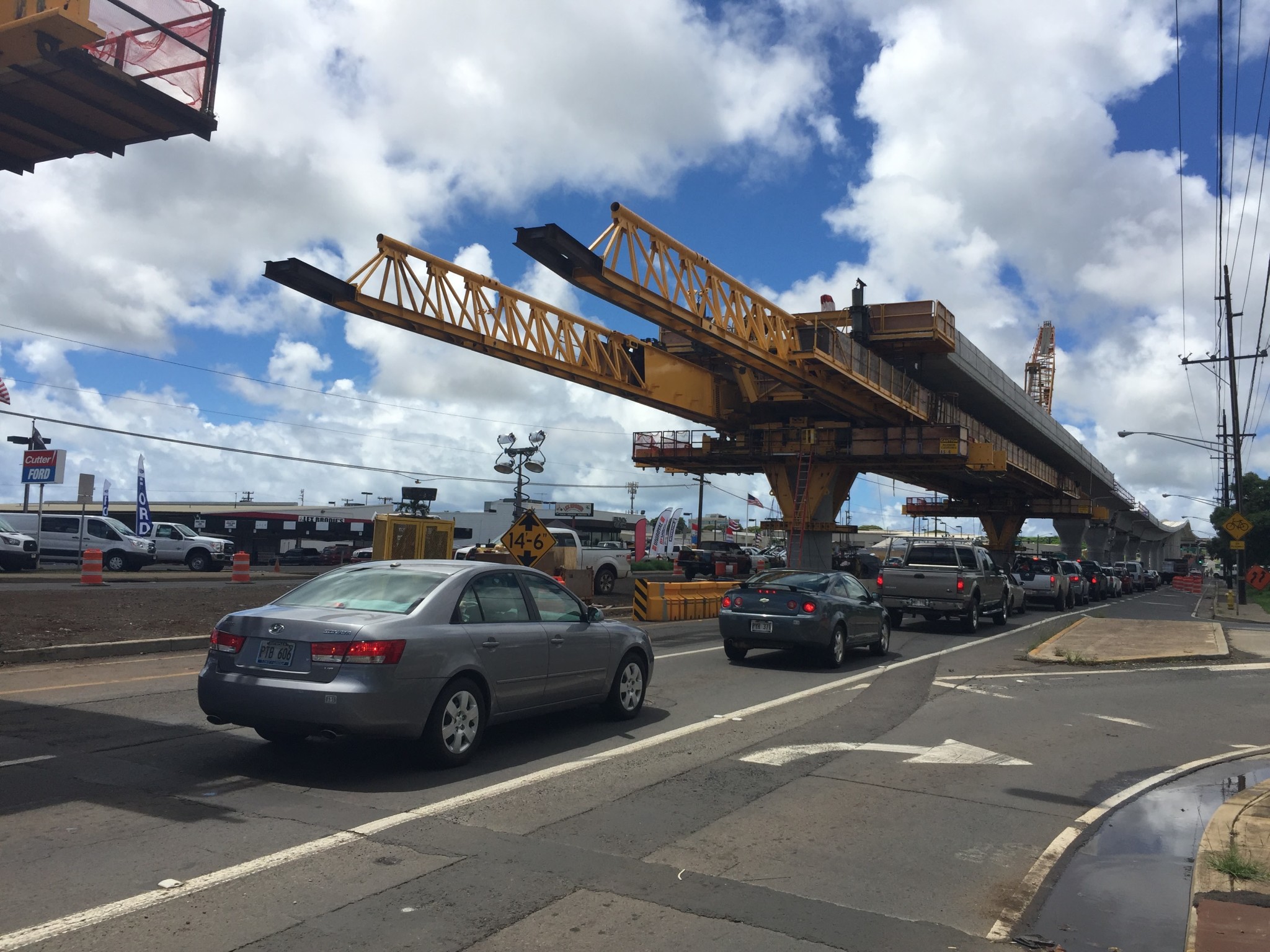
With the project now $1.5 billion over budget, red ink continuing to flow and elections just around the corner, voters and community organizations should put city leaders — and by extension, the semi-autonomous transit authority — on an even shorter leash.
First, they should demand that Honolulu mayoral and City Council candidates be crystal clear about what direction they support in advance of the Aug. 13 primary election.
Council members are responsible for key funding decisions regarding rail, as we saw last year when the Council approved the extension of the general excise tax surcharge funding the project.
But the mayor’s responsibilities are even larger. The mayor appoints three of the HART board’s 10 members; another two (ex officio members) are city department heads who report to the mayor. Those five have potentially decisive influence over the board’s 10th member, who is chosen by the rest of the board. The mayor’s five could dictate the selection of that last board member.
The volunteer board “oversees the planning, construction, operation and extension of the rail system” and hires — and can fire — its executive director.
Voters should demand that Honolulu mayoral and City Council candidates be crystal clear about what direction they support in advance of the Aug. 13 primary election.
Each mayoral candidate, then, owes voters detailed plans for how the project would go forward under his leadership.
In Thursday night’s mayoral debate, presented by Civil Beat and KITV, Caldwell re-committed to — eventually — building the entire, 20-mile route, all the way to Ala Moana. Caldwell estimated additional costs of $1 billion to $1.5 billion for the final 4.3 miles and the last eight stations of the route. “Now I’m working to put together a financial plan to get us the full way,” he said.
Neatly avoided was the mayor’s abrupt announcement last month at a HART board meeting that he and City Council Chair Ernie Martin favor halting the project at Middle Street. “Let’s do a good job for the first 15 miles and then we can talk about the rest later,” Caldwell said at the time.
Nor was there an explanation as to why a financial plan isn’t already in hand. Rail’s deep money troubles are not new. Contingency planning should have dictated that a backup plan already be in place. But as we’ve seen throughout this project, rail’s challenges seem to continually surprise those in charge and send them scrambling.
Challengers Charles Djou and Peter Carlisle were hardly any better. Djou’s articulation of the obvious — it’s “way over budget” and a “major problem,” for example — didn’t include any original ideas for how to right the ship.
Carlisle seemed more interested in pointing out Djou’s longtime enmity for rail and his own commitment to building the entire route. But new ideas for how to move forward? Not so much.
To be sure, time was limited for this topic in last week’s debate. So, let us repeat: No candidate’s case for mayor — or City Council — should be considered complete without making public a specific, legitimate way forward for rail.
If Honolulu rail is ever to be brought into an acceptable state of transparency and accountability, this is where it must begin — by getting to know the stances of those responsible for the project and squaring those with both its historic failings and its deep needs going forward.
Missing: A Sense Of Urgency
The second part of keeping city leaders and HART on a short leash involves their revised financial plan, which must be on the table by mid-November to clear the local consideration-and-approval process in time for year’s end submission to the FTA.
Though that’s earlier than they wanted, they owe it to voters to make the plan public earlier still, by mid-October, to give voters sufficient time to consider it prior to the election. By then, per the FTA’s letter, the city and HART will have already submitted an interim plan that will include “immediate milestones and deliverables.” It is not too much to expect that the revised plan draft be available soon thereafter.
Waiting until mid-November would mean voters would only see the details after the Nov. 8 general election and that they’d relinquish what little control they have over the project. If neither Caldwell, Carlisle nor Djou win a majority in the August primary, Honolulu’s next mayor will be chosen in November. Voters deserve the chance to make a decision with the positions of the candidates and the facts of the revised plan in front of them.
All of which means city leaders and HART don’t have a moment to waste. Only 22 weeks remain until the deadline for submission to the FTA. That kind of timetable ought to give even the most jaded bureaucrat a sense of urgency, but urgency seems in short supply.
The HART board met Thursday, for instance, just one week after the FTA sent its letter to Caldwell, and barely enough members showed up to do official business. Midway through the meeting, board member William “Buzz” Hong departed, leaving the group without a quorum and much of its agenda undone.
To borrow an apt phrase, this is no way to run a railroad.
Honolulu needs clear, unequivocal answers for rail. If the city’s elected leaders can’t provide them, voters can and should find others who will.