

Neal Milner: Who Is The Better Master Of Disaster?
The Honolulu mayor’s race is no longer a referendum on rail because both candidates are saying the same thing: we don’t really know what to do about it.
Remember back, oh maybe a couple of months ago, when the Honolulu mayoral election was going to be about rail?
Not any more, but for an ironic and — for challenger Charles Djou — tragic reason.
Rail is so important that it has become unimportant. Charles Djou’s mayoral chances got slimmer as rail’s problems got bigger.
That’s because the rail situation is so out of control and the proposed fixes are so unknowable that Djou, who was historically opposed to rail is now stuck in the same tar pit of trying to fix it as Caldwell is.
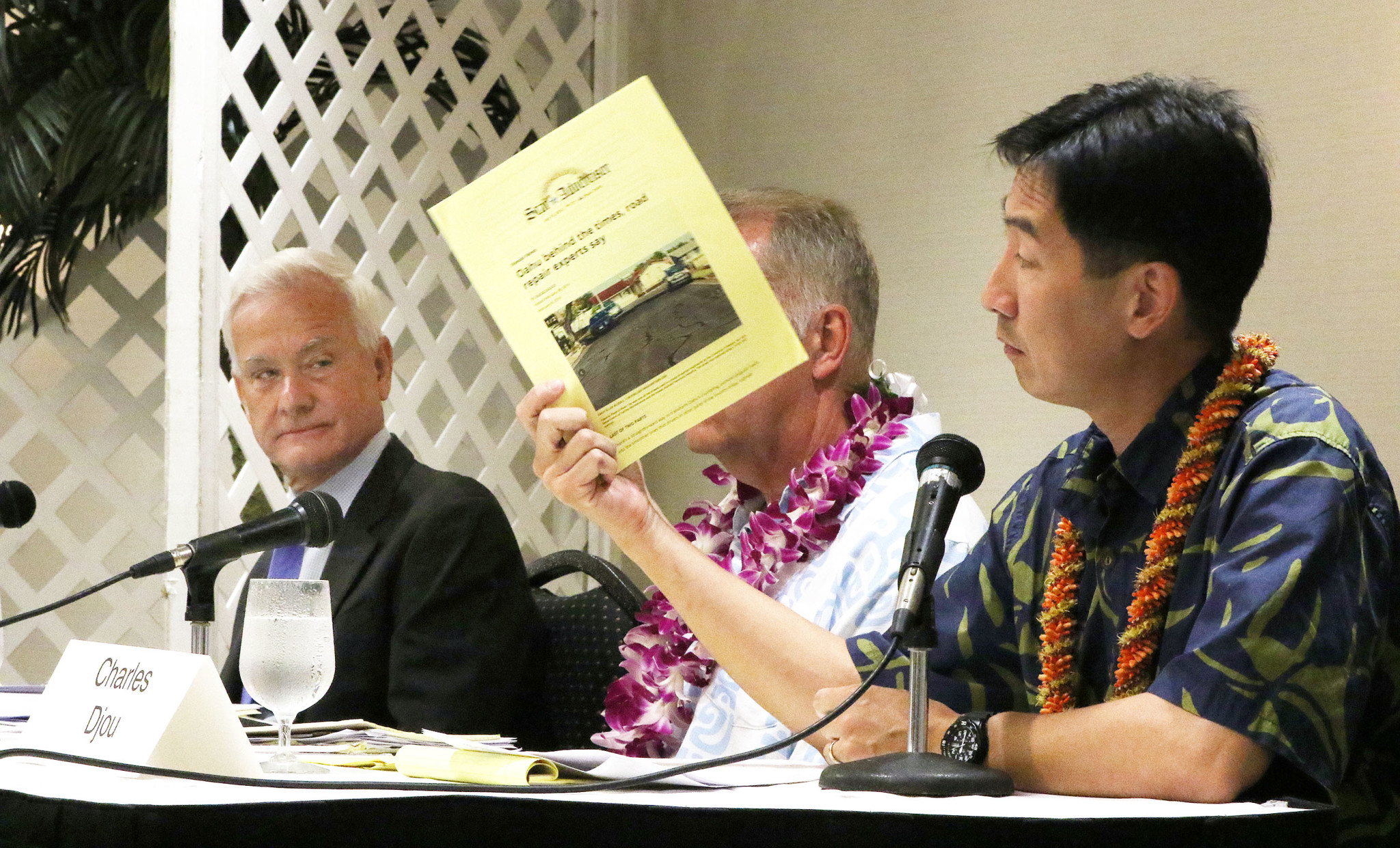
To understand Djou’s plight, let’s look at how elections work.
Think of any election as the mingling of two sets of forces. One set is quite stable, transcending any particular election. Those are the fundamentals.
The other set involves things particular to a specific election. Call these situational.
At least three fundamentals influence Hawaii’s elections whether they are partisan or not (the mayoral race is nominally non-partisan).
First, an incumbent has a big advantage. Normally elections with an incumbent are a referendum on that incumbent— is the person in office good enough for government work.
The second fundamental is that the number of Democratic voters in Hawaii is far greater than Republican voters. Enough said. Well ok, add that this numerical advantage is important even in the nominally non-partisan mayor’s race.
Third, the electorate in a primary is different from the electorate in a general election. The general election brings in more voters who are less engaged and less issue-oriented.
Rail was supposed to be the exceptional wedge issue that would work to Djou’s advantage. No more.
And a combination of the second fundamental and simple arithmetic shows that most of those new voters typically vote Democrat.
Every one of these fundamentals favors Caldwell.
The best evidence of this is the 2012 mayoral race. Ben Cayetano, a full on anti-rail candidate when that really mattered, won the primary with 44 percent of the votes in a three-way race. Caldwell, then the acting mayor, got only 29 percent.
In the general election Caldwell jumped to 53 percent, while Cayetano’s percentage stayed almost exactly the same.
Caldwell had plenty of room to find Democrats while Cayetano’s voter stash was essentially used up.
The pre-primary pools in the present race showed that Republicans were by far the strongest Djou supporters. Two-thirds of the Republicans, compared to a quarter of the Democrats and 44 percent of the respondents overall, said they would vote for him.
Think of the Republican mayoral voters in 2012 1and 2016 as intense, partisan, but way too few and far between with little chance of growing.
But what about the other half of the equation, the situationals? Are there things about this specific election that definitively work in the challenger’s favor?
Not very likely because the rail situation has gotten even worse.
Rail was supposed to be the exceptional wedge issue that would work to Djou’s advantage. No more.
The election is no longer a referendum on rail because both candidates are saying the same thing: We need to build the whole thing, and we need to find new money from, well, we don’t know exactly where, but we are working on it.
In fact Djou, who is a standard no-more-taxes conservative Republican, has recently changed his mind and suggested that he may be in favor of an increase in the state excise tax earmarked for rail.
When was the last time you heard any Republican commit such heresy? More amazingly, when was the last time you know of a candidate to do this sort of 180 in the heat of a campaign?
So the rail issue has moved from who has a better plan to something more amorphous, general, and hypothetical: who is the better manager of a disaster that’s happening with no apparent solution available.
Things have become so bizarre that the election has become ordinary.
You have to give Djou credit for his honesty and flexibility. He should feel proud. But that should not take away from the main point: no good deed goes unpunished.
Foxholes can’t afford to have any atheists.
Rail’s disastrous condition weakens the challenger’s candidacy by taking away the issue with the most promise for distinguishing between himself and the incumbent.
To do otherwise – to claim that he has a definitive rail plan — Charles Djou would have to concoct a story so brazen and preposterous that it would make building a wall at the border seem like a Boy Scout merit badge project.
There doesn’t seem to be any other issue powerful enough to overcome the advantages that the fundamentals give Caldwell.
Djou has certainly gone after some of Caldwell’s flaws, particularly on ethics, but these are likely to appeal to only a small number of voters, and not likely to the large number of general election voters who don’t pay attention to those matters.
What’s his message then: I can manage better? Another tough one to use against an incumbent because it is a hard case to make in ways that move voters, especially voters who usually vote Democratic.
The biggest management issue of all, rail, is still a management issue but in a very different way. It has moved from rail shows what a bad manager Caldwell is to how can we all manage to get through this disaster together.
Things have become so bizarre that the election has become ordinary. If it stays that way, Djou’s candidacy is toast.
That’s not to say it will stay that way. The election is still almost two months away.
Which is why instead of making an out and out prediction, I’ll speak in probabilities.
If the mayoral election follows a typical pattern, it is a high probability that Mayor Caldwell will be re-elected.
The probabilities of that victory lessen to the extent that Djou can make this election more about the situationals.
That is so hard because the fundamentals so shackle Djou and because rail, potentially the most powerful key to removing these shackles, is effectively off the table.

