Reader Rep: Exploring The Media — Where Do We Go From Here?
After a year of praising and criticizing Hawaii journalists, this columnist is looking to ratchet up the public discourse.
Unlikely presidential candidate Donald Trump was still defensively describing the size of his body parts last year when I wrote the first Reader Rep column.
While some American media organizations in recent times have eliminated their media critic positions, Civil Beat notably launched a media criticism column, and my initial piece in this role outlined how I intended to uphold the journalistic ideology.
I have written more than 40 columns and dozens of responses to reader comments since.
Writing is a form of thinking, and when I reflect upon the past year, I realize how much I have learned about this state and its media quirks. I began by feeling around the edges of the community, criticizing both Civil Beat’s approach to a political story and the routine use by some local media of anonymous sources.
The more I explored this terrain, the better I understood what troubled and delighted me in Hawaii media, as well as what most interested you.
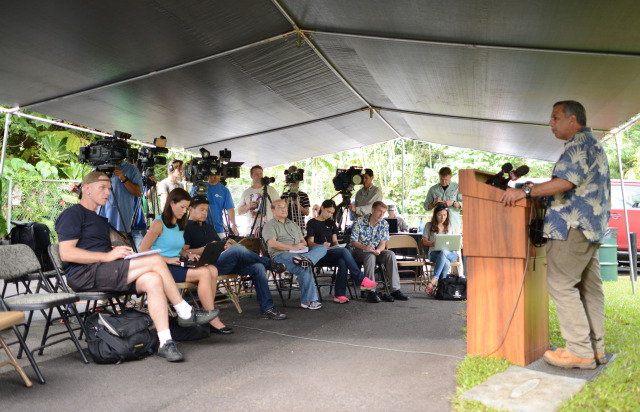
With the weakening of newspapers worldwide, including the state’s largest, the Honolulu Star-Advertiser, and the media-literacy crisis in our country giving rise to treacherous fake news, discourse about media failings went fully mainstream.
My column generally stayed tethered to Hawaii, and focused on our perspective from the middle of the Pacific, leading to analysis of local and regional media sources and issues. That’s when I think Reader Rep was at its best.
I also think the column worked well when it was addressing critical community concerns, such as unfairly restricted access to public records, places and business. With such new-year optimism and introspection, then, I will recap 2016 and explain my hopes for Reader Rep in 2017.
To begin with, at the heart of most matters, I perceive a ridiculous level of corruption, cronyism and inefficiencies throughout the state. This deserves much more media attention.
It’s not sufficient to say “that’s the way it is in Hawaii” and let it go. The necessary journalistic resources for such an endeavor could be mustered through a decrease in the annual rehashing of hiking, dining and surfing stories.
Since the public systems themselves are enabling these problems to persist and grow, the antidote is – partially, at least – more good journalism.
I perceive a ridiculous level of corruption, cronyism and inefficiencies throughout the state. This deserves much more media attention.
An example of this issue is the almost complete lack of police accountability in the state, which has inspired Civil Beat to create a web page dedicated to that singular topic. Honolulu has one of the largest police forces in the country, in terms of size, but appears in a league of its own in relation to its closed-to-the-media practices.
Excluding journalists is a way for the police to keep you – members of the public, the primary stakeholders, who pay for this police force – out of its business.
Why would the Honolulu Police Department want you in the dark about its policing practices? Because it has something to hide, obviously, as shown by the recent investigation of Chief Louis Kealoha, who voluntarily went on paid leave as a federal grand jury examined corruption charges against him and his wife (a city prosecutor) and several officers.
Did HPD put in charge someone eager to clean up the department? No; it appointed as Kealoha’s replacement an assistant, Cary Okimoto, who also may have close ties to the allegations.
The state’s Sheriff Division, a separate force under the Hawaii Department of Public Safety, also keeps the public in the dark. For example, I have written a couple of Reader Rep columns about the departmental leaders who were alleged to have bungled cases for decades, only to have the Department of Public Safety cover for them and obstruct media inquiries, including mine, about the bungling.
I asked the Sheriff Division in April to provide me with a list of its commanding officers (because I wanted to ask them about what they have been accused of). This should be a simple request, because it is the law (every public employee must be identified, since we are, as taxpayers, paying for that person’s employment).
Instead of putting all of this public information in the light for transparent communal examination, the Department of Public Safety has been shielding its officers from this legitimate public scrutiny.
Carlotta Amerino, a staff attorney for the Office of Information Practices, the state organization that handles appeals of public-document-request denials, wrote to me in October to explain how underfunded the agency is and to say that a decision on this case could take “another year or more.”
We can dramatically improve our police departments through public agencies that transparently serve the public, not the people in power. Journalists need to support the good officers, help root out the bad officers and foster more engaging discussions about goals, strategies and tactics of community policing (as well as analyze metrics of their successes and failures).
Regarding local media coverage of law enforcement, I have criticized often, but I have also praised some of the best local journalism in the past year.
I haven’t written much about radio (because of so few local radio journalists) and magazines (because I still am trying to understand how all of them work within their sub-ecosystem). So in addition to expanding my thoughts about newspaper, TV and web journalism in the state, I intend to open a larger umbrella to include more discourse about magazine and radio journalism.
Many of my columns start with a small local incident (often noticed and shared by readers) and then attempt to connect that moment with a larger point. But sometimes, a small incident is interesting just for what it is. So I’ve collected dozens of these for months and written a variety of drafts to try to capsulize those pieces into a worthwhile collection of sorts. But it’s never quite worked well enough for me to submit it for publication.
This year, though, I’m going to work harder to address more smaller ideas about local journalism.
My larger goal is to make this column a vibrant place for discussing the state’s media environment, including what you see and hear. Let me know what you find compelling, confusing, bizarre, disappointing and inspiring about local media.
I want to respond to your concerns and issues, rather than setting the agenda myself. That’s why I chose the label Reader Rep.
I’m yours. So bring me your questions, send me your tips.
What do you want more of (or less of) from this column in 2017? Let’s find out, together.