

Neal Milner: Don’t Kill The Messenger, Even If It’s Sean Spicer
President Trump’s press secretary has it tougher than most, but spokespeople are only as good as their bosses want them to be.
We now go live to the daily White House media briefing with Press Secretary Sean Spicer:
“Good morning. Before I take questions, I would like to open with the following brief statement: ‘President Trump lied yesterday about the size of his inaugural crowd.’ The president did not authorize this statement, but I offer it because it’s the right thing to do. That’s just the kind of guy I am.”
In your dreams.
No press secretary can be that guy no matter who the president is, because spokespeople are worker bees, and the executive office is a workplace.
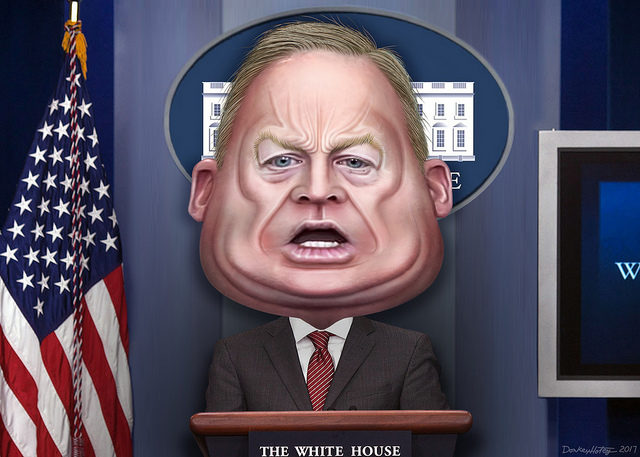
So before you castigate Spicer for not martyring himself and Trump for not hiring Jon Stewart or Marian the Librarian, let’s think about what it means to be an employee with a scary boss.
Even the most passionate supporters of what the Trump administration has done during their first month have to admit that all the chaos and turmoil makes the White House an awesomely tough place to work.
Trump creates very public messes that get dumped on his people to clean up.
His leadership style has put his closest advisers, especially Kellyanne Conway and Spicer, in very precarious positions.
All that is a nicely generic definition of an awful boss, whether it’s in the White House or the Pancake House. At least the Pancake House can have a cold opening.
You want to make a judgment of their character, go ahead, but calling Sean Spicer or Kellyanne Conway slime artists naively assumes that it’s simply about their bad values. If only it were that simple.
Many of you have been there yourselves, working for a bad boss in a toxic workplace. Most of you didn’t quit or publicly confront that boss for a variety of reasons: lack of good alternatives, loyalty, belief in the organization’s broader mission, and of course, probably the most common reason of all in Hawaii, money.
Others might see what you do as cowardly, sleazy, compromising or even immoral, but that does not explain why you do what you do.
The same is true for understanding what it means to be a spokesperson, particularly a press secretary.
The Washington Post recently published this sanitized description of a presidential spokesperson’s role: “There’s a theory under which some people operate which holds that presidential advisers appear in the news media to provide insight into what the president is doing for the American people. … Since our democracy depends on an informed populace, it has historically been important to shed as much light as possible on what’s happening.”
That sounds more like a Fourth of July speech than an analysis. Our democracy may depend on it, but come on, that description considers only the sunny side.
Conway recently tweeted a more accurate job description: “I serve at the pleasure of @POTUS. His message is my message. His goals are my goals. Uninformed chatter doesn’t matter.”
In reality, presidents and consequently their spokespeople have a very filtered view of what the populace needs to know.
A key part of any press secretary’s job is to make his or her boss look good, to do his bidding and even more importantly to frame issues in such a way as to further the president’s agenda.
Presidents vary in their honesty and integrity. Some chief executives have been far less suspicious and confident than others.
As the Post said, “Politicians and their allies don’t always like to shed that light, but they’ve generally acquiesced to participating in the effort.”
And some quite obviously haven’t. How would you like to have presided over Richard Nixon’s press conferences?
Trump is certainly not one to acquiesce. Given what the public — especially the segment that voted for him — thinks about the press, our new president is on pretty solid political ground.
Most presidents keep their spokespeople, and for that matter themselves, out of hot water by not telling the spokesperson what the chief executive does not want the public to know.
That’s called plausible deniability. In those cases, at worst, the spokesperson lies by omission. More commonly she does not know she is lying.
Plausible deniability acts as a form of coloration — camouflage that protects both the worker and his boss.
But so far there is little plausible deniability in the Trump White House. Trump makes outrageous, inconsistent statements, and he makes them very publicly.
That’s the fodder and style that Spicer and Conway have to work with.
Press secretaries can only be as good as their bosses. Spicer and Conway act the way they do because it is what their boss demands.
You want to make a judgment of their character, go ahead, but calling Spicer or Conway slime artists naively assumes that it’s simply about their bad values. If only it were that simple.
Being a spokesperson at any level is tough job. Many of them in Hawaii, including the ones who work for politicians, are good at it. The bad ones may be that way because it is a requirement of their job.
Honolulu Police Department spokespeople are typically not forthcoming because the HPD does not want them to be. Department of Health spokespeople give lame explanations when their DOH superiors do lame things.
And here is a very recent Hawaii example. It’s from a column appropriately enough entitled “Don’t Let Trump Overshadow Local Issues.” A group of UH journalism students were working on a story about illegal trampolines on North Shore beaches:
“You are just a student. You take what we give you, and that’s that.”
Did that communications specialist lack a moral compass?
Maybe, but a far better explanation is that she acted just the way her bosses wanted her to.

